Vietnamese, Cambodian inspectors reinforce collaboration

The Government Inspectorate of Vietnam broadly accepted the Cambodian ministry's proposals to maintain, renew and make more effective regular meetings between professional units and training establishments, and increase exchanges of senior, expert and specialised working-group delegations.

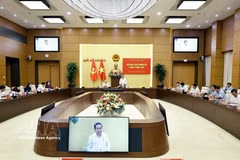
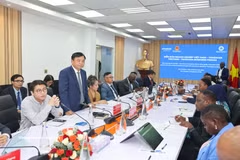
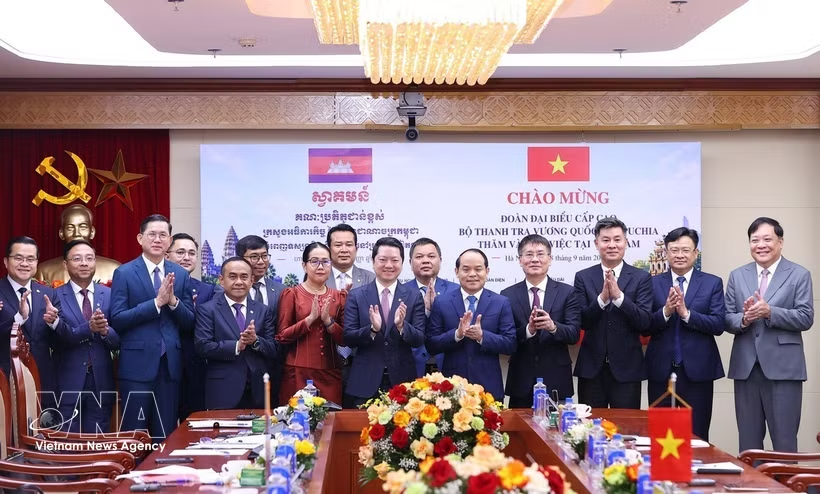
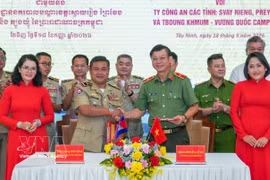
Officials at the talks between the Government Inspectorate of Vietnam and the Cambodian Ministry of Inspection in Hanoi on September 28, 2026 (Photo: VNA)

Hanoi (VNA) – Government Inspector-General Nguyen Quoc Doan hosted a welcoming ceremony and held talks with Cambodian Minister of Inspection Sok Soken in Hanoi on September 28.

Doan said Vietnam–Cambodia ties, built on the motto of "good neighbourliness, traditional friendship, comprehensive cooperation and long-term sustainability", have been nurtured by generations of leaders and people and are an invaluable asset to both nations. Bilateral inspection cooperation carries particular significance as the two countries work to follow the agreements reached by their leaders and prepare to mark the 60th anniversary of diplomatic ties (June 24) next year.

He called the talks a chance to share experience in directing inspection work, receiving citizens and settling complaints and denunciations, a step that will deepen bilateral cooperation and foster ties between the two States.

Sok Soken, in reply, pointed to the long history of relations and close friendship between Cambodia and Vietnam, saying the 60th anniversary next year will give both sides an opportunity to celebrate together, consolidate ties and reaffirm their commitment to friendship and cooperation across various fields.

He praised bilateral inspection cooperation, which has run continuously since 2005. His ministry now performs four core functions, including inspection; monitoring law enforcement; receiving, reviewing and settling complaints and denunciations; and legal education and dissemination, including public forums.

According to him, the ministry is bolstering all of these areas while stepping up the drafting of legal documents, institutional capacity building, cooperation and the adoption of digital technologies.

Doan said Vietnam's inspection sector has streamlined its organisation in line with the policy of slimming down the State apparatus, aiming for better efficiency and effectiveness. The system now runs uniformly on two levels, the Government Inspectorate and provincial-level inspectorates, with inspection bodies retained in the People's Army, the People's Public Security force, the State Bank of Vietnam, the cipher sector and other bodies established under international treaties.

One year into the new model, the apparatus has stabilised quickly and markedly improved its performance, he noted.

Beyond restructuring, the Government Inspectorate has overhauled its management methods, accelerated decentralisation and delegation of authority, refined the institutional framework, and improved the quality of inspections and the handling of complaints and denunciations. Inspection work has shifted sharply from dealing with consequences to prevention, early warning and risk control, and from broad-based inspections to targeted ones driven by data and risk assessments.

In the first nine months of 2026, the sector reviewed and cut 78% of the year's planned inspections, freeing resources for areas more prone to corruption, wastefulness and other misconduct, the host added.

On future cooperation, Doan said the Government Inspectorate of Vietnam broadly accepts the Cambodian ministry's proposals to maintain, renew and make more effective regular meetings between professional units and training establishments, and increase exchanges of senior, expert and specialised working-group delegations.

The two sides also agreed to keep sharing experience in inspection, citizen reception, complaint and denunciation settlement, and other areas of common interest. They will also create opportunities for officials, civil servants and trainees from the Cambodian ministry to come to Vietnam for study, research, experience sharing and capacity-building courses./.
VNA

See more

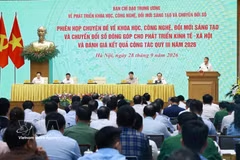
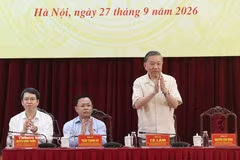
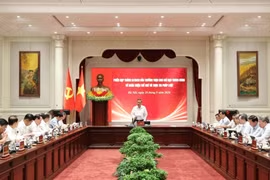
General Secretary of the Communist Party of Vietnam Central Committee and President To Lam speaks at the September meeting of the Standing Board of the central steering committee on institution improvement and law enforcement on September 28. (Photo: VNA)

Urgent action needed to address law enforcement as weak link: Top leader

Chairing the September meeting of the Standing Board of the central steering committee on institution improvement and law enforcement, which also saw the attendance of Politburo members: Prime Minister Le Minh Hung and Standing Member of the Party Central Committee’s Secretariat Tran Cam Tu, General Secretary and President Lam said the effectiveness of lawmaking and enforcement should be measured by the removal of bottlenecks, lower compliance costs, better mobilisation of resources, stronger discipline and the effective protection of the legitimate rights and interests of people and businesses.

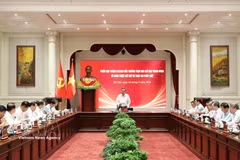
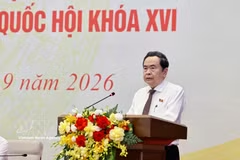
National Assembly (NA) President Tran Thanh Man speaks at the first conference of full-time deputies of the 16th-tenure NA. (Photo: VNA)

Top legislator stresses importance of sound policies, robust regulations, consistent legal system, smooth enforcement

National Assembly (NA) President Tran Thanh Man noted that the 16th-tenure NA has handled a substantial legislative workload from the beginning of its term, with about 45 draft laws and resolutions expected to be considered at the second session. Many have a broad scope and directly affect the State apparatus, the investment and business environment, and the rights and interests of people and enterprises.

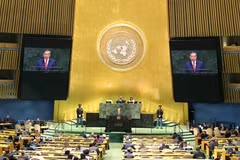
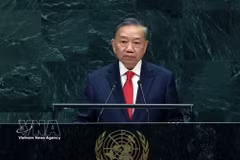
General Secretary of the Communist Party of Vietnam Central Committee and President To Lam delivers remarks at the 81st session of the United Nations General Assembly. (Photo: VNA)

Statecraft leaves strong imprint on Vietnam’s diplomacy

Ton Sinh Thanh, who is former Vietnamese Ambassador to India and senior lecturer at the Diplomatic Academy of Vietnam, said that General Secretary and President Lam’s message at the UNGA that restoring trust does not require countries to eliminate differences but to responsibly manage them was particularly significant amid growing polarisation and divisions worldwide.

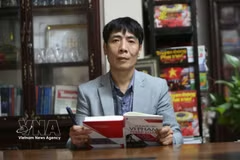
Vietnamese Ambassador to Belarus Nguyen Van Trung (Photo: VNA)

Vietnamese community in Belarus helps strengthen bilateral ties: Ambassador

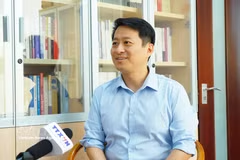
The Vietnamese community in Belarus had embraced the resolution, recognising that the Party and State consider OVs not only an integral part of the nation but also an important force making practical contributions to national socio-economic development and defence, said Ambassador to Belarus Nguyen Van Trung.

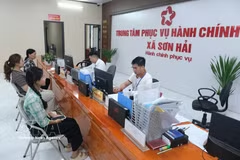
Residents at the Public Service Centre of Son Hai Commune (Bac Ninh) to handle public administrative procedures. (Photo: VNA)

Addressing bottlenecks to improve administrative system operations

To make the model more effective, however, bottlenecks in personnel, data, resources and coordination mechanisms identified in the third round of inspection and supervision by the Politburo and Party Central Committee Secretariat must continue to be addressed.

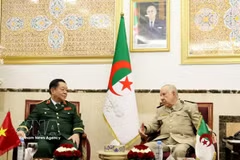
Gen. Nguyen Trong Nghia (left), Director of the Vietnam People’s Army's General Department of Politics, and Gen. Said Chengriha, Minister Delegate to the Minister of National Defence and Chief of Staff of the People’s National Army (PNA) of Algeria at their meeting on September 26. (Photo: VNA)

Vietnam, Algeria seek stronger defence cooperation

Algeria-Vietnam relations have deep historical and humanitarian roots, forged through the struggle against colonialism and for national independence and strengthened by solidarity, mutual respect and trust.

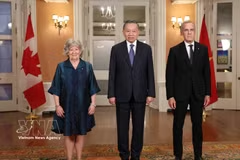
General Secretary of the Communist Party of Vietnam Central Committee and President To Lam (middle), Governor General Louise Arbour (L) and PM Mark Carney (Photo: VNA)

Vietnam-Canada ties enter dynamic, substantive new phase

The two countries also share common views on international law, free trade and regional stability, with complementary strengths in play: Vietnam is leaning on science, technology and global integration to hit development targets for 2030 and 2045, while Canada is diversifying its markets and expanding its footprint in the Indo-Pacific.