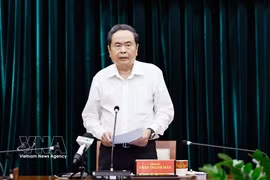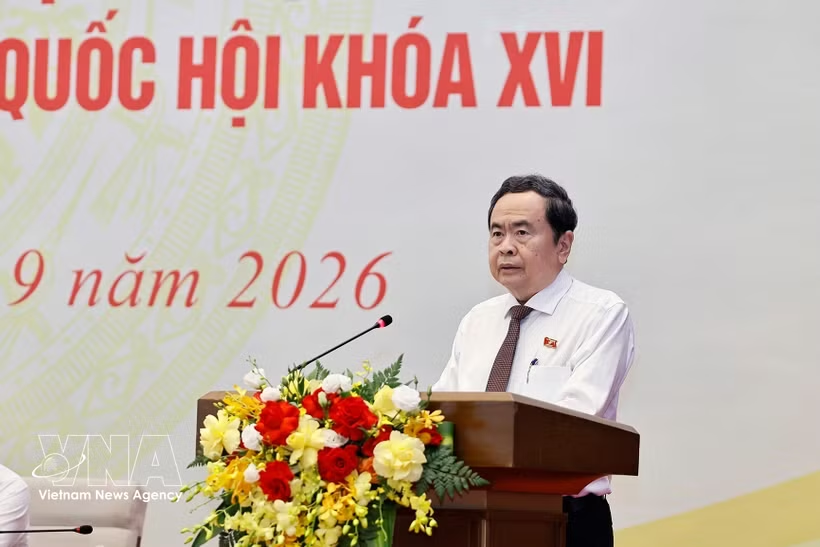
Hanoi (VNA) – National Assembly (NA) President Tran Thanh Man emphasised on September 28 that legislative work must focus on policy quality rather than the number of legal provisions, with laws designed to address practical problems, remove bottlenecks and create favourable conditions for development.
He made the remarks while chairing the first conference of full-time deputies of the 16th-tenure NA, which discussed 17 important draft laws expected to be submitted to the legislature at its second session.
NA President Man said the conference took place as Vietnam is implementing the Resolution of the 14th National Party Congress, with major policies on science and technology, innovation, digital transformation, international integration, private-sector development and legal reform being urgently institutionalised.
He noted that the 16th-tenure NA has handled a substantial legislative workload from the beginning of its term, with about 45 draft laws and resolutions expected to be considered at the second session. Many have a broad scope and directly affect the State apparatus, the investment and business environment, and the rights and interests of people and enterprises.
He stressed that although the workload is heavy and time is limited, quality must not be compromised. The conference, he said, should serve as a “quality filter” before draft laws are submitted to the NA.
He called for each draft law to clearly identify the practical problem it seeks to address, the rationale for legislative changes, the value of proposed policies, those affected, compliance costs, implementation resources and agencies ultimately responsible.
He also urged deputies to focus on policies that remain controversial, have major impacts on people and businesses, or involve new mechanisms that have not yet been fully tested.
According to the NA President, legislation should concentrate on matters under the NA’s authority and establish fundamental and stable principles, while frequently changing or technical issues should be assigned to competent agencies to ensure flexibility in administration. However, this must not mean shifting difficult issues to decrees or circulars. Matters concerning human and citizens’ rights, business conditions, resource allocation, the organisation of State power and State agencies’ responsibilities must be clearly regulated by law.
He underlined the principle that laws should be shorter but not less substantial in policy content; contain fewer provisions but clearly define responsibilities; and remain stable while being adaptable to changing circumstances.
Emphasising the need for a systemic approach, the top legislator called for close review of consistency in concepts, authority, procedures, decentralisation, land, finance, data and effective dates across related laws. He warned against resolving a bottleneck in one law while creating another elsewhere, or forcing people and businesses to determine for themselves which conflicting provision should prevail.
Legislation must be assessed from the perspective of implementation, he said, adding that it is necessary to clearly identify who will implement each provision, at which level, with what resources and data, and with what responsibilities. This is particularly important under the two-tier local administration model and the continued push for decentralisation. Decentralisation, he said, must involve the transfer of authority, resources, data and responsibility in a coordinated manner.
The NA President also called for substantive digital transformation, noting that digitising an unreasonable procedure does not constitute reform. Detailed regulations should be prepared alongside laws so that legislation does not take effect while awaiting decrees or circulars.
He asked full-time deputies to provide concise and well-reasoned opinions based on thorough study of documents and practical conditions, and to clearly identify draft laws that are ready for consideration and those requiring further improvement.
Bills with major unresolved policy differences, inadequate impact assessments, unresolved overlaps with other laws or insufficient implementation conditions should be further refined rather than rushed through, he said.
NA President Man reiterated that the legislative body does not make laws simply to fulfil its legislative programme. Rather, laws must address practical problems, protect legitimate rights and interests, remove bottlenecks, mobilise resources and create room for development.
He concluded that the ultimate measure of legislative effectiveness is whether laws help the State apparatus operate better, make life easier for people and businesses, unlock social resources and improve national governance./.
VNA