Statecraft leaves strong imprint on Vietnam’s diplomacy

Ton Sinh Thanh, who is former Vietnamese Ambassador to India and senior lecturer at the Diplomatic Academy of Vietnam, said that General Secretary and President Lam’s message at the UNGA that restoring trust does not require countries to eliminate differences but to responsibly manage them was particularly significant amid growing polarisation and divisions worldwide.

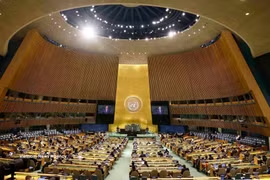
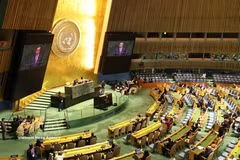
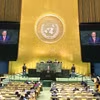
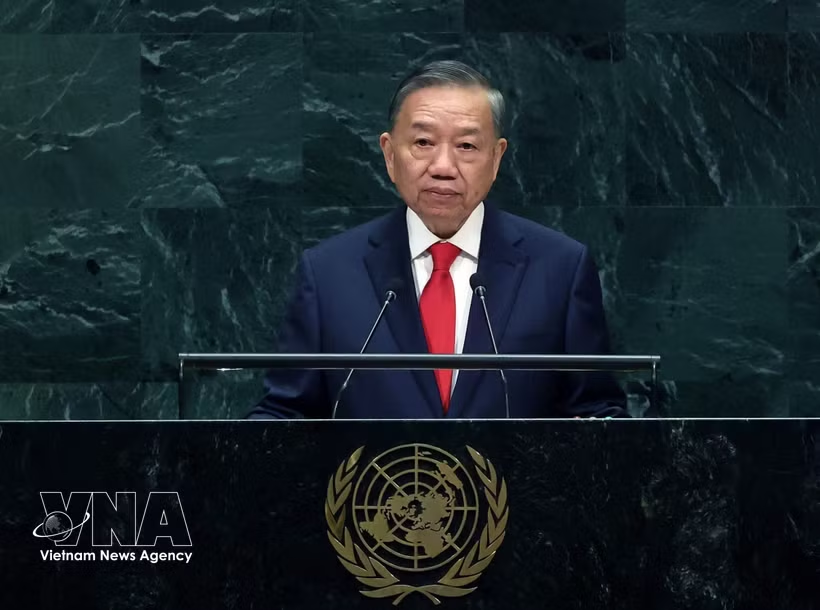
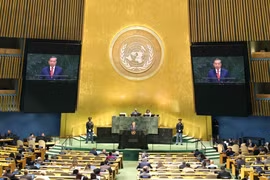
General Secretary of the Communist Party of Vietnam Central Committee and President To Lam delivers remarks at the 81st session of the United Nations General Assembly. (Photo: VNA)

Hanoi (VNA) – As General Secretary of the Communist Party of Vietnam Central Committee and President To Lam just concluded his trip to attend the 81st session of the United Nations General Assembly and conduct working activities in the US, as well as his state visit to Canada, Ambassador, Dr. Ton Sinh Thanh gave an interview to the Vietnam News Agency, highlighting the development of Vietnam’s multilateral diplomacy, the significance of “head-of-state diplomacy” and new foreign-policy thinking in the country’s new development era.

Thanh, who is former Vietnamese Ambassador to India and senior lecturer at the Diplomatic Academy of Vietnam, said that General Secretary and President Lam’s message at the UNGA that restoring trust does not require countries to eliminate differences but to responsibly manage them was particularly significant amid growing polarisation and divisions worldwide.

The message clearly stressed that differences should be addressed through dialogue, in strict accordance with international law and the UN Charter, rather than through force. Even in complex issues such as territorial disputes, the only way forward is to maintain control and respect international law, particularly the 1982 United Nations Convention on the Law of the Sea (UNCLOS), rather than resorting to force to resolve them.

This approach, Thanh said, reflected Vietnam’s consistent policy of not choosing sides or depending on any particular party, but standing firmly for international law and the UN Charter, thereby safeguarding national independence and strategic autonomy.

Regarding Vietnam’s shift from following existing rules to proactively contributing to the shaping of new global governance frameworks, the ambassador stated that the General Secretary and President’s UNGA address has put forward major orientations for the UN, including the governance of technology, particularly artificial intelligence (AI), in a way that serves people, ensures inclusiveness and respects national sovereignty. Thanh viewed this as a clear reflection of Vietnam’s evolving foreign-policy thinking and its increasingly proactive role in proposing initiatives and contributing to the formation of international rules, particularly in emerging fields.

He noted that this development was consistent with major Party orientations on elevating multilateral diplomacy and deepening international integration, as well as the 14th National Party Congress’s foreign policy directions. Vietnam has increasingly demonstrated this role through initiatives and co-sponsored initiatives on global issues, including environmental protection, women’s and children’s rights and sustainable development.

Looking back nearly five decades since Vietnam joined the UN in 1977, Thanh said the country’s multilateral diplomacy has matured significantly. From a country primarily receiving international assistance for post-war reconstruction, Vietnam has become an active contributor of resources and experience to the international community. It has also played increasingly prominent roles in ASEAN, the Asia-Pacific Economic Cooperation (APEC) forum and the UN, including serving as ASEAN Chair, hosting APEC summits and holding non-permanent membership of the UN Security Council.

He noted that Vietnam’s participation in UN peacekeeping operations in Africa has further demonstrated its practical commitment to international peace and security.
vnanet-tolam2.jpg
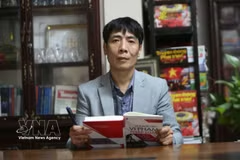
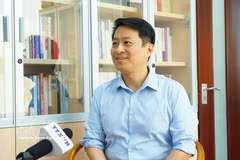
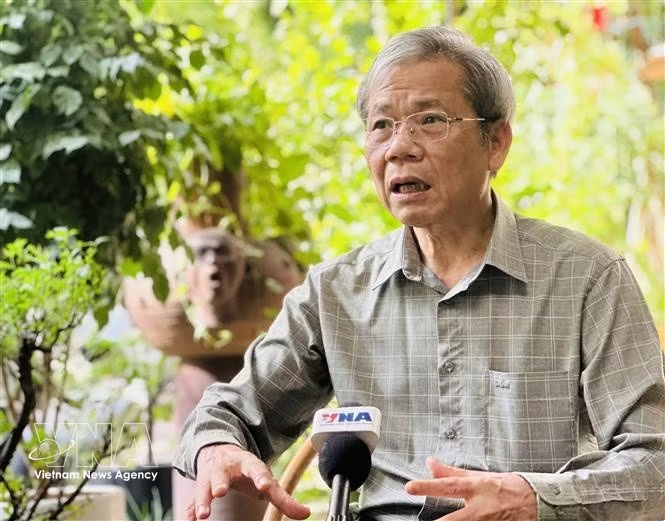
Ambassador, Dr. Ton Sinh Thanh gives an interview to the Vietnam News Agency. (Photo: VNA)

On “head-of-state diplomacy”, the ambassador said direct engagement among national leaders offered distinctive advantages, including building high-level personal trust, strengthening commitments and helping resolve complex issues more effectively. High-level policy messages also have strong international reach and symbolic value.

He viewed General Secretary and President Lam’s recent engagements at the UN, in the US and in Canada as important opportunities to reaffirm Vietnam’s foreign-policy direction and highlight its transition from a rule follower to a contributor to international rule-making. Direct contacts with leaders, political circles and business communities in the US and Canada, he said, could help open new frameworks for cooperation and mobilise high-quality external resources for national development.

In the new development period, Thanh stated, stronger bilateral and multilateral diplomacy would help the country combine its internal strengths with external resources to meet its socio-economic development goals./.
VNA

See more

Vietnamese Ambassador to Belarus Nguyen Van Trung (Photo: VNA)

Vietnamese community in Belarus helps strengthen bilateral ties: Ambassador

The Vietnamese community in Belarus had embraced the resolution, recognising that the Party and State consider OVs not only an integral part of the nation but also an important force making practical contributions to national socio-economic development and defence, said Ambassador to Belarus Nguyen Van Trung.

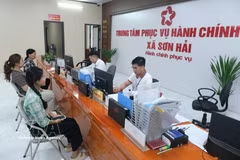
Residents at the Public Service Centre of Son Hai Commune (Bac Ninh) to handle public administrative procedures. (Photo: VNA)

Addressing bottlenecks to improve administrative system operations

To make the model more effective, however, bottlenecks in personnel, data, resources and coordination mechanisms identified in the third round of inspection and supervision by the Politburo and Party Central Committee Secretariat must continue to be addressed.

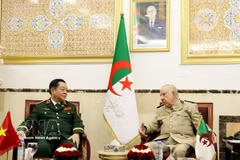
Gen. Nguyen Trong Nghia (left), Director of the Vietnam People’s Army's General Department of Politics, and Gen. Said Chengriha, Minister Delegate to the Minister of National Defence and Chief of Staff of the People’s National Army (PNA) of Algeria at their meeting on September 26. (Photo: VNA)

Vietnam, Algeria seek stronger defence cooperation

Algeria-Vietnam relations have deep historical and humanitarian roots, forged through the struggle against colonialism and for national independence and strengthened by solidarity, mutual respect and trust.

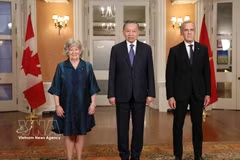
General Secretary of the Communist Party of Vietnam Central Committee and President To Lam (middle), Governor General Louise Arbour (L) and PM Mark Carney (Photo: VNA)

Vietnam-Canada ties enter dynamic, substantive new phase

The two countries also share common views on international law, free trade and regional stability, with complementary strengths in play: Vietnam is leaning on science, technology and global integration to hit development targets for 2030 and 2045, while Canada is diversifying its markets and expanding its footprint in the Indo-Pacific.

Minister of Foreign Affairs Le Hoai Trung (Photo: VNA)

Top leader’s trip to US, Canada underscores Vietnam’s message in new era: FM

Bilateral and multilateral engagement during General Secretary of the Communist Party of Vietnam Central Committee and President To Lam's five-day trip through the US and Canada opened doors for concrete cooperation while advancing shared goals with the UN, US and Canada want Vietnam to take a bigger hand in global and regional affairs.

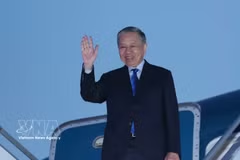
General Secretary of the Communist Party of Vietnam (CPV) Central Committee and President To Lam leaves Ottawa on the evening of September 25 (local time), concluding his state visit to Canada. (Photo: VNA)

Top leader concludes state visit to Canada

General Secretary of the Communist Party of Vietnam (CPV) Central Committee and President To Lam left Ottawa on the evening of September 25 (local time), concluding his state visit to Canada at the invitation of Governor General Louise Arbour.

General Secretary of the Communist Party of Vietnam Central Committee and President To Lam delivers remarks at the high-level general debate of the 81st session of the United Nations General Assembly. (Photo: VNA)

Vietnam, Canada have ample room for cooperation in new era: Canadian researcher

This convergence of interests creates space for Vietnam and Canada to develop broader and deeper relations. Although the two countries do not take exactly the same approach to every international issue, they share an interest in maintaining a rules-based system in which institutions and dialogue help limit the influence of power politics while giving countries greater room to pursue autonomous development choices, Vina Nadjibulla, co-founder and CEO of the Centre for Strategic Statecraft of Canada, said

General Secretary of the Communist Party of Vietnam Central Committee and President To Lam (R) speaks at the event. (Photo: VNA)

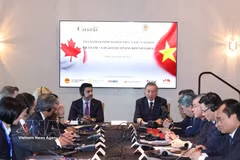
General Secretary and President To Lam attends Vietnam-Canada business roundtable

Addressing the roundtable, General Secretary and President To Lam spoke highly of the sound friendship between Vietnam and Canada, built on trust, mutual respect and win-win cooperation. The Comprehensive Partnership established in 2017 has provided a favourable framework for expanding bilateral cooperation across various fields.