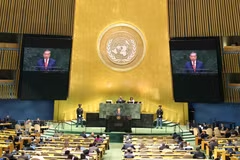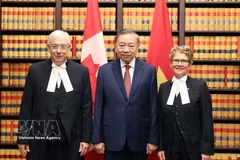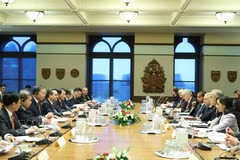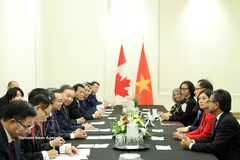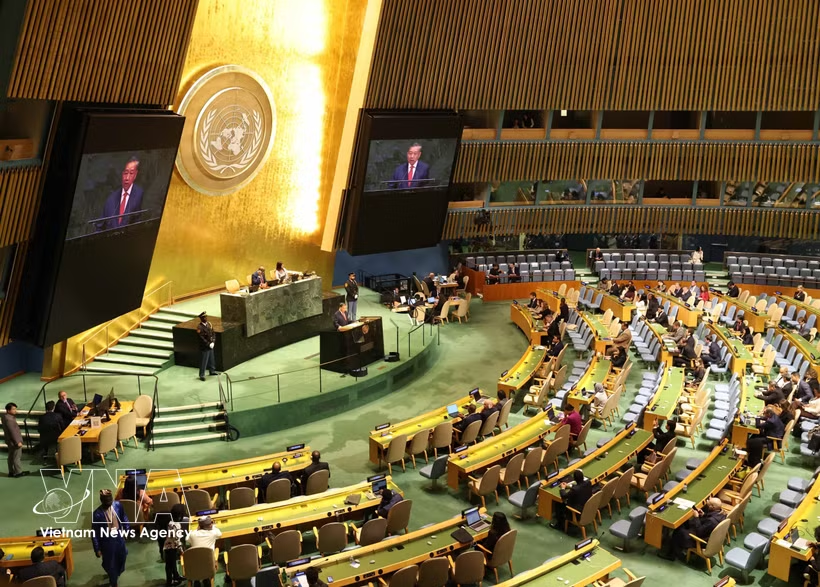
Ottawa (VNA) - The message delivered by General Secretary of the Communist Party of Vietnam Central Committee and President To Lam at the United Nations General Assembly (UNGA) on restoring trust, upholding international law and promoting multilateral cooperation shares many similarities with Canada’s foreign policy priorities, opening up new room for the two countries to expand cooperation.
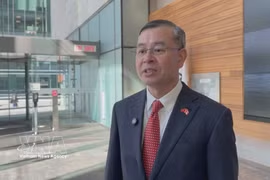
In an interview with Vietnam News Agency correspondents in Canada, Vina Nadjibulla, co-founder and CEO of the Centre for Strategic Statecraft of Canada, said a notable aspect of the Vietnamese leader’s speech was the convergence between the country’s message and the positions Canada is promoting at the UN.
According to Nadjibulla, General Secretary and President Lam’s emphasis on restoring trust, respecting the UN Charter and international law, responsibly addressing differences and maintaining dialogue amid intensifying geopolitical competition reflects common concerns among many countries over current challenges.
This convergence of interests creates space for Vietnam and Canada to develop broader and deeper relations. Although the two countries do not take exactly the same approach to every international issue, they share an interest in maintaining a rules-based system in which institutions and dialogue help limit the influence of power politics while giving countries greater room to pursue autonomous development choices.
Regarding Vietnam’s role in the multilateral system, Nadjibulla identified three areas where Vietnam could make practical contributions: rules-based trade, regional diplomacy and technology governance.
In trade, Vietnam is deeply integrated into the global economy and is playing an increasingly important role in international production and supply chains. This gives the country a direct interest in maintaining open, predictable markets governed by common rules.
General Secretary and President Lam’s call for strengthening an open, fair and transparent multilateral trading system is particularly significant as the global trading system faces mounting pressure. Vietnam’s role as Chair of the Comprehensive and Progressive Agreement for Trans-Pacific Partnership (CPTPP) in 2026 also provides an opportunity for the country to contribute to strengthening one of the important rules-based trade frameworks in the Indo-Pacific.
In regional diplomacy, Nadjibulla described Vietnam as an influential member of the Association of Southeast Asian Nations (ASEAN), with extensive experience in maintaining dialogue and cooperation with partners holding different interests and positions.
She noted that the nation’s experience in balancing relations with major powers and maintaining strategic autonomy offers valuable lessons for developing and middle countries.
In particular, in the field of technology governance, the Canadian expert welcomed General Secretary and President Lam’s emphasis that developing countries should have a substantive voice in shaping international rules on digital technology and artificial intelligence (AI), rather than merely adapting to standards developed elsewhere.
She said Vietnam could help ensure that international discussions on AI, digital governance and the green transition more fully reflect the development needs and perspectives of emerging economies. This would also help promote a more inclusive technology governance system, in which the benefits of innovation could be shared more widely.
Regarding Vietnam-Canada relations, Nadjibulla said the priority for the next phase should be to expand cooperation beyond trade in goods towards investment, technology partnerships and greater economic resilience.
She said the two countries already had important institutional foundations for advancing this agenda, including the CPTPP, the bilateral cooperation framework on science, technology and innovation, and the Vietnam-Canada joint economic committee.
She also proposed strengthening regular dialogue between the two governments on economic security and resilience, with a focus on critical minerals, energy, supply chains, emerging technologies and investment.
In addition, Vietnam and Canada should make use of the CPTPP and the process of establishing an ASEAN-Canada free trade framework not only to increase trade in goods, but also to promote investment and production cooperation.
According to Nadjibulla, Canada has advantages in energy, critical minerals, capital and research capabilities in AI and advanced technologies, while Vietnam has significant manufacturing capacity, a rapidly growing market and deep integration into production networks in Southeast Asia. These complementary strengths provide opportunities for the two countries to jointly build more diversified and resilient supply chains that are better able to withstand external shocks.
Another area of cooperation she particularly highlighted is strengthening links between businesses, universities and research institutions in the two countries in AI governance, cybersecurity, digital standards, clean technology and human resource development. She said General Secretary and President Lam’s message that technology development should expand opportunities rather than create new forms of dependence has direct relevance to the direction of this cooperation./.
See more
Vietnamese, German parties hold 11th theoretical exchange
The two sides held four discussion sessions on the multipolar world and changes in the international order; development models in the digital and artificial intelligence (AI) era; protection of international trade in a multipolar world; and the role of political parties in guiding transformation and addressing contemporary challenges.
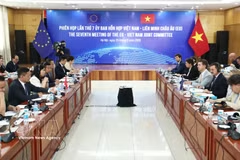
Vietnam, EU hold seventh meeting of Joint Committee
The meeting provided an opportunity for the two sides to brief each other on their respective socio-economic situations and foreign policies, comprehensively review bilateral relations and assess the outcomes of meetings of the Joint Committee’s subcommittees on political affairs, sustainable development, and good governance, rule of law and human rights.
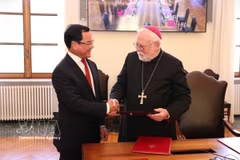
Vietnam, Holy See step up exchanges, cooperation
A delegation from Vietnam’s Ministry of Ethnic and Religious Affairs visited the Vatican's Secretariat of State, Dicastery for Evangelisation, Dicastery for Communication and Vatican Radio.
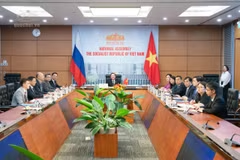
Vietnam, Russia agree to strengthen parliamentary cooperation
National Assembly (NA) Vice President Nguyen Khac Dinh, who is also Chairman of the Vietnam-Russia Friendship Parliamentarians’ Group, stressed that cooperation between the Vietnamese NA and the Russian Federation Council, including activities between their respective groups, has received high appreciation from the leaders of both countries.
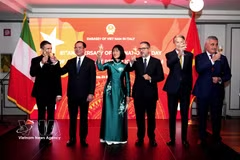
Italy, Vietnam maintain international standing by staying true to their identities: Italian official
Economic cooperation between the two countries has continued to expand, from Italian machinery used in factories in Vietnam and growing Vietnamese coffee exports to Italy, to value chains combining Vietnam’s manufacturing capacity with Italian technology and expertise, said Italian Deputy Minister of Enterprise and Made in Italy Valentino Valentini.
Decentralisation must not lead to fragmented responsibility: NA President
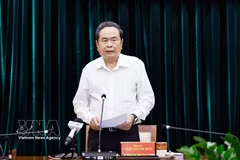
Agencies directly managing, assigning and employing personnel must bear primary responsibility for their assessment and performance, while the Ho Chi Minh City Party Committee’s advisory bodies should strengthen guidance, supervision and early risk warnings, President of the National Assembly (NA) Tran Thanh Man said.
Top legislator orders putting people at centre of resolving grassroots issues
After listening to voters’ opinions and recommendations, NA President Man asked the city to classify them clearly. Issues falling under the authority of the wards should be proactively addressed by grassroots administrations immediately after the meeting.
Vietnam, Cambodia step up youth exchanges to strengthen traditional friendship
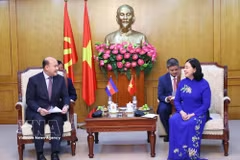
Vietnam and Cambodia need to strengthen youth and student exchanges to foster mutual understanding and trust, thus consolidating the traditional friendship between the two countries, President of the Vietnam Fatherland Front (VFF) Central Committee Bui Thi Minh Hoai has said.
Engineering Unit Rotation 5 departs for peacekeeping missions at UNISFA
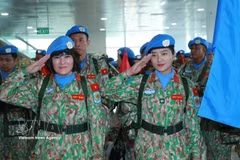
Engineering Unit Rotation 5 consists of 184 personnel from the Air Defence – Air Force Service, the Navy, military regions, army corps, and the Vietnam Department of Peacekeeping Operations. It will replace Engineering Unit Rotation 4 at UNISFA.
☕ Afternoon briefing on September 25
The following is a brief review of the day’s events as reported by the Vietnam News Agency.
UNGA 81: Top leader highlights four points reflecting int'l community’s common views
General Secretary and President To Lam's recent visits to several countries and his trip to New York to attend the High-Level General Debate of UNGA 81 signal the growing emphasis by Vietnam’s leadership on a diplomatic strategy of diversification and balance in response to the increasingly complex and uncertain global landscape, said Prof. Dr. Cheng Hanping of China.
Key leader orders stronger measures to drive cultural development
Cultural spending should reach at least 2% of total State budget expenditure, with greater efficiency in allocation and disbursement and stronger mobilisation of social resources, said Politburo Member and Standing Member of the Party Central Committee’s Secretariat Tran Cam Tu.
Top leader’s UN speech reaffirms Vietnam’s consistent choice of peace, cooperation, development
The speech carries one consistent message: humanity shouldn't treat confrontation as inevitable in a fast-changing world. Instead, it should proactively manage change through trust, international law, dialogue, cooperation and shared responsibility.
Vietnam, Hungary seek to deepen bilateral ties
Hungary is one of Vietnam’s leading important partners in Central and Eastern Europe. Vietnam attaches importance to and wishes to continuously strengthen multifaceted ties with the country.
Vietnam ready to work with Canada to build substantive Strategic Partnership: Top leader
The top Vietnamese leader said the two countries' decision to elevate their relations to a Strategic Partnership comes as a result of more than five decades of friendship and cooperation, reflecting their commitment to jointly investing in the future.
Vietnam, Canada issue joint statement on Strategic Partnership
The two leaders elevated Vietnam - Canada relations to a Strategic Partnership anchored in eight pillars. Collectively, these pillars position Vietnam and Canada to address shared challenges, seize emerging opportunities, and contribute to a more secure, prosperous, and dynamic Indo-Pacific region.
☀️ Morning digest on September 25
The following is a list of selected news summaries reported last night by the Vietnam News Agency.
Top leader meets with Speakers of Canada’s Senate and House of Commons
Building on more than 50 years of friendship and the newly established Strategic Partnership framework, Vietnam–Canada relations as a whole, as well as cooperation between the two countries’ legislative bodies in particular, would continue to develop in an increasingly substantive and effective manner, for the benefit of the people of both countries and for peace, cooperation, and development in the region and the world.
Top leader holds talks with Canadian Prime Minister
Vietnam regards Canada as a friend and a trusted partner with which it shares many common interests and strategic perspectives, said top leader To Lam.
Party General Secretary and President receives Canada-Vietnam Parliamentary Friendship Group
The parliamentary friendship groups of Vietnam and Canada should increase delegation exchanges and contacts among parliamentarians, specialised committees, women parliamentarians, and young parliamentarians; promote joint activities and the sharing of experience in legislation and oversight; and further play their role in building broad consensus within the Canadian Parliament and society on strengthening relations with Vietnam.