Key leader orders stronger measures to drive cultural development

Cultural spending should reach at least 2% of total State budget expenditure, with greater efficiency in allocation and disbursement and stronger mobilisation of social resources, said Politburo Member and Standing Member of the Party Central Committee’s Secretariat Tran Cam Tu.

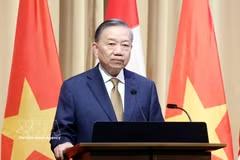
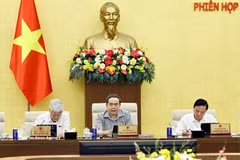
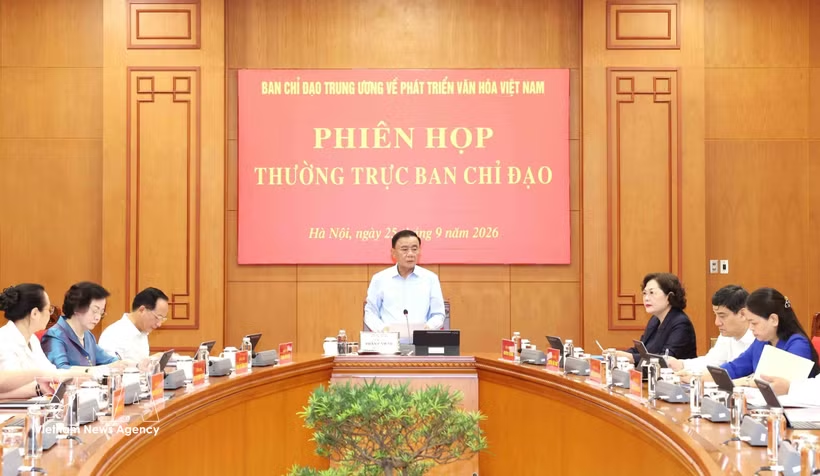
Politburo Member and Standing Member of the Party Central Committee’s Secretariat and Head of the Central Steering Committee for the Development of Vietnamese Culture Tran Cam Tu speaks at the meeting. (Photo: VNA)

Hanoi (VNA) – Politburo Member and Standing Member of the Party Central Committee’s Secretariat and Head of the Central Steering Committee for the Development of Vietnamese Culture Tran Cam Tu on September 25 asked for concerted implementation of Resolution No. 80-NQ/TW on cultural development and related Party policies, with practical solutions needed to address bottlenecks and drive major shifts in the sector.

He made the request while chairing a meeting of the steering committee’s standing members in Hanoi to deploy tasks for the fourth quarter of 2026.

​The meeting reviewed the implementation of Resolution No.80 of the Political Bureau, and directions by General Secretary of the Communist Party of Vietnam Central Committee and President To Lam at the Central Steering Committee’s second meeting on July 13; and discussed preparations for the fourth National Cultural Conference and Vietnam Culture Day on November 24.

The key leader noted clear and positive changes in the political system’s awareness and actions regarding cultural development, with the National Assembly adopting the amended Publishing Law and Resolution No. 28 on cultural development, while the Government issued six decrees and the Prime Minister issued three vital decisions. Several major localities have also introduced policies and plans to mobilise resources for culture.

He highlighted four gaps identified by the General Secretary and President: limited capacity to promote positive cultural values in the digital environment; inadequate ability to turn heritage into data, digital knowledge, intellectual property and creative resources; limited capacity to develop competitive cultural products; and institutional and ecosystem shortcomings in developing cultural industries.

Resolution No. 80 aims to raise the contribution of cultural industries to GDP from about 4% currently to 7% by 2030 and 9% by 2045.

Emphasising the strategic orientations set out in the Resolution, he called for deeper study and thorough implementation of the top leader’s directions, particularly three major shifts in Vietnam’s cultural development - viewing culture as a spiritual foundation, pillar of development and new growth driver; expanding cultural development into both physical and digital spaces; and combining preservation with creativity to generate new knowledge, products, markets and national soft power.

He also requested completion of the draft law on cultural industry development and policies concerning decentralisation, investment, land, copyright and public-private partnerships.

Cultural spending should reach at least 2% of total State budget expenditure, with greater efficiency in allocation and disbursement and stronger mobilisation of social resources, he noted.

He also called for faster digital transformation and stronger cultural data infrastructure, with a unified, interconnected national digital cultural database that can be verified and used sustainably, alongside tools to measure cultural development, including the National Cultural Index and indicators of the cultural industries’ contribution to economic growth.

​Conservation must be linked with the promotion of values, education, creativity and development, ensuring that heritage does not merely exist as resources that have yet to be transformed into knowledge and new values, he said.

The meeting also discussed measures to develop cultural industries as a contributor to double-digit economic growth, including identifying promising fields, leading localities, businesses and projects with potential to generate products, jobs, intellectual property and markets.

The Government needs to urgently complete and operationalise the national statistical system for cultural industries, establishing baseline data, a unified methodology and a regular reporting mechanism in 2026. The system should measure contributions of each industry and locality, domestic and export revenues, enterprises, employment and income, copyright and intellectual property values, and Vietnamese firms’ participation in value chains, the key leader said.

“Each locality should select only a few suitable sectors and a small number of flagship projects. Each project must clearly identify its products, implementing enterprise, funding sources, market, intellectual property assets, and expected contributions to GRDP, employment, exports and tourism attraction,” he added.

Regarding preparations for the Vietnam Culture Day, he asked ministries, sectors and localities to consider reducing or waiving fees at public cultural and sports facilities on November 24 and organise practical grassroots activities./.
VNA

See more

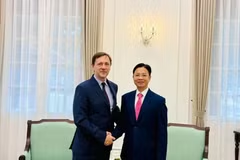
Deputy Minister of Foreign Affairs Ngo Le Van (R) receives Hungarian Ambassador to Vietnam Baloghdi Tibor in Hanoi on September 24 (Photo: Ministry of Foreign Affairs)

Vietnam, Hungary seek to deepen bilateral ties

Hungary is one of Vietnam’s leading important partners in Central and Eastern Europe. Vietnam attaches importance to and wishes to continuously strengthen multifaceted ties with the country.

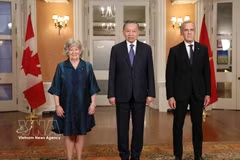
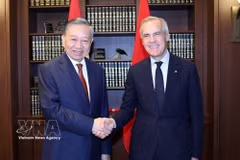
General Secretary of the Communist Party of Vietnam Central Committee and President To Lam (L) meets with Canadian Prime Minister Mark Carney in Ottawa on September 24, 2026. (Photo: VNA)

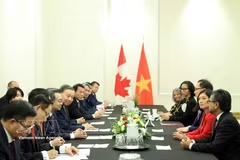
Vietnam, Canada issue joint statement on Strategic Partnership

The two leaders elevated Vietnam - Canada relations to a Strategic Partnership anchored in eight pillars. Collectively, these pillars position Vietnam and Canada to address shared challenges, seize emerging opportunities, and contribute to a more secure, prosperous, and dynamic Indo-Pacific region.

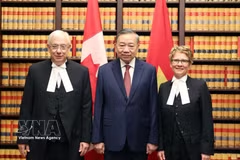
General Secretary of the Communist Party of Vietnam Central Committee and President To Lam meets with Speaker of the Senate Raymonde Gagné and Speaker of the House of Commons Francis Scarpaleggia on September 24 (local time). Photo: VNA

Top leader meets with Speakers of Canada’s Senate and House of Commons

Building on more than 50 years of friendship and the newly established Strategic Partnership framework, Vietnam–Canada relations as a whole, as well as cooperation between the two countries’ legislative bodies in particular, would continue to develop in an increasingly substantive and effective manner, for the benefit of the people of both countries and for peace, cooperation, and development in the region and the world.

General Secretary of the Communist Party of Vietnam Central Committee and President To Lam receives representatives from the Canada–Vietnam Parliamentary Friendship Group at the Parliament of Canada on September 24 (local time). (Photo: VNA)

Party General Secretary and President receives Canada-Vietnam Parliamentary Friendship Group

The parliamentary friendship groups of Vietnam and Canada should increase delegation exchanges and contacts among parliamentarians, specialised committees, women parliamentarians, and young parliamentarians; promote joint activities and the sharing of experience in legislation and oversight; and further play their role in building broad consensus within the Canadian Parliament and society on strengthening relations with Vietnam.

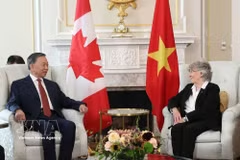
General Secretary of the Communist Party of Vietnam Central Committee and President To Lam meets with Governor General of Canada Louise Arbour at Rideau Hall in Ottawa on September 24 morning (local time). Photo: VNA

Top leader meets with Governor General of Canada

Vietnam consistently attaches importance to its relations with Canada, and highly valued the important progress in bilateral relations after nearly a decade of implementing the Comprehensive Partnership framework, said General Secretary of the Communist Party of Vietnam Central Committee and President To Lam.

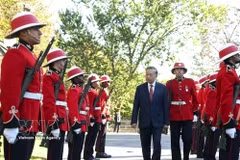
General Secretary of the Communist Party of Vietnam Central Committee and President To Lam reviews the guard of honour at the official welcome ceremony in Ottawa on the morning of September 24, 2026 (local time). (Photo: VNA)

Governor General of Canada hosts welcome ceremony for Vietnam’s top leader

General Secretary and President To Lam voiced his hope that the visit will open a new chapter in Vietnam–Canada relations, reflecting a new level of political trust, increasingly close alignment of interests and visions, as well as the determination of both countries to build a long-term, stable and substantive relationship and make it a model of cooperation between two countries on opposite sides of the Pacific Ocean.

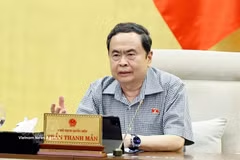
NA President Tran Thanh Man speaks at the NA Standing Committee's sixth session in Hanoi on September 24. (Photo: VNA)

Legislators move to overhaul food safety law with single focal point

The top legislator warned that food safety shouldn't be used to bring back a "request-and-grant" mechanism, and administrative reform shouldn't be an excuse to lower safety standards. Any policy that directly affects products or public health must rest on scientific evidence.

Deputy Foreign Minister pledges support for Fulbright University Vietnam

Deputy Foreign Minister pledges support for Fulbright University Vietnam

With the two countries actively and effectively delivering on their Comprehensive Strategic Partnership, and Vietnam entering a new growth phase that demands a more skilled workforce, Deputy Minister of Foreign Affairs Nguyen Minh Hang expressed her hope that the university will keep innovating, broaden its fields of study, and further sharpen training quality to support Vietnam's workforce development and bilateral educational ties.

Vietnamese Ambassador to the UK Do Minh Hung speaks at the ceremony in London on September 23. (Photo: VNA)

Vietnam, UK strengthen friendship and people-to-people ties

Vietnamese Ambassador to the UK Do Minh Hung said people are the foundation of the bilateral ties, stressing the role of Vietnamese students, intellectuals and the Vietnamese community in promoting mutual understanding and connecting the two countries.

Prime Minister Le Minh Hung speaks at the meeting with voters in Hai Phong city on September 24 ahead of the second session of the legislature. (Photo: VNA)

PM Le Minh Hung meets with Hai Phong voters ahead of 16th NA’s second session

PM Hung asked Hai Phong city to work harder to achieve its targets for economic growth, budget collection, investment attraction and public investment disbursement, while addressing bottlenecks and promoting industry, electronics, trade, tourism and support for businesses, particularly small and medium-sized enterprises.

NA Vice President Do Van Chien speaks at the sixth session of the NA Standing Committee on September 24. (Photo: VNA)

Lawmakers weigh draft law to grant cultural industries formal legal status

The bill aims to complete the legal framework, clear institutional bottlenecks, pool resources and unlock creative potential, while boosting the cultural content of products and services. It's also meant to shield the domestic market and turn cultural industries into a breakthrough growth driver.

NA President Tran Thanh Man addresses the discussion (Photo: VNA)

Lawmakers discuss facilitating intellectual property registration

Presenting the draft law, Deputy Minister of Science and Technology Hoang Minh said the draft law centres on two major policy areas: further simplifying procedures and reducing business conditions, and transferring the management of rights to plant varieties from the Ministry of Agriculture and Environment to the Ministry of Science and Technology.

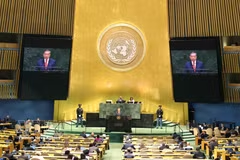
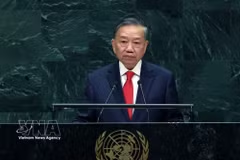
General Secretary of the Communist Party of Vietnam Central Committee and President To Lam speaks at the High-Level General Debate of the 81st United Nations General Assembly (UNGA 81) on September 22 (Photo: VNA)

Vietnam affirms proactive, responsible diplomacy at UNGA 81

This marked General Secretary and President Lam’s first working trip to the UN and the US since Vietnam successfully held the 14th National Party Congress and the election of deputies to the 16th National Assembly and People’s Councils at all levels for the 2026-2031 term. It reaffirmed Vietnam’s consistent foreign policy of independence, self-reliance, multilateralisation and diversification, along with proactive and active international integration in a comprehensive and extensive manner.