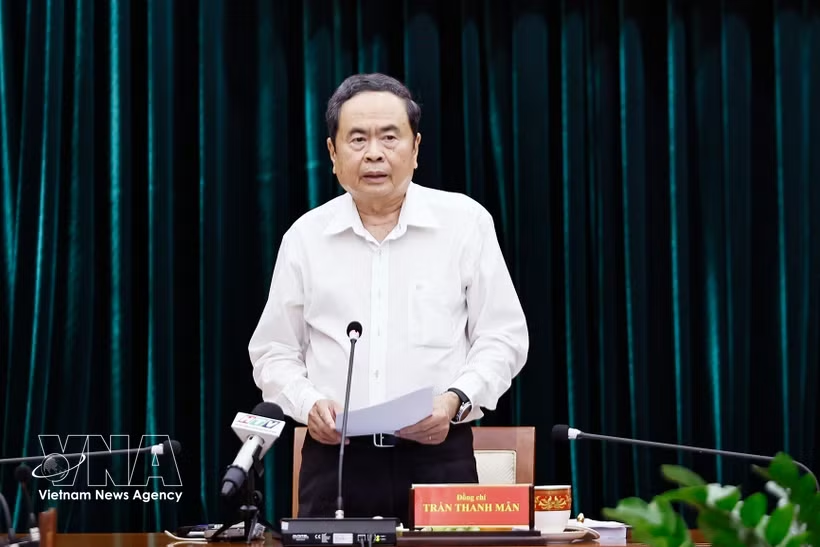
Decentralisation must not lead to fragmented responsibility: NA President

Agencies directly managing, assigning and employing personnel must bear primary responsibility for their assessment and performance, while the Ho Chi Minh City Party Committee’s advisory bodies should strengthen guidance, supervision and early risk warnings, President of the National Assembly (NA) Tran Thanh Man said.

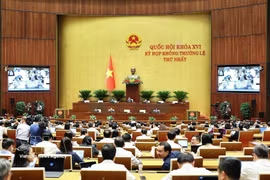
President of the National Assembly (NA) Tran Thanh Man speaks at the conference in Ho Chi Minh City to adopt a draft report on the third round of inspection and supervision of the municipal Party Committee’s Standing Board. (Photo: VNA)

Ho Chi Minh City (VNA) - Decentralisation must make the apparatus faster in handling work, closer to the people and more effective, but must not lead to fragmented responsibility or create wide disparities in quality among localities, Politburo member and President of the National Assembly (NA) Tran Thanh Man stressed on September 25.

The NA President, who is head of the Inspection and Supervision Team No. 220 of the Party Central Committee’s Politburo and Secretariat, made the statement while chairing a conference in Ho Chi Minh City to adopt a draft report on the third round of inspection and supervision of the municipal Party Committee’s Standing Board.

He requested the municipal Party Committee to move from “having studied, disseminated and issued programmes” to determining “what changes and products have been created and what problems have been solved”. Each resolution, he said, must be accompanied by clear targets, expected products, responsible agencies, resources, timelines, impact indicators and regular evaluation mechanisms, ensuring that resolutions are translated into substantive results and narrowing the gap between political determination and implementation capacity.

Regarding personnel management and quality, the NA Chairman acknowledged that decentralisation and delegation of authority have enabled grassroots-level agencies to be more proactive in organisational arrangements, personnel deployment and handling of work. However, he noted that some localities still face shortages of advisory personnel and specialised staff in science and technology, data and digital transformation.

He therefore called on the municipal Party Committee’s Standing Board to review the entire decentralisation mechanism based on the principle that authority must be accompanied by the conditions necessary to exercise it. Agencies directly managing, assigning and employing personnel must bear primary responsibility for their assessment and performance, while the municipal Party Committee’s advisory bodies should strengthen guidance, supervision and early risk warnings.
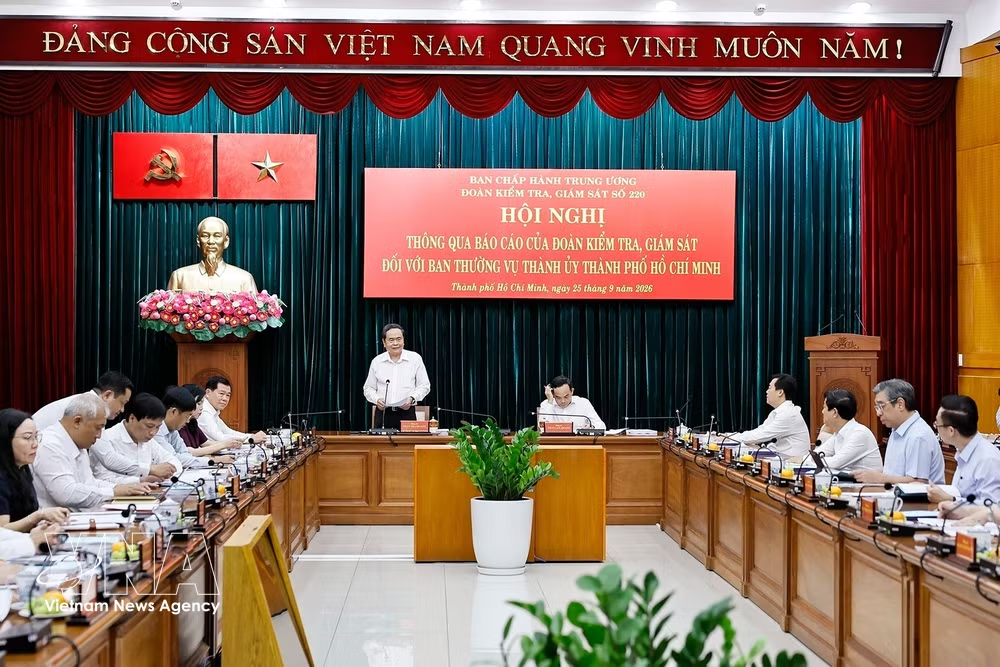
vnanet-tranthanhman2.jpg
President of the National Assembly (NA) Tran Thanh Man speaks at the conference in Ho Chi Minh City to adopt a draft report on the third round of inspection and supervision of the municipal Party Committee’s Standing Board. (Photo: VNA)

NA President Man also urged the city to make more substantive use of performance-based personnel assessment. While welcoming the application of products, timelines, quality criteria and key performance indicators (KPIs), he said assessment results must be linked to personnel planning, training, appointment, commendation, screening and replacement. Otherwise, assessment will have limited impact on personnel decisions.

He further called for stronger inspection and supervision, power control and digital transformation. He noted that specialised self-inspections remain irregular in some local Party committees, while data for monitoring and power control has yet to be fully interconnected. Ho Chi Minh City has made progress in digitising documents, developing Party member databases and using electronic Party member handbooks, but digital transformation should go beyond digitising existing procedures to support governance, forecasting and early risk warning.

The NA President stressed that, given Ho Chi Minh City’s particularly important role, the requirements for its personnel work must also be higher. The ultimate purpose of inspection and supervision, he said, is not merely to determine whether procedures are right or wrong, but to help identify areas requiring consolidation, bottlenecks that need to be removed and issues that must be elevated to build a contingent of officials with the qualities and capacity to implement the city’s development goals./.
VNA

See more

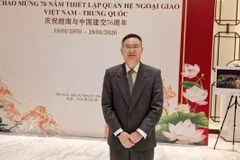
Prof. Dr. Cheng Hanping, Executive Director of the Institute of Regional and Country Studies and Director of the Vietnam Research Centre at China's Zhejiang University of Technology (Photo published by VNA)

UNGA 81: Top leader highlights four points reflecting int'l community’s common views

General Secretary and President To Lam's recent visits to several countries and his trip to New York to attend the High-Level General Debate of UNGA 81 signal the growing emphasis by Vietnam’s leadership on a diplomatic strategy of diversification and balance in response to the increasingly complex and uncertain global landscape, said Prof. Dr. Cheng Hanping of China.

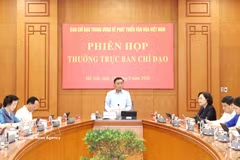
Politburo Member and Standing Member of the Party Central Committee’s Secretariat and Head of the Central Steering Committee for the Development of Vietnamese Culture Tran Cam Tu speaks at the meeting. (Photo: VNA)

Key leader orders stronger measures to drive cultural development

Cultural spending should reach at least 2% of total State budget expenditure, with greater efficiency in allocation and disbursement and stronger mobilisation of social resources, said Politburo Member and Standing Member of the Party Central Committee’s Secretariat Tran Cam Tu.

Deputy Minister of Foreign Affairs Ngo Le Van (R) receives Hungarian Ambassador to Vietnam Baloghdi Tibor in Hanoi on September 24 (Photo: Ministry of Foreign Affairs)

Vietnam, Hungary seek to deepen bilateral ties

Hungary is one of Vietnam’s leading important partners in Central and Eastern Europe. Vietnam attaches importance to and wishes to continuously strengthen multifaceted ties with the country.

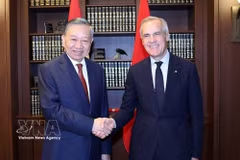
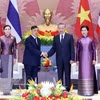
General Secretary of the Communist Party of Vietnam Central Committee and President To Lam (L) meets with Canadian Prime Minister Mark Carney in Ottawa on September 24, 2026. (Photo: VNA)

Vietnam, Canada issue joint statement on Strategic Partnership

The two leaders elevated Vietnam - Canada relations to a Strategic Partnership anchored in eight pillars. Collectively, these pillars position Vietnam and Canada to address shared challenges, seize emerging opportunities, and contribute to a more secure, prosperous, and dynamic Indo-Pacific region.

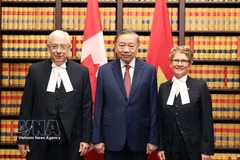
General Secretary of the Communist Party of Vietnam Central Committee and President To Lam meets with Speaker of the Senate Raymonde Gagné and Speaker of the House of Commons Francis Scarpaleggia on September 24 (local time). Photo: VNA

Top leader meets with Speakers of Canada’s Senate and House of Commons

Building on more than 50 years of friendship and the newly established Strategic Partnership framework, Vietnam–Canada relations as a whole, as well as cooperation between the two countries’ legislative bodies in particular, would continue to develop in an increasingly substantive and effective manner, for the benefit of the people of both countries and for peace, cooperation, and development in the region and the world.

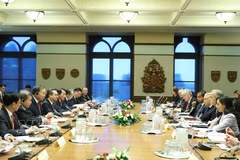
General Secretary of the Communist Party of Vietnam Central Committee and President To Lam receives representatives from the Canada–Vietnam Parliamentary Friendship Group at the Parliament of Canada on September 24 (local time). (Photo: VNA)

Party General Secretary and President receives Canada-Vietnam Parliamentary Friendship Group

The parliamentary friendship groups of Vietnam and Canada should increase delegation exchanges and contacts among parliamentarians, specialised committees, women parliamentarians, and young parliamentarians; promote joint activities and the sharing of experience in legislation and oversight; and further play their role in building broad consensus within the Canadian Parliament and society on strengthening relations with Vietnam.

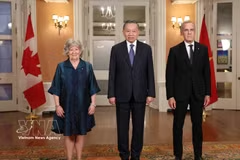
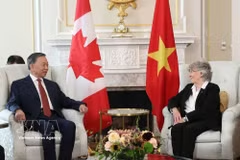
General Secretary of the Communist Party of Vietnam Central Committee and President To Lam meets with Governor General of Canada Louise Arbour at Rideau Hall in Ottawa on September 24 morning (local time). Photo: VNA

Top leader meets with Governor General of Canada

Vietnam consistently attaches importance to its relations with Canada, and highly valued the important progress in bilateral relations after nearly a decade of implementing the Comprehensive Partnership framework, said General Secretary of the Communist Party of Vietnam Central Committee and President To Lam.

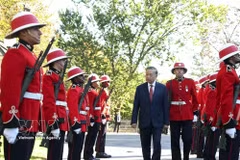
General Secretary of the Communist Party of Vietnam Central Committee and President To Lam reviews the guard of honour at the official welcome ceremony in Ottawa on the morning of September 24, 2026 (local time). (Photo: VNA)

Governor General of Canada hosts welcome ceremony for Vietnam’s top leader

General Secretary and President To Lam voiced his hope that the visit will open a new chapter in Vietnam–Canada relations, reflecting a new level of political trust, increasingly close alignment of interests and visions, as well as the determination of both countries to build a long-term, stable and substantive relationship and make it a model of cooperation between two countries on opposite sides of the Pacific Ocean.

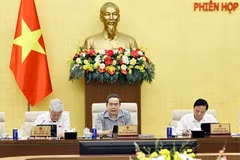
NA President Tran Thanh Man speaks at the NA Standing Committee's sixth session in Hanoi on September 24. (Photo: VNA)

Legislators move to overhaul food safety law with single focal point

The top legislator warned that food safety shouldn't be used to bring back a "request-and-grant" mechanism, and administrative reform shouldn't be an excuse to lower safety standards. Any policy that directly affects products or public health must rest on scientific evidence.

Deputy Foreign Minister pledges support for Fulbright University Vietnam

Deputy Foreign Minister pledges support for Fulbright University Vietnam

With the two countries actively and effectively delivering on their Comprehensive Strategic Partnership, and Vietnam entering a new growth phase that demands a more skilled workforce, Deputy Minister of Foreign Affairs Nguyen Minh Hang expressed her hope that the university will keep innovating, broaden its fields of study, and further sharpen training quality to support Vietnam's workforce development and bilateral educational ties.

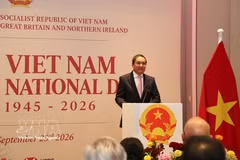
Vietnamese Ambassador to the UK Do Minh Hung speaks at the ceremony in London on September 23. (Photo: VNA)

Vietnam, UK strengthen friendship and people-to-people ties

Vietnamese Ambassador to the UK Do Minh Hung said people are the foundation of the bilateral ties, stressing the role of Vietnamese students, intellectuals and the Vietnamese community in promoting mutual understanding and connecting the two countries.

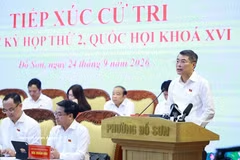
Prime Minister Le Minh Hung speaks at the meeting with voters in Hai Phong city on September 24 ahead of the second session of the legislature. (Photo: VNA)

PM Le Minh Hung meets with Hai Phong voters ahead of 16th NA’s second session

PM Hung asked Hai Phong city to work harder to achieve its targets for economic growth, budget collection, investment attraction and public investment disbursement, while addressing bottlenecks and promoting industry, electronics, trade, tourism and support for businesses, particularly small and medium-sized enterprises.