Vietnam eyes building national brands for cultural industries

This is the first time a Party document has set specific quantitative targets for cultural brands and cultural industries. With thousands of tangible and intangible heritage assets and the rich cultural life of 54 ethnic groups, Vietnam has a strong foundation for achieving these goals. However, turning cultural resources into recognised brands requires determination and systematic approaches.

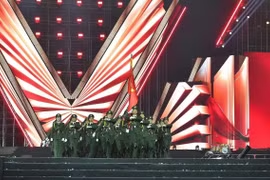
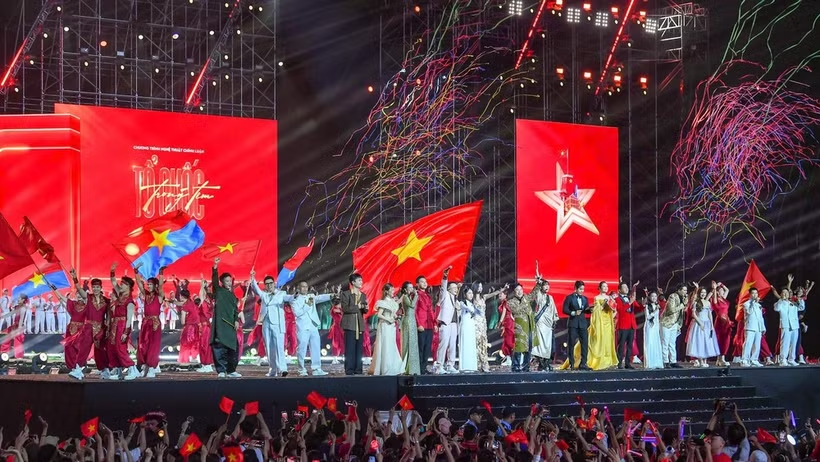
Political-artistic programme “Fatherland in Our Hearts”, jointly organised by Nhan Dan Newspaper and the Ho Chi Minh City People’s Committee. (Photo: nhandan.vn)

Hanoi (VNA) – Vietnam has set targets for cultural industries to contribute 7% of GDP and for Vietnam to develop five to 10 national cultural-industry brands in promising sectors such as film, performing arts, cultural tourism, design and fashion by 2030.

The goals are part of the Politburo’s Resolution No. 80-NQ/TW, dated January 7, 2026, on developing Vietnamese culture in the new era.

This is the first time a Party document has set specific quantitative targets for cultural brands and cultural industries. With thousands of tangible and intangible heritage assets and the rich cultural life of 54 ethnic groups, Vietnam has a strong foundation for achieving these goals. However, turning cultural resources into recognised brands requires determination and systematic approaches.

Turning culture into brands

A national brand represents the distinctive image, reputation and values that a country builds in the eyes of the international community. According to Brand Finance, Vietnam's national brand ranking has improved in recent years, supported by economic growth and efforts to improve the investment environment. However, in terms of soft power, where culture plays a central role, Vietnam still has room to improve. In the Global Soft Power Index released by Brand Finance in January, Vietnam ranked 52nd among 193 countries and ninth in Asia.

Experts say the country’s challenge is not a lack of cultural resources, but a shortage of cultural products capable of creating a distinctive national identity. Japan has transformed manga, anime and popular culture into sources of global influence, while the Republic of Korea (RoK) has developed an ecosystem spanning music, cinema, fashion, cosmetics and tourism, creating the Hallyu, or Korean Wave, as a systematic soft-power strategy. In 2025, the RoK's cultural-content exports reached nearly 14.9 billion USD, while the sector's total value approached 38 billion USD.

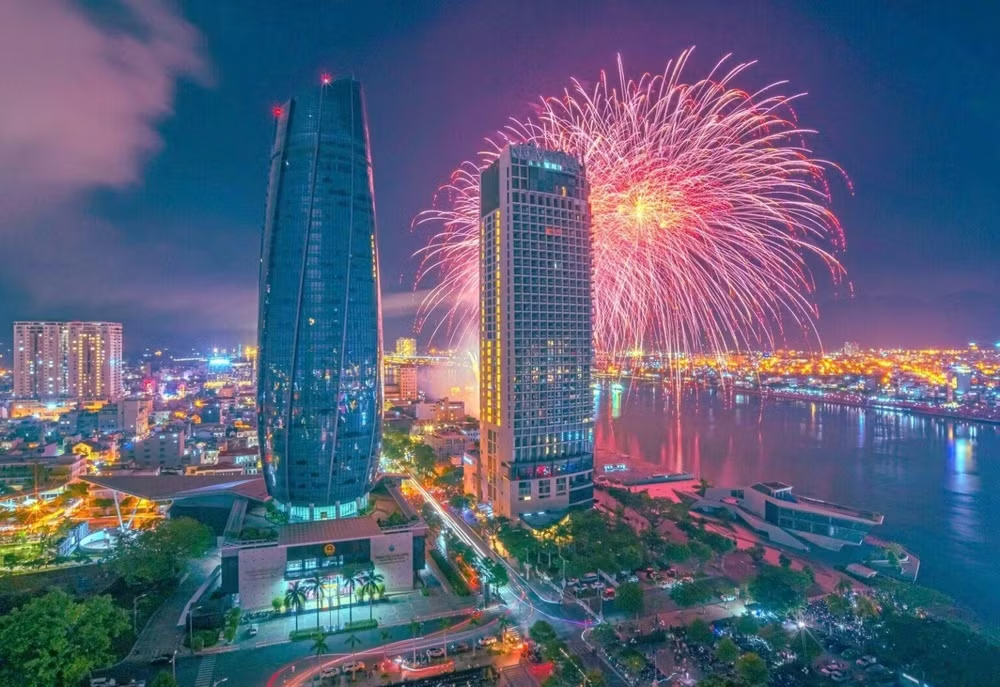
Vietnam has also seen encouraging signs. The Hue Festival, Da Nang International Fireworks Festival (DIFF), Da Nang Asian Film Festival (DANAFF) and contemporary art events in Hanoi and Ho Chi Minh City have demonstrated the potential to connect heritage, tourism and creative industries. However, experts note that such events need distinctive identities and continuity to become effective branding tools.

Phan Minh Thu, CEO of Senplus JSC, said Vietnam has abundant cultural resources but remains limited in its ability to tell brand stories that resonate with international audiences. Culture can become an economic driver only when it is transformed into experiences, products and services capable of reaching markets.

Removing bottlenecks

Deputy Minister of Culture, Sports and Tourism Nguyen Huy Dung said the cultural industry value chain remains fragmented, from creativity and intellectual property to capital, production, distribution and reinvestment. He noted that about 80% of investment capital in Vietnamese game startups flows to Singapore, while more than 60% of domestic animation studios mainly provide outsourcing services for foreign projects rather than owning their own intellectual property.
le-hoi.jpg
In April 2026, Da Nang International Fireworks Festival (DIFF) is named by Travel + Leisure among the world’s top nine festivals worth experiencing. (Photo: Organising board)

Following Resolution No. 80-NQ/TW, the National Assembly adopted Resolution No. 28/2026/QH16 on mechanisms and policies for developing Vietnamese culture. A draft Law on Cultural Industry Development is expected to be submitted to the 16th National Assembly for consideration in October.

The draft law aims to establish the position of cultural industries in the national economy, connect value chains, increase exports and strategic investment, and promote Vietnamese cultural identity and soft power internationally.

The Government also approved a communication strategy on promoting Vietnam’s image abroad for 2026-2030, with a vision to 2045, aiming to place Vietnam among the top three ASEAN countries and the world’s top 30 in the Global Soft Power Index.

With the policy framework gradually taking shape and political determination in place, the focus now is on implementation, from selecting the right products and markets to telling the right stories. The outcomes will depend on how ministries, agencies, businesses and cultural practitioners work together in the years ahead./.
VNA

See more

Mo Muong is a national intangible cultural heritage closely associated with the spiritual life of the Muong ethnic minority community (Photo: VNA)

Digital transformation helps preserve Mo Muong cultural values

Digital transformation is emerging as an important solution to preserve and promote traditional cultural values at risk of fading, including Mo Muong, a national intangible cultural heritage closely associated with the spiritual life of the Muong ethnic minority community.

An international tourist joins the Mid-Autumn Festival atmosphere by Hoan Kiem Lake, surrounded by colourful traditional toys. (Photo: VNA)

Thang Long cultural symbols featured in Mid-Autumn lantern parade around Hoan Kiem Lake

The lantern parade featured familiar Mid-Autumn lanterns and folk art forms alongside distinctive images of Thang Long-Hanoi, including paper doctors, the Pen Tower and Ink Slab. According to the organisers, these symbols evoke the tradition of valuing education and knowledge, as well as the hopes that previous generations have placed in children.

A visitor learns about the traditional culture of the Mong ethnic community. (Photo: VNA)

Vietnamese identity finds new expression in creative design

From traditional knowledge and craftsmanship, contemporary design draws inspiration from Vietnamese cultural identity and passes it on through the language of a new era. Linking knowledge, design, production, and markets can help turn cultural resources into sustainable economic value and create more creative design brands with a distinct Vietnamese identity.

A delegation from the Vietnam Federation of UNESCO Associations (VFUA) led by Deputy Secretary General Nguyen Le Hang, has a meeting with the Vietnamese Embassy in Greece. (Photo courtesy of the embassy)

Vietnam, Greece hold cultural dialogue

Cultural exchanges such as “Ode to Peace” contributed to promoting the role of culture, enhancing understanding among nations, and advancing peace and sustainable development.

Vietnamese Ambassador to Japan Pham Quang Hieu meets with 30 Vietnamese content creators and key opinion leaders in Japan on September 23 (Photo: VNA)

Vietnamese KOLs in Japan encouraged to strengthen community ties

Speaking at a meeting in Tokyo on September 23 with around 30 Vietnamese content creators and key opinion leaders (KOLs) in Japan, Vietnamese Ambassador to Japan Pham Quang Hieu said their ability to deliver information quickly and reach large audiences enables them to make practical contributions to strengthening bilateral ties and building a united Vietnamese community in Japan.

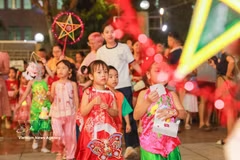
Children join a Mid-Autumn lantern procession. (Photo: VNA)

2026 Mid-Autumn Festival celebrates childhood, traditional culture

Since the 1990s, Mid-Autumn celebrations at Van Ho have become a memorable part of childhood in the capital, characterised by warmth, simplicity and traditional cultural values. Even when material conditions were limited, children's joy was kindled by candlelit handmade lanterns, drumbeats, laughter and moments spent with family and friends.

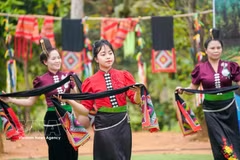
Thai ethnic women perform at a cultural activity at the Vietnam National Village for Ethnic Culture and Tourism. (Photo: VNA)

Vietnam Culture Day expected to become national cultural brand

People, communities, artists, intellectuals, businesses and young people should be placed at the centre as both participants and creators, as well as direct beneficiaries of cultural achievements during activities marking Vietnam Culture Day, according to Deputy PM Pham Thi Thanh Tra.