Vietnam demonstrates spirit of independence, self-reliance at UN forum: Chinese expert

General Secretary and President Lam’s call for competition not to turn into confrontation and for technological progress not to create new divides shows Vietnam’s direct interest in emerging issues of global governance.

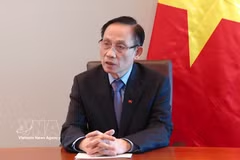
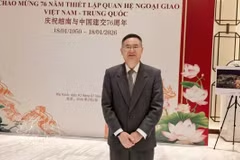
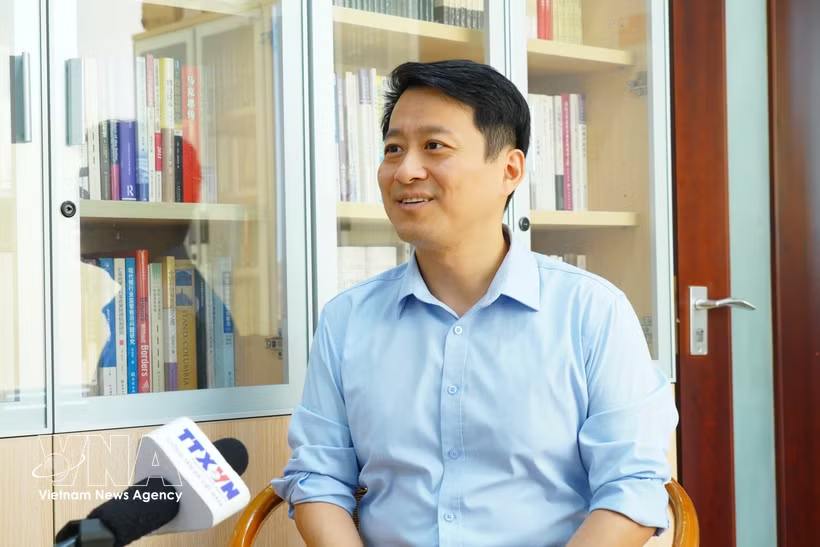
Professor Qu Qiang of Minzu University of China speaks to a Vietnam News Agency correspondent in Beijing. (Photo: VNA)

Beijing (VNA) – Vietnam’s message at the high-level general debate of the 81st session of the United Nations General Assembly reflects the increasingly proactive role of a developing country in the Global South in addressing international issues, according to Professor Qu Qiang of Minzu University of China and commentator for China Global Television Network (CGTN).

Speaking to a Vietnam News Agency (VNA) correspondent in Beijing, Qu said the speech by General Secretary of the Communist Party of Vietnam (CPV) Central Committee and President To Lam came as the international order faces major changes, growing competition among major powers, and challenges related to the economy, technology, climate change and global governance.

He highlighted Vietnam’s emphasis on restoring trust, promoting equitable development, governing technologies and strengthening multilateralism.

According to the expert, General Secretary and President Lam’s call for competition not to turn into confrontation and for technological progress not to create new divides shows Vietnam’s direct interest in emerging issues of global governance. It also reflects concerns shared by many developing countries, including the need for more equal participation in the formulation and implementation of international rules.

Qu said Vietnam’s role in multilateral forums is also evolving. The participation of the Party and State leader in the UN General Assembly demonstrates the importance Vietnam attaches to multilateral diplomacy, he noted.

Vietnam is gradually moving from mainly participating in international mechanisms to proactively putting forward initiatives and contributing to agenda-setting, he said, citing Vietnam’s hosting of the signing ceremony for the UN Convention against Cybercrime and preparations to host APEC 2027.

Assessing Vietnam’s foreign policy approach, Qu said the speech demonstrated a combination of principle and flexibility. Vietnam stressed the peaceful settlement of disputes in accordance with international law, including the 1982 UN Convention on the Law of the Sea (UNCLOS), while expressing its positions on issues concerning Palestine and Cuba.

He said this approach underscores Vietnam’s commitment to sovereignty, international law and peaceful settlement of disputes, while maintaining an independent and non-confrontational stance. In his view, this is consistent with Vietnam’s growing international integration and could offer a reference for other ASEAN countries seeking to maintain strategic space and promote cooperation.

Qu also noted that Vietnam has linked its long-term development goals to innovation, productivity growth, digital transformation and new development models. This helps the international community better understand the country’s development orientation while reflecting its desire to attract resources, technology and investment and participate more deeply in global value chains.

Regarding Vietnam’s message to the Global South, Qu said issues such as development gaps, access to technology, development financing, climate change and reform of multilateral institutions are shared concerns among developing countries.

He said Vietnam’s emphasis on multilateralism, dialogue, equal cooperation and leaving no one behind shows its effort to connect national development goals with broader concerns of the Global South.

Looking ahead, Qu said Vietnam’s continued participation in ASEAN, APEC, the UN and other multilateral mechanisms would provide further opportunities for the country to contribute to regional and global issues. He noted, however, that efforts to restore trust, promote development and strengthen multilateral cooperation face challenges including major-power competition, geopolitical conflicts, global market fragmentation, financing needs for the energy transition and issues arising from the rapid development of artificial intelligence.

The speech, Qu concluded, reflects Vietnam’s desire to maintain a stable international environment, promote dialogue over confrontation and strengthen developing countries’ participation in shaping global rules and governance mechanisms./.


VNA
See more

Minister of Foreign Affairs Le Hoai Trung (Photo: VNA)

Top leader’s trip to US, Canada underscores Vietnam’s message in new era: FM

Bilateral and multilateral engagement during General Secretary of the Communist Party of Vietnam Central Committee and President To Lam's five-day trip through the US and Canada opened doors for concrete cooperation while advancing shared goals with the UN, US and Canada want Vietnam to take a bigger hand in global and regional affairs.

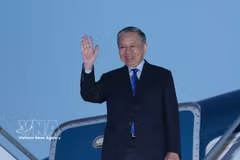
General Secretary of the Communist Party of Vietnam (CPV) Central Committee and President To Lam leaves Ottawa on the evening of September 25 (local time), concluding his state visit to Canada. (Photo: VNA)

Top leader concludes state visit to Canada

General Secretary of the Communist Party of Vietnam (CPV) Central Committee and President To Lam left Ottawa on the evening of September 25 (local time), concluding his state visit to Canada at the invitation of Governor General Louise Arbour.

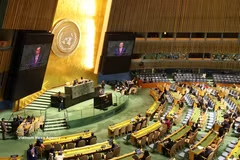
General Secretary of the Communist Party of Vietnam Central Committee and President To Lam delivers remarks at the high-level general debate of the 81st session of the United Nations General Assembly. (Photo: VNA)

Vietnam, Canada have ample room for cooperation in new era: Canadian researcher

This convergence of interests creates space for Vietnam and Canada to develop broader and deeper relations. Although the two countries do not take exactly the same approach to every international issue, they share an interest in maintaining a rules-based system in which institutions and dialogue help limit the influence of power politics while giving countries greater room to pursue autonomous development choices, Vina Nadjibulla, co-founder and CEO of the Centre for Strategic Statecraft of Canada, said

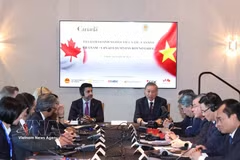
General Secretary of the Communist Party of Vietnam Central Committee and President To Lam (R) speaks at the event. (Photo: VNA)

General Secretary and President To Lam attends Vietnam-Canada business roundtable

Addressing the roundtable, General Secretary and President To Lam spoke highly of the sound friendship between Vietnam and Canada, built on trust, mutual respect and win-win cooperation. The Comprehensive Partnership established in 2017 has provided a favourable framework for expanding bilateral cooperation across various fields.

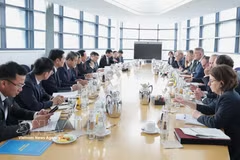
The 11th theoretical exchange between the Communist Party of Vietnam (CPV) and the Social Democratic Party of Germany (SPD) in Berlin on September 24. (Photo: VNA)

Vietnamese, German parties hold 11th theoretical exchange

The two sides held four discussion sessions on the multipolar world and changes in the international order; development models in the digital and artificial intelligence (AI) era; protection of international trade in a multipolar world; and the role of political parties in guiding transformation and addressing contemporary challenges.

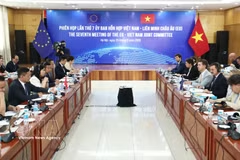
An overview of the 7th meeting of the Vietnam-EU Joint Committee. (Photo: VNA)

Vietnam, EU hold seventh meeting of Joint Committee

The meeting provided an opportunity for the two sides to brief each other on their respective socio-economic situations and foreign policies, comprehensively review bilateral relations and assess the outcomes of meetings of the Joint Committee’s subcommittees on political affairs, sustainable development, and good governance, rule of law and human rights.

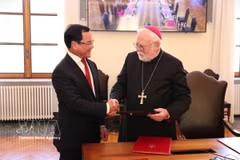
Minister of Ethnic and Religious Affairs Nguyen Dinh Khang (L) and Archbishop Paul Richard Gallagher, Secretary for Relations with States and International Organisations of the Holy See, on September 23, 2026. (Photo: VNA)

Vietnam, Holy See step up exchanges, cooperation

A delegation from Vietnam’s Ministry of Ethnic and Religious Affairs visited the ‌Vatican's Secretariat of State, Dicastery for Evangelisation, Dicastery for Communication and Vatican Radio.

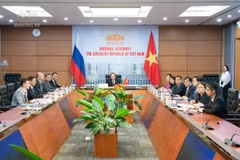
An overview of the online meeting with the Russian Federation Council’s group for cooperation with the Vietnamese NA in Hanoi on September 25. (Photo: quochoi.vn)

Vietnam, Russia agree to strengthen parliamentary cooperation

National Assembly (NA) Vice President Nguyen Khac Dinh, who is also Chairman of the Vietnam-Russia Friendship Parliamentarians’ Group, stressed that cooperation between the Vietnamese NA and the Russian Federation Council, including activities between their respective groups, has received high appreciation from the leaders of both countries.

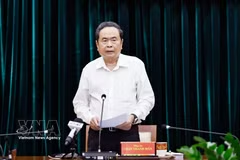
President of the National Assembly (NA) Tran Thanh Man speaks at the conference in Ho Chi Minh City to adopt a draft report on the third round of inspection and supervision of the municipal Party Committee’s Standing Board. (Photo: VNA)

Decentralisation must not lead to fragmented responsibility: NA President

Agencies directly managing, assigning and employing personnel must bear primary responsibility for their assessment and performance, while the Ho Chi Minh City Party Committee’s advisory bodies should strengthen guidance, supervision and early risk warnings, President of the National Assembly (NA) Tran Thanh Man said.

Prof. Dr. Cheng Hanping, Executive Director of the Institute of Regional and Country Studies and Director of the Vietnam Research Centre at China's Zhejiang University of Technology (Photo published by VNA)

UNGA 81: Top leader highlights four points reflecting int'l community’s common views

General Secretary and President To Lam's recent visits to several countries and his trip to New York to attend the High-Level General Debate of UNGA 81 signal the growing emphasis by Vietnam’s leadership on a diplomatic strategy of diversification and balance in response to the increasingly complex and uncertain global landscape, said Prof. Dr. Cheng Hanping of China.

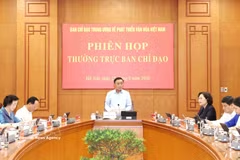
Politburo Member and Standing Member of the Party Central Committee’s Secretariat and Head of the Central Steering Committee for the Development of Vietnamese Culture Tran Cam Tu speaks at the meeting. (Photo: VNA)

Key leader orders stronger measures to drive cultural development

Cultural spending should reach at least 2% of total State budget expenditure, with greater efficiency in allocation and disbursement and stronger mobilisation of social resources, said Politburo Member and Standing Member of the Party Central Committee’s Secretariat Tran Cam Tu.