Hanoi (VNS/VNA) - The National Technology Innovation Foundation (NATIF) is preparing a funding programme, as it seeks to accelerate AI adoption among businesses and expand opportunities for domestic AI solution providers.
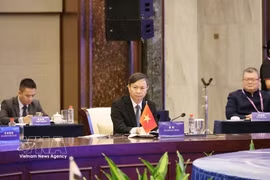
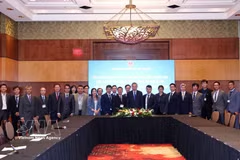
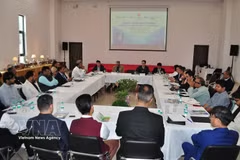
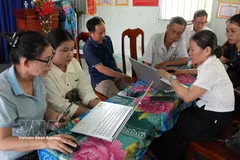
The programme was discussed at a working session between NATIF and the Vietnam Association of Science and Technology Enterprises last weekend at the Ministry of Science and Technology, focusing on proposals for technology innovation projects applying AI.
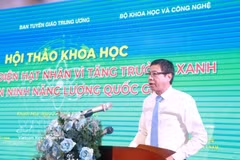
Chu Duc Hoang, chief of NATIF's Office and head of its Funding and Commissioning Division, said the programme was being implemented under a new legal framework, including the 2025 Law on Science and Technology, and decrees like Decree No. 267/2025/ND-CP on science and technology tasks and Decree No. 268/2025/ND-CP on innovation activities.
NATIF plans to select and sign contracts for about 15 key AI application projects in 2026. From 2027, the programme is expected to expand to around 50 projects annually.
The programme is based on an adapted version of Singapore's 100 Experiment model, under which participating projects can receive funding of up to 150,000 USD, equivalent to about 3 billion VND.
The model has been adjusted to suit Vietnam's business and technology environment.
Under the Vietnamese model, the programme brings together three groups.
The State, represented by NATIF, provides funding and strategic direction. Businesses identify practical problems and provide data, while research institutes, universities, experts, research teams and technology companies develop solutions.
Manufacturing and business enterprises of medium and large size that have practical AI needs and sufficient data are the priority group for submitting problems. Technology companies, including small and micro enterprises, can participate as solution providers.
The State will finance up to 50% of the total cost of an approved project, capped at 3 billion VND. Participating businesses are responsible for the remaining funding, with cash contributions prioritised.
The funding mechanism is also designed to link disbursement to project progress rather than relying solely on final settlement.
"For example, under phased settlement, in the first stage, when the AI problem has been clarified and the data prepared, the enterprise will receive 20%," Hoang said.
"In the second stage, after successfully developing the AI model, the State will disburse 30%. In the third stage, when the model is put into actual operation at the enterprise, its economic effectiveness is demonstrated and productivity is measured, and the enterprise will receive 50%."
The mechanism is intended to tie public funding to measurable stages of AI deployment, from problem definition and data preparation to model development and production deployment.
The programme has received strong interest from the business community.
Nguyen Thi Huong Lien, standing vice chairwoman of the Vietnam Association of Science and Technology Enterprises (VST) and vice chairwoman of Sao Thai Duong JSC, said the association had received 26 proposals shortly after being informed about the programme.
Of these, 14 enterprises registered as buyers, or businesses seeking to apply AI, while 12 registered as sellers, or providers of AI solutions.
Lien said the State's 50% funding support was an important boost for domestic manufacturing businesses, helping them overcome cost barriers to AI adoption in areas including automation, sales management, quality control and competitiveness with foreign solutions.
At the discussion, businesses raised questions about application and evaluation procedures and how to define suitable AI problems. They also expressed a need to connect with expert networks to better understand their specific technology requirements and identify appropriate solutions.
Hoang said NATIF would support businesses in clarifying their AI problems, accessing a structured approach to innovation and connecting with suitable experts.
He also proposed that VST establish a dedicated consulting team with appropriate training to provide direct guidance and support to its member enterprises nationwide./.
See more
Ho Chi Minh City to develop specialised digital technology park
According to Su Ngoc Khuong, Senior Director of Investment at Savills Vietnam, infrastructure will become one of the key drivers shaping a new development cycle for the property market. Major transport projects are improving inter-regional connectivity and creating new growth poles along economic corridors.
PM urges stronger contribution of science, technology to economic growth
Ministries, agencies and localities were also told to accelerate the development of national databases and digital infrastructure, with key databases on education, social security, personnel and health to be completed by November 30, 2026.
AI helps transform tourism experiences in digital era
Bui Thanh Tu, Marketing Director of Bestprice Travel, said treating data as an asset and applying AI to specific business needs have produced concrete results in the company’s travel operations.
Hanoi hosts International Olympiad on Astronomy and Astrophysics for first time
Vietnam is participating in IOAA 2026, which runs through October 5, with a 10-member team selected in accordance with regulations set by the Ministry of Education and Training.
Top leader calls for greater contribution from Vietnamese experts in Canada
At a meeting with representatives of the Canadian Vietnamese Scientists and Experts Association (CVSEA) on September 25 (local time), the top leader praised the contributions and professional capabilities of Vietnamese experts and intellectuals in Canada, describing them as a valuable intellectual resource and an important bridge connecting Vietnam with Canada and the wider world.
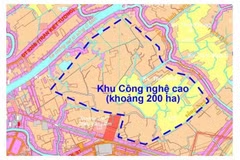
Can Tho city to establish over 192 million USD hi-tech park
The Can Tho Hi-Tech Park is set to become a multifunctional economic-technical zone linking scientific research, strategic technology development, business incubation, high-quality human resources training and the production of high-value-added products.
Science-technology diplomacy helps build bridge for Vietnam-Hong Kong (China) strategic cooperation: diplomat
Hong Kong's high-quality universities and research institutions, international financial centre, startup ecosystem and access to the Guangdong-Hong Kong-Macao Greater Bay Area (GBA) offer significant opportunities for collaboration with Vietnam.
Vietnam enlists OV in push for tech edge
The Ministry of Science and Technology has named the National Foundation for Science and Technology Development (NAFOSTED) as the focal point to gather research problems and match them with experts under national sci-tech schemes, said NAFOSTED Deputy Director Nguyen Phu Binh. Building on its existing AI network, NAFOSTED will build a system to track those problems alongside a database of Vietnamese scientists abroad.
Ho Chi Minh City builds comprehensive ecosystem to attract high-quality personel
Ho Chi Minh City is finalising a comprehensive policy framework for identifying, recruiting, deploying, remunerating, assessing, developing and retaining high-quality personnel. It will pursue three approaches – attraction, recruitment and selection – to expand the talent pool while effectively utilising capable personnel already within the system.
Hanoi–India hi-tech roundtable targets deals, talent, tech transfer
Discussions covered India’s technology and innovation ecosystem; Vietnam’s strategic priorities, potential and strengths; technology partnership models and specialised technologies; and cooperation in quality workforce training and technology transfer.
Vietnam, Singapore expand cooperation in semiconductor workforce training
The two countries can complement each other and work closely together to develop human resources, SSIA Executive Director Ang Wee Seng said, stressing that the workforce must be able to adapt and reskill as technology evolves, particularly as advanced manufacturing moves towards AI-supported smart manufacturing.
Vietnam takes steps towards mastery of specialised semiconductor chips
Developing specialised semiconductor chips is a suitable pathway for leveraging Vietnam’s strengths and gradually moving deeper into the global semiconductor value chain.
VNEAT strengthens Vietnam-Taiwan technology, expert connections
Nguyen Van Nam, representative of the Vietnam Economic and Cultural Office in Taipei (VECO), and Prof. Yuei-An Liou, Honorary Chairman of VNEAT, spoke highly of the association's role as a bridge, while affirming VECO's active support for activities aimed at connecting intellectual resources and developing the Vietnamese expert community in Taiwan, China.
Digital services bring transformation closer to people
Nearly two years after the Politburo issued Resolution No. 57-NQ/TW on December 22, 2024, on breakthroughs in science and technology, innovation and national digital transformation, localities have been focusing on solutions that address specific needs and deliver tangible benefits.
Hanoi to host TECHFEST Vietnam 2026 in November
TECHFEST 2026 will adopt an open-air format to encourage public participation and direct interaction with startups, businesses and investors. Key activities will include an opening ceremony, startup product exhibitions, technology demonstrations and the final round of the national innovative startup talent competition.
Vietnam, Japan promote cooperation in semiconductor sector
VJSS-2026 provides a platform for scientists, experts and businesses to discuss the latest advances across a wide range of areas, from chip design, semiconductor components and materials to manufacturing, packaging and testing technologies, artificial intelligence and quantum computing.
Nuclear power development key to green growth, national energy security
Politburo Resolution No. 70-NQ/TW, dated August 20, 2025, on ensuring national energy security through 2030 with a vision to 2045, identifies firmly ensuring national energy security as a fundamental and important prerequisite for national development. It calls for adequate, stable and high-quality energy supplies for socio-economic development, national defence and security, improved living standards and environmental protection.
Strategic “Make in Vietnam” products: Businesses at the core
The list of six priority strategic technology products set out in the Prime Minister's Decision No. 2815/QD-TTg demonstrates an important shift in policy-making thinking, with businesses playing the central role in the innovation ecosystem and serving as the core element in the country’s goal of double-digit growth in the new era.
Expert suggests pathways for Vietnam to make breakthroughs in plant biotechnology
One approach Vietnam should prioritise is the application of Big Data, AI and bioinformatics in genetic resource research, thereby shortening the time needed to identify genes of economic value.
Vietnamese students compete in Global HackAtom 2026 finals in Russia
Participation in the international finals of Global HackAtom 2026 in Russia from September 11–17 offers Vietnamese students an opportunity to compete directly with peers from leading Russian universities with long-standing traditions in nuclear science, including Tomsk Polytechnic University and the National Research Nuclear University MEPhI.