Vietnam sustaining exceptional growth: economist

Vietnam is the resilience story. Its projected growth moderates slightly from its exceptional post-2016 pace, but remains around 5% — a rate that would be remarkable for most advanced economies.

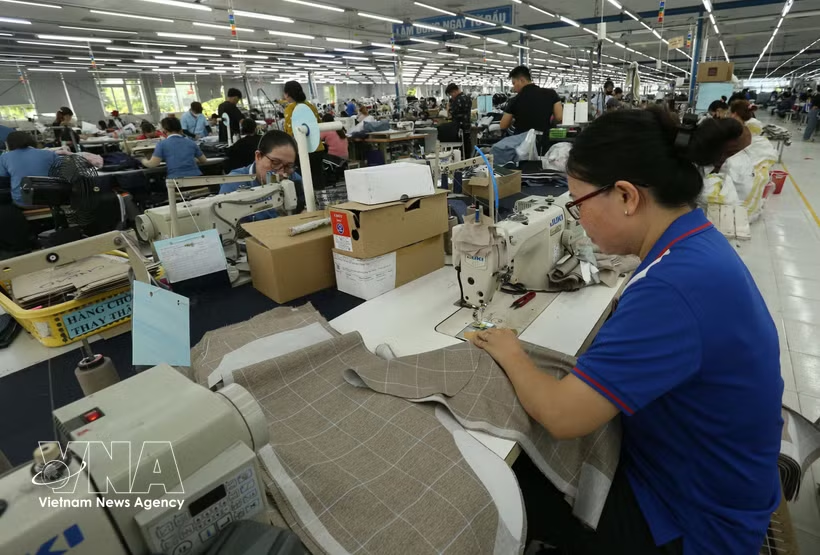
Workers make clothes for export at Nha Be- Hau Giang Garment JSC in Vi Thanh ward, Can Tho city. (Photo: VNA)

​Kuala Lumpur (VNA) – Vietnam is sustaining exceptional growth and, together with Malaysia, Thailand and the Philippines, is strengthening the case for ASEAN’s “Fabulous Five,” according to Shan Saeed, Global Chief Economist at Juwai IQI.

Bloomberg's latest cross-decade growth matrix delivers a clear signal: global growth is slowing, advanced economies are entering a slower-growth era, and genuine accelerators are increasingly rare.

"Buried in that matrix is a trend that reinforces a thesis I've been developing for months — ASEAN's growth story is becoming increasingly differentiated from that of the mature world," Saeed told the Vietnam News Agency.

He said Indonesia is the acceleration story. Its growth rate, clustered around 4% over the past decade, rises toward roughly 5% in the next — putting it above the 45-degree parity line that separates economies gaining momentum from those losing it.

"Vietnam is the resilience story. Its projected growth moderates slightly from its exceptional post-2016 pace, but remains around 5% — a rate that would be remarkable for most advanced economies," the economist noted.

"Together, they provide two different expressions of the broader ASEAN opportunity."

Saeed said this is the empirical spine of the Fabulous Five — the framework he has built around a simple proposition: ASEAN's next decade will be shaped disproportionately by five markets, driven not simply by commodity cycles but by labour depth, manufacturing capacity, domestic consumption, infrastructure and increasingly sophisticated supply chains.

He elaborated that Indonesia's downstream nickel strategy and industrial localisation provide tangible mechanisms for its acceleration. Meanwhile, Vietnam's electronics manufacturing and export ecosystem provide a different engine of resilience.

The two countries are not following identical paths; that is precisely the point, he said, explaining that one is gaining momentum while the other is sustaining an unusually high rate of expansion.

The economist added that the comparable data for Malaysia, Thailand and the Philippines sits outside this particular Bloomberg matrix. But the broader structural case for the Fabulous Five rests on more than a single growth chart: together, these five economies account for the overwhelming majority of ASEAN's population and represent some of the region's deepest pools of labour, manufacturing capacity, consumption and investment opportunity./.​

VNA

See more

The Asia Pacific Foundation of Canada website published two commentaries by former parliamentarian Bryon Wilfert and researcher Julie Nguyen on the significance of the visit. (Photo: Screenshot of the articles)

Canadian media highlight new milestone in Vietnam–Canada relations

The coverage by Canadian media and researchers shows that the top Vietnamese leader's state visit was seen not only as an important diplomatic milestone but also as an opportunity for the two countries to deepen substantive cooperation, diversify partnerships and seek new drivers of development amid a changing global landscape.

Thailand promotes “Chip Made in Thailand” strategy

Thailand promotes “Chip Made in Thailand” strategy

According to Narit Therdsteerasukdi, Secretary-General of the Thailand Board of Investment (BOI), the strategy aims to attract 500 billion THB (about 15 billion USD) in investment over the next five years through 2030, and more than 2.5 trillion THB by 2050. Thailand also targets raising revenue from the semiconductor and advanced electronics industries to 5 trillion THB and creating more than 230,000 jobs.

Singaporean labour market sends mixed signals

Singaporean labour market sends mixed signals

About 4,620 workers in Singapore were retrenched in the second quarter of 2026, or about two per 1,000 workers, up significantly from 3,830 in the first quarter. The figure was the highest since the fourth quarter of 2020, when Singapore was heavily affected by the COVID-19 pandemic.

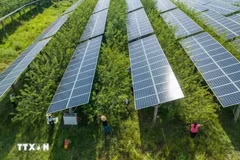
China has remained Thailand’s largest solar panel supplier over the past five years.

Thailand’s solar panel imports surge

China has remained Thailand’s largest solar panel supplier over the past five years. Its exports to Thailand reached a record 649.1 million USD in 2023, out of total imports of 654.2 million USD. The figure subsequently fell to 422.3 million USD in 2024 and 364.1 million USD in 2025.

Timor-Leste encourages women to develop businesses using local resources

Timor-Leste encourages women to develop businesses using local resources

According to a nationwide survey conducted by the Timor-Leste Women’s Business Association (AEMTL) from October 2024 to March 2025, nearly 63% of the women-owned businesses surveyed were operating informally or had not been registered with SERVE, Timor-Leste’s business registration and licensing authority.

A tourist in Bangkok, Thailand (Photo: Xinhua/VNA)

World Bank recommends Thailand develop satellite cities to drive growth

According to the World Bank's “Thailand Cities of the Future: Urban Foundations for a High-Income Economy” report, Thailand’s urban system remains heavily concentrated in Bangkok, which generates close to half of national output and is nearly 27 times larger than Chiang Mai, the country’s second-largest city.

Singapore's core inflation rises to 2.2% in August

Singapore's core inflation rises to 2.2% in August

Data released by Singapore's Department of Statistics (SingStat) on September 23 showed that core inflation, which excludes private transport and accommodation costs, increased from 2% in July to 2.2% in August.