Timor-Leste encourages women to develop businesses using local resources

According to a nationwide survey conducted by the Timor-Leste Women’s Business Association (AEMTL) from October 2024 to March 2025, nearly 63% of the women-owned businesses surveyed were operating informally or had not been registered with SERVE, Timor-Leste’s business registration and licensing authority.

Hanoi (VNA) – Timor-Leste is encouraging the development of businesses based on locally available products and resources, with a focus on strengthening women-owned enterprises to boost domestic production, create greater added value and reduce reliance on imports.

The policy direction was outlined by Timor-Leste Prime Minister Kay Rala Xanana Gusmao as the country expands the domestic production base and creates more business opportunities for people in local communities.

The move is particularly significant for the small business sector, where women-owned enterprises account for a considerable share of economic activity but largely remain small-scale and informal.

According to a nationwide survey conducted by the Timor-Leste Women’s Business Association (AEMTL) from October 2024 to March 2025, nearly 63% of the women-owned businesses surveyed were operating informally or had not been registered with SERVE, Timor-Leste’s business registration and licensing authority.

These businesses are concentrated mainly in retail (52%), food and beverage services (14%) and livestock farming (5.5%). As many as 66% are run solely by women business owners, with most employing no more than five workers. Their revenues are therefore limited, with nearly 64% of the surveyed businesses earning less than 500 USD per month, indicating that most women-owned businesses remain at household or micro-enterprise scale.

Against this backdrop, shifting from small-scale trading to production, processing and the development of higher-value-added products is seen as one way to improve the competitiveness of this business sector. Agriculture-based products, food, handicrafts and other locally distinctive products can create more jobs, expand markets and raise incomes for local communities.

The Timor-Leste Government also plans to strengthen the capacity of business owners through training in management, innovation, marketing, networking and product development. These are essential for small businesses to gradually move towards formal operations and gain access to broader markets.

Under this approach, supporting women-owned businesses is not only about creating more livelihood opportunities but can also contribute to efforts to expand domestic production. By making use of resources available in local communities, Timor-Leste aims to develop higher-value products, create jobs and gradually reduce dependence on imported goods./.
VNA

See more

A tourist in Bangkok, Thailand (Photo: Xinhua/VNA)

World Bank recommends Thailand develop satellite cities to drive growth

According to the World Bank's “Thailand Cities of the Future: Urban Foundations for a High-Income Economy” report, Thailand’s urban system remains heavily concentrated in Bangkok, which generates close to half of national output and is nearly 27 times larger than Chiang Mai, the country’s second-largest city.

Singapore's core inflation rises to 2.2% in August

Singapore's core inflation rises to 2.2% in August

Data released by Singapore's Department of Statistics (SingStat) on September 23 showed that core inflation, which excludes private transport and accommodation costs, increased from 2% in July to 2.2% in August.

The ASEAN Regional Dialogue for Circular Economy in Makati city on September 22 is expected to help promote a coordinated approach to the circular economy amid growing challenges posed by plastic pollution and waste in many countries across the region. (Illustrative photo: VNA)

Philippines develops national plastics roadmap

A Philippine official said government agencies, local governments and development partners are already implementing programmes to address plastic waste, but noted that the efforts need to be mapped to identify gaps.

Cambodia invests 30 million USD in e-waste management

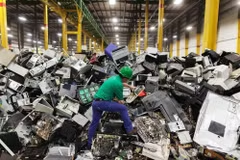
Cambodia invests 30 million USD in e-waste management

The initiative is being implemented with the United Nations Development Programme (UNDP), with 26 million USD in co-financing from the Cambodian Government and private-sector partners and a 4-million-USD grant from the Global Environment Facility (GEF).

Prime Minister of Cambodia Hun Manet (Photo: VNA)

Cambodia strives for inclusive, sustainable development

Cambodia’s development vision is based on inclusive prosperity, with no one left behind, particularly vulnerable groups, including women and girls, persons with disabilities, vulnerable families and rural communities.

European Commissioner for Trade and Economic ⁠Security Maros Sefcovic (Photo: Xinhua/VNA)

Philippines, EU reach initial agreement on FTA

Electronics are a key area of EU-Philippine trade, with the EU exporting aircraft, pork and pharmaceuticals, while importing semiconductors, microchips and industrial machinery manufactured in the Philippines.

ASEAN, Hong Kong revise investment pact to strengthen protection

ASEAN, Hong Kong revise investment pact to strengthen protection

The protocol provides for fair treatment of businesses, free movement of investment capital and profits, and compensation for losses caused by war, conflict or other circumstances. It is expected to strengthen legal protection, improve the investment environment and encourage greater investment flows.

Indonesia expands People’s School programme for poor children

Indonesia expands People’s School programme for poor children

Led by the Indonesian Ministry of Social Affairs, the programme was launched in July 2025 as a boarding-school model for children from disadvantaged families, with priority given to those who have dropped out or are at risk of dropping out. Students receive State-supported education, accommodation and daily living services.

AI exhibition areas at CAEXPO 2026 attract the attention of both businesses and visitors. (Photo: VNA)

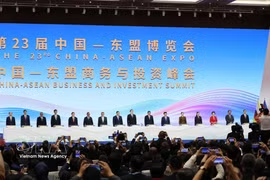
CAEXPO highlights China–ASEAN AI cooperation

Wang Jicai, Secretary General of the CAEXPO Secretariat, said exhibition space for AI increased 60% from the previous edition, while the number of participating companies rose 48% year on year to 296.

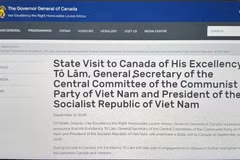
As screenshot of the press release published on the website of the Office of the Governor General of Canada.

Canada attaches importance to relations with Vietnam: statement

“Vietnam is an important partner for Canada in the Indo-Pacific, as well as a valued partner within APEC and the Organisation internationale de la Francophonie (OIF)," according to a statement issued by the Office of the Governor General of Canada.

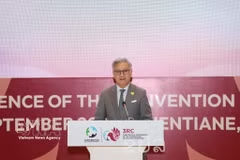
Lao Deputy Prime Minister, Minister of Foreign Affairs and Chairman of the National Regulatory Authority for Unexploded Ordnance (UXO)/Mine Action Sector Thongsavanh Phomvihane delivers his closing remark at the conference. (Photo: VNA)

Vientiane Action Plan on cluster munitions adopted

The Vientiane Action Plan 2027–2031 serves as a crucial strategic roadmap for expanding the convention’s membership and comprehensively implementing the CCM from now until the next five-year review cycle.