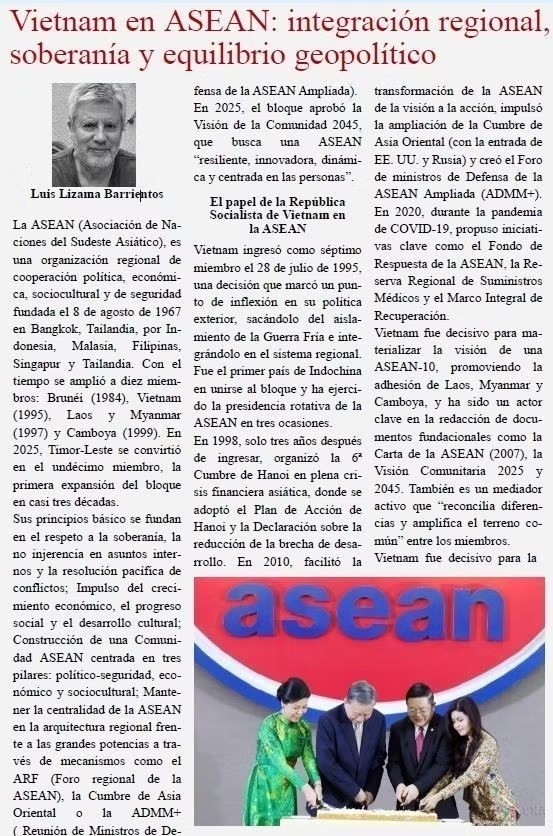
Buenos Aires (VNA) - Vietnam is an active and proactive member with an increasingly important role in the integration and building process of the ASEAN Community, as well as in maintaining the region's geostrategic balance, according to Chilean newspaper SurAndino.
SurAndino has published a piece by Luis Lizama Barrientos, a specialist at the Chilean Centre for Studies on the Democratisation of Knowledge (CEDECON), detailing Vietnam's contributions over 30 years after joining ASEAN.
According to the author, Vietnam's accession to ASEAN on July 28, 1995, as its seventh member to join the bloc, marked a major turning point in its foreign policy and contributed to the country's regional integration.
Over three decades of ASEAN membership, Vietnam has held the bloc's chairmanship three times and made significant contributions to key stages of its development.
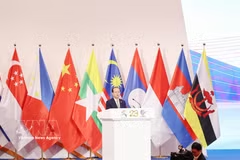
Just three years after joining, Vietnam hosted the 6th ASEAN Summit in Hanoi in 1998, against the backdrop of the severe impacts of the Asian financial crisis. The summit adopted the Hanoi Plan of Action and the Declaration on Narrowing the Development Gap, helping to strengthen ASEAN's cooperation and resilience.
The author particularly highlights Vietnam's role in propelling ASEAN from vision to action. During its 2010 chairmanship, Vietnam helped promote the expansion of the East Asia Summit to include the US and Russia, and the establishment of the ASEAN Defence Ministers' Meeting Plus (ADMM+), thereby reinforcing ASEAN's role in the regional security architecture.
In 2020, amid the COVID-19 pandemic, Vietnam once again demonstrated its coordinating role by proposing crucial initiatives, including the ASEAN COVID-19 Response Fund, the Regional Reserve of Medical Supplies, and the ASEAN Comprehensive Recovery Framework. According to the author, these initiatives showcased Vietnam's ability to propose collective responses to regional-scale challenges.
The article also underscores Vietnam's contribution to consolidating a ten-member ASEAN. Vietnam actively pushed for the admission of Laos, Myanmar, and Cambodia into the organisation, helping to realise the goal of an ASEAN that encompasses the entire Southeast Asian region, both mainland and maritime.
Furthermore, Vietnam participated in drafting major documents that have shaped ASEAN's future, including the 2007 ASEAN Charter, the ASEAN Community Vision 2025, and the ASEAN Community Vision 2045.
According to Luis Lizama Barrientos, one of Vietnam's standout contributions is its ability to foster consensus within ASEAN. The author describes Vietnam as a member playing a connective role, helping to "reconcile differences and expand points of consensus" among member states. This is an especially vital factor for an organisation made up of countries with diverse levels of development, interests, and strategic positions.
Vietnam is also a major driver of ASEAN's economic integration. The article notes that trade between Vietnam and ASEAN has multiplied nearly 25-fold, surging from 3.26 billion USD in 1995 to 83.6 billion USD in 2024. Currently, ASEAN is Vietnam's fourth-largest export market and its third-largest source of imports. Through ASEAN and regional trade pacts, notably the Regional Comprehensive Economic Partnership (RCEP), Vietnam has significantly expanded its economic and trade networks with partners inside and outside Southeast Asia.
In the realm of regional security, Vietnam, alongside the Philippines, is among the countries that regularly bring the East Sea issue to the ASEAN agenda. Vietnam supports the implementation of the Declaration on the Conduct of Parties in the East Sea (DOC), pushes for negotiations on a Code of Conduct (COC), and underscores the 1982 United Nations Convention on the Law of the Sea (UNCLOS) as the legal basis for peacefully resolving disputes.
The author also highlights Vietnam's role in ASEAN's external relations. Vietnam has served as the coordinator for ASEAN's ties with major partners such as China, the European Union (EU), India, Japan, and the Republic of Korea, and is currently coordinating ASEAN-UK and ASEAN-New Zealand relations for the 2024-2027 term. In 2024, Vietnam also spearheaded the creation of the ASEAN Future Forum (AFF), providing a new platform for countries to exchange views on strategic issues and the region's future.
According to the article, for Vietnam, ASEAN constitutes a central pillar of its multilateral foreign policy and a vital bridge to international integration. Conversely, for ASEAN, Vietnam is an economically dynamic and diplomatically active member playing a crucial role in promoting the bloc's unity, cohesion, and centrality.
Looking toward the ASEAN Community Vision 2045, the author believes Vietnam can continue to play a prominent role in areas such as regional connectivity, supply chain strengthening, digital transformation, and green economy development, thereby contributing to the goal of building a "resilient, innovative, dynamic, and people-centered" ASEAN./.
VNA