Indonesia advances transport corridor linking three countries

The Kalimantan Corridor under the ASEAN Customs Transit System (ACTS) aims to shorten transit times and reduce transportation costs while limiting repetitive procedures at border crossings of Indonesia, Malaysia, and Brunei.

Jakarta (VNA) – Indonesia is preparing infrastructure and finalising the legal framework and procedures for the Kalimantan Corridor under the ASEAN Customs Transit System (ACTS), thereby promoting freight transport connectivity among Indonesia, Malaysia, and Brunei on the island of Borneo.

The corridor is expected to begin operations in 2027.

According to the official portal of the Association of Southeast Asian Nations (ASEAN), ACTS aims to shorten transit times and reduce transportation costs while limiting repetitive procedures at border crossings. The mechanism also allows for the application of a common guarantee system for taxes and fees that may arise during transit.

A notable feature of ACTS is that licensed transport vehicles can continue their journey across borders without having to transfer goods to vehicles of the host country at each border crossing. Participating vehicles must meet technical requirements and be granted an ASEAN goods vehicle cross-border permit. Each member country can issue a maximum of 500 permits to eligible vehicles.

For Indonesia, preparations for the Kalimantan Corridor are of significant importance because the territories of Indonesia, Malaysia, and Brunei on the island of Borneo form a contiguous geographical area. Kalimantan occupies the majority of the island's territory.

The formation of the transport corridor under ACTS is expected to help reduce procedural bottlenecks and strengthen road transport connectivity and the flow of goods among the three countries.

ASEAN has welcomed pilot rail transport within the framework of ACTS and encouraged Brunei and Indonesia to officially participate in the operation of the system along the Borneo Corridor. It is also considering the possibility of connecting ACTS with China in the future, thereby expanding the trade network and economic benefits generated by regional transport routes./.

VNA

See more

China has remained Thailand’s largest solar panel supplier over the past five years.

Thailand’s solar panel imports surge

China has remained Thailand’s largest solar panel supplier over the past five years. Its exports to Thailand reached a record 649.1 million USD in 2023, out of total imports of 654.2 million USD. The figure subsequently fell to 422.3 million USD in 2024 and 364.1 million USD in 2025.

Timor-Leste encourages women to develop businesses using local resources

Timor-Leste encourages women to develop businesses using local resources

According to a nationwide survey conducted by the Timor-Leste Women’s Business Association (AEMTL) from October 2024 to March 2025, nearly 63% of the women-owned businesses surveyed were operating informally or had not been registered with SERVE, Timor-Leste’s business registration and licensing authority.

A tourist in Bangkok, Thailand (Photo: Xinhua/VNA)

World Bank recommends Thailand develop satellite cities to drive growth

According to the World Bank's “Thailand Cities of the Future: Urban Foundations for a High-Income Economy” report, Thailand’s urban system remains heavily concentrated in Bangkok, which generates close to half of national output and is nearly 27 times larger than Chiang Mai, the country’s second-largest city.

Singapore's core inflation rises to 2.2% in August

Singapore's core inflation rises to 2.2% in August

Data released by Singapore's Department of Statistics (SingStat) on September 23 showed that core inflation, which excludes private transport and accommodation costs, increased from 2% in July to 2.2% in August.

The ASEAN Regional Dialogue for Circular Economy in Makati city on September 22 is expected to help promote a coordinated approach to the circular economy amid growing challenges posed by plastic pollution and waste in many countries across the region. (Illustrative photo: VNA)

Philippines develops national plastics roadmap

A Philippine official said government agencies, local governments and development partners are already implementing programmes to address plastic waste, but noted that the efforts need to be mapped to identify gaps.

Cambodia invests 30 million USD in e-waste management

Cambodia invests 30 million USD in e-waste management

The initiative is being implemented with the United Nations Development Programme (UNDP), with 26 million USD in co-financing from the Cambodian Government and private-sector partners and a 4-million-USD grant from the Global Environment Facility (GEF).

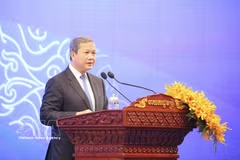
Prime Minister of Cambodia Hun Manet (Photo: VNA)

Cambodia strives for inclusive, sustainable development

Cambodia’s development vision is based on inclusive prosperity, with no one left behind, particularly vulnerable groups, including women and girls, persons with disabilities, vulnerable families and rural communities.

Timor-Leste prepares legal instruments for ASEAN integration

Timor-Leste prepares legal instruments for ASEAN integration

Vice Minister for ASEAN Affairs Milena Rangel said the Ministry of Foreign Affairs and Cooperation of Timor-Leste is coordinating with other ministries and agencies to develop and finalise necessary legal instruments for integration, with nearly 50 targeted for completion in 2026 - 2027.

European Commissioner for Trade and Economic ⁠Security Maros Sefcovic (Photo: Xinhua/VNA)

Philippines, EU reach initial agreement on FTA

Electronics are a key area of EU-Philippine trade, with the EU exporting aircraft, pork and pharmaceuticals, while importing semiconductors, microchips and industrial machinery manufactured in the Philippines.

ASEAN, Hong Kong revise investment pact to strengthen protection

ASEAN, Hong Kong revise investment pact to strengthen protection

The protocol provides for fair treatment of businesses, free movement of investment capital and profits, and compensation for losses caused by war, conflict or other circumstances. It is expected to strengthen legal protection, improve the investment environment and encourage greater investment flows.

Indonesia expands People’s School programme for poor children

Indonesia expands People’s School programme for poor children

Led by the Indonesian Ministry of Social Affairs, the programme was launched in July 2025 as a boarding-school model for children from disadvantaged families, with priority given to those who have dropped out or are at risk of dropping out. Students receive State-supported education, accommodation and daily living services.

AI exhibition areas at CAEXPO 2026 attract the attention of both businesses and visitors. (Photo: VNA)

CAEXPO highlights China–ASEAN AI cooperation

Wang Jicai, Secretary General of the CAEXPO Secretariat, said exhibition space for AI increased 60% from the previous edition, while the number of participating companies rose 48% year on year to 296.