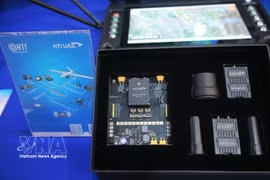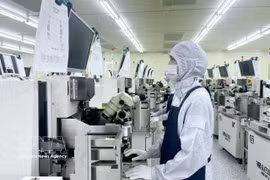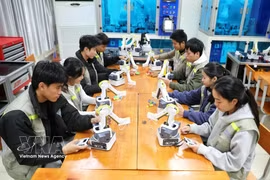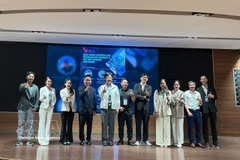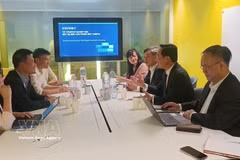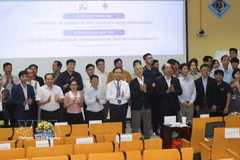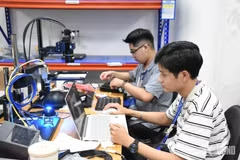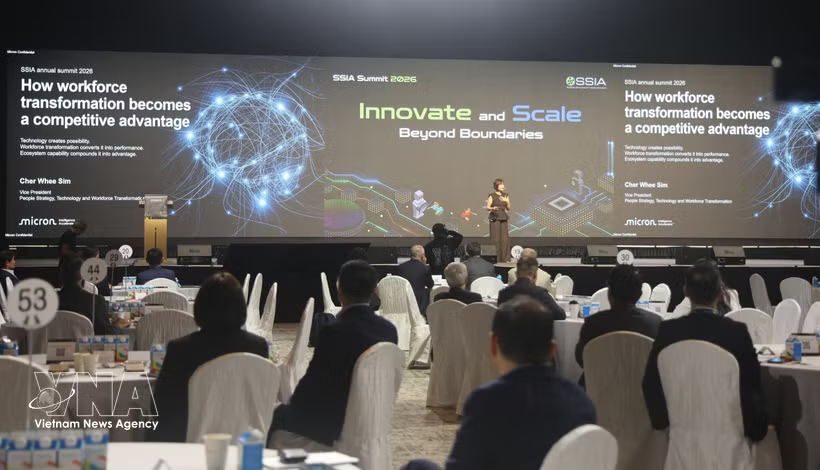
Singapore (VNA) – Vietnam and Singapore boast huge potential to expand cooperation in engineer training, university – industry links and the development of a skilled workforce for deeper participation in the global semiconductor value chain, participants heard at the first Regional Student Talent Exchange Programme hosted by the Singapore Semiconductor Industry Association (SSIA) from September 23 to 25.
Bringing together more than 50 students and lecturers from Singapore, Vietnam, India, Indonesia and Malaysia, along with representatives of semiconductor businesses worldwide, the event is an expansion activity of the SSIA Summit 2026 in Singapore.
According to SSIA, the global semiconductor industry is expected to need more than 1 million skilled workers by 2030, or over 100,000 annually. In Singapore, semiconductor engineers, instrumentation engineers and process engineers are among occupations facing manpower shortages, including positions in integrated circuit design and microchip engineering.
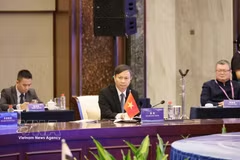
Talking to the Vietnam News Agency, Cao Xuan Thang, head of the Vietnam Trade Office in Singapore, said amid the global shortage of highly skilled semiconductor workers, cooperation with Singapore in training and employing engineers holds strategic and long-term significance to Vietnam.
He noted that Singapore has developed a closely connected ecosystem linking training, research and businesses. Cooperation will help Vietnam access modern training programmes, improve the professional expertise, skills and thinking of engineers, and strengthen links among the State, universities and businesses.
Thang highlighted Singapore’s State – business – university model, under which training closely follows industry needs, with businesses participating in curriculum development, receiving interns and providing on-the-job training.
The Vietnam Trade Office in Singapore has coordinated with SSIA to connect Vietnamese training institutions with the association’s member companies. The participation of Vietnamese lecturers and students in the exchange programme is among the initial outcomes, he said.
SSIA Executive Director Ang Wee Seng said Vietnam has emerged as an important semiconductor hub in ASEAN, with strengths in chip manufacturing and design and a large workforce. Singapore, meanwhile, has built its semiconductor industry over nearly six decades, developing a diverse ecosystem and skilled workforce.
The two countries can complement each other and work closely together to develop human resources, Ang said, stressing that the workforce must be able to adapt and reskill as technology evolves, particularly as advanced manufacturing moves towards AI-supported smart manufacturing.
He expressed confidence that Vietnamese universities and training institutions can adapt to this trend and prepare students for the evolving needs of the industry.
Dr Nguyen Vu Anh Quang from the Vietnam-Korea University of Information and Communication Technology (VKU) under the University of Da Nang pointed to gaps between semiconductor training in Vietnam and the requirements of businesses, including the high cost of industry-standard design software, academically oriented curricula, and limited opportunities for lecturers to participate in businesses’ projects.
He proposed “Train the Trainer” programmes, resource sharing, virtual laboratories and licensed software, as well as a “sandwich” training model allowing students to gain foundational knowledge in Vietnam before undertaking graduation projects, internships or research in Singapore.
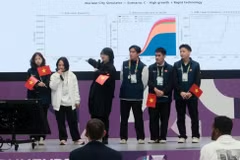
Nguyen Tien Anh, a student at Ho Chi Minh City University of Technology under Vietnam National University-Ho Chi Minh City, said exchanges with engineers from semiconductor enterprises such as AMD and Infineon showed that young Vietnamese engineers need strong specialised foundations as well as English, communication and teamwork skills to join the global semiconductor value chain.
According to SSIA, the exchange programme connects students with industry at an early stage and gives Vietnamese participants specialising in chip design and integrated circuits opportunities to engage directly with companies, engineers and industry leaders.
SSIA said no country can handle the entire chip-making process alone, nor can it develop the workforce independently. The programme therefore opens avenues for Vietnam–Singapore cooperation in semiconductor training, research and workforce development./.
See more
VNEAT strengthens Vietnam-Taiwan technology, expert connections
Nguyen Van Nam, representative of the Vietnam Economic and Cultural Office in Taipei (VECO), and Prof. Yuei-An Liou, Honorary Chairman of VNEAT, spoke highly of the association's role as a bridge, while affirming VECO's active support for activities aimed at connecting intellectual resources and developing the Vietnamese expert community in Taiwan, China.
Digital services bring transformation closer to people
Nearly two years after the Politburo issued Resolution No. 57-NQ/TW on December 22, 2024, on breakthroughs in science and technology, innovation and national digital transformation, localities have been focusing on solutions that address specific needs and deliver tangible benefits.
Hanoi to host TECHFEST Vietnam 2026 in November
TECHFEST 2026 will adopt an open-air format to encourage public participation and direct interaction with startups, businesses and investors. Key activities will include an opening ceremony, startup product exhibitions, technology demonstrations and the final round of the national innovative startup talent competition.
Nuclear power development key to green growth, national energy security
Politburo Resolution No. 70-NQ/TW, dated August 20, 2025, on ensuring national energy security through 2030 with a vision to 2045, identifies firmly ensuring national energy security as a fundamental and important prerequisite for national development. It calls for adequate, stable and high-quality energy supplies for socio-economic development, national defence and security, improved living standards and environmental protection.
Vietnam launches national generative AI competition for university students
“AI Arena: Viet Nam 2026" contest aims to improve students’ ability to use generative AI, design prompts and develop products. Using Google Gemini and Google AI Studio, contestants will analyse problems, develop ideas and create proof-of-concept products within a limited time.
Strategic “Make in Vietnam” products: Businesses at the core
The list of six priority strategic technology products set out in the Prime Minister's Decision No. 2815/QD-TTg demonstrates an important shift in policy-making thinking, with businesses playing the central role in the innovation ecosystem and serving as the core element in the country’s goal of double-digit growth in the new era.
Expert suggests pathways for Vietnam to make breakthroughs in plant biotechnology
One approach Vietnam should prioritise is the application of Big Data, AI and bioinformatics in genetic resource research, thereby shortening the time needed to identify genes of economic value.
Vietnam seeks to build safe AI future with China, ASEAN
Deputy Minister of Science and Technology Hoang Minh said a safe AI future must be built on each country's governance capacity and trust among partners. Vietnam, therefore, wishes to work with China and ASEAN member states to contribute to such a future for the benefit of the people and the prosperity of the region.
Vietnamese students compete in Global HackAtom 2026 finals in Russia
Participation in the international finals of Global HackAtom 2026 in Russia from September 11–17 offers Vietnamese students an opportunity to compete directly with peers from leading Russian universities with long-standing traditions in nuclear science, including Tomsk Polytechnic University and the National Research Nuclear University MEPhI.
AI contest to be organised in Vietnam
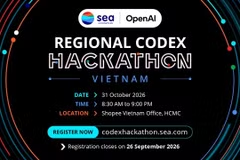
Jointly organised by Sea Limited and OpenAI, the contest is expected to provide participants with hands-on experience in artificial intelligence, while also offering a platform to exchange ideas and connect with members of the country’s fast-growing AI and developer community.
Vietnam, France step up cooperation in science, innovation
A delegation from the Communist Party of Vietnam (CPV) Central Committee’s Commission for Policy and Strategy paid a working visit to France from September 13-16, focusing on exchanging experience in science and technology, innovation, startup ecosystems and human resources development.
Digital transformation promotes sustainable development in Mekong Delta
Experts said the Mekong Delta region does not lack data, but valuable information collected by government agencies, universities, businesses, projects and communities is scattered across different locations and formats, making it difficult to access, compare and use effectively.
Population data, DNA technology aid efforts to identify fallen soldiers
Under the direction of the Government and the Ministry of Public Security, the ministry’s Police Department for Administrative Management of Social Order (C06) has led efforts to review and standardise information on martyrs and their relatives, collect DNA samples from relatives, and build and manage a DNA database. It also coordinates with forensic agencies to compare DNA data and identify the remains of fallen soldiers.
Integrated planning needed for urban e-vehicle charging networks: expert
The rapid growth of EVs is creating new infrastructure challenges for cities, requiring charging networks to be planned according to travel demand, power supply capacity and available urban space.
Controlled sandboxes needed to speed up application of new technologies
Although the Political Bureau’s Resolution No. 57-NQ/TW allows pilot schemes for new practical issues and accepts risks and delays in science, technology and innovation, concerns over risks and responsibility persist.
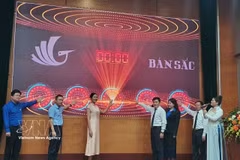
‘Ban Sac’ 2026 brings Vietnamese cultural values to life in digital space
“Ban Sac” is an online platform combining culture, digital communications and artificial intelligence (AI), running from September 15 to October 31 on its official website, www.bansac.vn.
VNA accelerates digital transformation, builds modern information ecosystem
Digital technology may change how journalism is practiced, but the core mission of journalists at a news agency remains unchanged: serving the nation and the people while ensuring a flow of official and reliable information that helps build public trust in the Party’s leadership.
Vietnam seeks to boost education and technology cooperation with France
Education and training, science and technology, and high-quality human resources are key areas of cooperation in Vietnam-France relations, said Politburo Member, Secretary of the Communist Party of Vietnam Central Committee, and Chairman of its Commission for Organisation Nguyen Duy Ngoc while visiting the Institut Polytechnique de Paris on September 11.
Vietnam, France deepen cooperation in science, technology, workforce training
The University of Science and Technology of Hanoi (USTH), under the Vietnam Academy of Science and Technology (VAST), and the French Alternative Energies and Atomic Energy Commission (CEA) exchanged two cooperation agreements in Paris on September 11, in the presence of General Secretary of the Communist Party of Vietnam Central Committee and President To Lam.
Vietnam eyes UAV industry as key driver of low-altitude economy
For Vietnam, the opportunity presented by unmanned aerial vehicles (UAVs) lies not only in expanding their applications but, more importantly, in gradually building industrial capacity, mastering technologies and engaging more deeply in global value chains.