Digital services bring transformation closer to people

Nearly two years after the Politburo issued Resolution No. 57-NQ/TW on December 22, 2024, on breakthroughs in science and technology, innovation and national digital transformation, localities have been focusing on solutions that address specific needs and deliver tangible benefits.

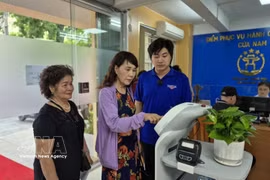
Members of the Phuong Quy 2 hamlet community digital technology team in Ngok Bay commune guides residents in submitting administrative applications online. (Photo: VNA)

Hanoi (VNA) — From QR-code payments at traditional markets to smart kiosks for administrative procedures, digital technology is increasingly becoming part of everyday life as localities turn digital transformation policies into practical services for residents.

Nearly two years after the Politburo issued Resolution No. 57-NQ/TW on December 22, 2024, on breakthroughs in science and technology, innovation and national digital transformation, localities have been focusing on solutions that address specific needs and deliver tangible benefits.

In Ca Mau province, the provincial Women’s Union, in coordination with relevant agencies, banks and technology businesses, has launched a “4.0 Market – Cashless Payments” model at Hoa Binh market and a “Digital Market” model at Cai Day Market in Vinh Loi commune.

More than 3,365 businesses in the province are using “.vn” domain names, while nearly 547,000 accounts have registered for cashless payment services and 114 e-commerce websites are operating.

The province has also supported 56 OCOP producers in putting 110 products on e-commerce platforms. Community digital technology teams in all hamlets, or residential areas, have helped more than 358,000 households access digital services.

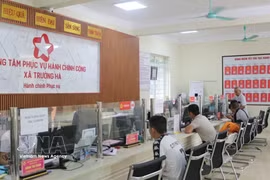
In Lang Son province, 10 digital public service stations equipped with smart kiosks have been installed at administrative service centres since late July.

After more than a month of pilot operation, the stations had assisted with 5,617 applications, including 4,021 online public service applications and 1,596 applications for digitally certified copies.

The results highlight the need for direct assistance as residents shift from traditional transactions to electronic services, particularly in mountainous and border areas.

In Bac Ninh province, a “people’s assistant” application is being piloted in five locations, supporting 60 administrative procedures.

As of September 8, the application had assisted with 2,234 applications. In Bac Giang ward, document recognition and electronic form-filling functions helped reduce the time needed to complete an application up 10 minutes to two-three minutes.

An analysis of 1,510 applications in Hiep Hoa commune and Bac Giang ward found that 10 procedures accounted for 1,363 applications, or 90.3% of the total, mainly involving civil status, certification, business registration and interconnected services.

In Xuan Huong-Da Lat ward, Lam Dong province, 14,624 administrative applications were received in the first six months of 2026, including 14,230 submitted online. All incoming applications and completed results were digitised, while all eligible procedures were provided as fully online public services.

The ward has also launched the “Digital Citizen Xuan Huong-Da Lat” application, allowing residents to access information, submit applications, track administrative procedures and send feedback to local authorities.

After more than two months, the application had received 148 public feedback submissions, with 40 already resolved.

The experience of these localities shows that digital transformation is increasingly being measured through practical use and tangible benefits.

By linking technology and innovation with specific administrative tasks, public services and everyday needs, localities are gradually translating Resolution No. 57-NQ/TW into concrete improvements in the way people access and use public services./.

VNA

See more

People try out virtual reality glasses at Techfest Vietnam 2025 in Hanoi. (Photo: VNA)

Hanoi to host TECHFEST Vietnam 2026 in November

TECHFEST 2026 will adopt an open-air format to encourage public participation and direct interaction with startups, businesses and investors. Key activities will include an opening ceremony, startup product exhibitions, technology demonstrations and the final round of the national innovative startup talent competition.

The semiconductor industry is directly linked to the competitiveness, technological autonomy and security of each country, requiring domestic capabilities to develop in tandem with international cooperation. (Illustrative photo: VNA)

Vietnam, Japan promote cooperation in semiconductor sector

VJSS-2026 provides a platform for scientists, experts and businesses to discuss the latest advances across a wide range of areas, from chip design, semiconductor components and materials to manufacturing, packaging and testing technologies, artificial intelligence and quantum computing.

Le Xuan Dinh, Deputy Minister of Science and Technology, addresses the event (Photo: VNA)

Nuclear power development key to green growth, national energy security

Politburo Resolution No. 70-NQ/TW, dated August 20, 2025, on ensuring national energy security through 2030 with a vision to 2045, identifies firmly ensuring national energy security as a fundamental and important prerequisite for national development. It calls for adequate, stable and high-quality energy supplies for socio-economic development, national defence and security, improved living standards and environmental protection.

Strategic “Make in Vietnam” products: Businesses at the core

Strategic “Make in Vietnam” products: Businesses at the core

The list of six priority strategic technology products set out in the Prime Minister's Decision No. 2815/QD-TTg demonstrates an important shift in policy-making thinking, with businesses playing the central role in the innovation ecosystem and serving as the core element in the country’s goal of double-digit growth in the new era.

Vietnamese Deputy Minister of Science and Technology Hoang Minh attends the 2026 China–ASEAN Ministerial Roundtable on Artificial Intelligence in Nanning, China, on September 17. (Photo: VNA)

Vietnam seeks to build safe AI future with China, ASEAN

Deputy Minister of Science and Technology Hoang Minh said a safe AI future must be built on each country's governance capacity and trust among partners. Vietnam, therefore, wishes to work with China and ASEAN member states to contribute to such a future for the benefit of the people and the prosperity of the region.

The Vietnamese team at the finals of Global HackAtom 2026 in Russia from September 11–17. (Photo: published by VNA)

Vietnamese students compete in Global HackAtom 2026 finals in Russia

Participation in the international finals of Global HackAtom 2026 in Russia from September 11–17 offers Vietnamese students an opportunity to compete directly with peers from leading Russian universities with long-standing traditions in nuclear science, including Tomsk Polytechnic University and the National Research Nuclear University MEPhI.

(Photo: Organising board)

AI contest to be organised in Vietnam

Jointly organised by Sea Limited and OpenAI, the contest is expected to provide participants with hands-on experience in artificial intelligence, while also offering a platform to exchange ideas and connect with members of the country’s fast-growing AI and developer community.

The meeting between the delegation from the CPV Central Committee’s Commission for Policy and Strategy and Station F (Photo: VNA)

Vietnam, France step up cooperation in science, innovation

A delegation from the Communist Party of Vietnam (CPV) Central Committee’s Commission for Policy and Strategy paid a working visit to France from September 13-16, focusing on exchanging experience in science and technology, innovation, startup ecosystems and human resources development.

Delegates at the workshop pose for a group photo (Photo: VNA)

Digital transformation promotes sustainable development in Mekong Delta

Experts said the Mekong Delta region does not lack data, but valuable information collected by government agencies, universities, businesses, projects and communities is scattered across different locations and formats, making it difficult to access, compare and use effectively.

Soldiers from the Dien Bien provincial Military Command offer incense at the graves of fallen soldiers at A1 Martyrs’ Cemetery before exhuming remains to collect samples (Photo: VNA)

Population data, DNA technology aid efforts to identify fallen soldiers

Under the direction of the Government and the Ministry of Public Security, the ministry’s Police Department for Administrative Management of Social Order (C06) has led efforts to review and standardise information on martyrs and their relatives, collect DNA samples from relatives, and build and manage a DNA database. It also coordinates with forensic agencies to compare DNA data and identify the remains of fallen soldiers.

Students practice microcontroller programming at the Viet - Han College of Technology in Bac Ninh province (Photo: VNA)

Vietnam steps up semiconductor talent training to meet market demand

Vietnam needs to step up semiconductor workforce training to meet growing market demand and enhance its capacity to participate in the global technology value chain, experts said, highlighting the importance of closely linking training with businesses, production and technological research.

Vietnam seeks to boost education and technology cooperation with France

Vietnam seeks to boost education and technology cooperation with France

Education and training, science and technology, and high-quality human resources are key areas of cooperation in Vietnam-France relations, said Politburo Member, Secretary of the Communist Party of Vietnam Central Committee, and Chairman of its Commission for Organisation Nguyen Duy Ngoc while visiting the Institut Polytechnique de Paris on September 11.

General Secretary of the Communist Party of Vietnam Central Committee and President To Lam witnesses the exchange of cooperation agreements between the two countries. (Photo: VNA)

Vietnam, France deepen cooperation in science, technology, workforce training

The University of Science and Technology of Hanoi (USTH), under the Vietnam Academy of Science and Technology (VAST), and the French Alternative Energies and Atomic Energy Commission (CEA) exchanged two cooperation agreements in Paris on September 11, in the presence of General Secretary of the Communist Party of Vietnam Central Committee and President To Lam.

A display area for unmanned aerial vehicles (UAVs) at a workshop in Da Nang city on June 12, 2026. (Photo: VNA)

Vietnam eyes UAV industry as key driver of low-altitude economy

For Vietnam, the opportunity presented by unmanned aerial vehicles (UAVs) lies not only in expanding their applications but, more importantly, in gradually building industrial capacity, mastering technologies and engaging more deeply in global value chains.