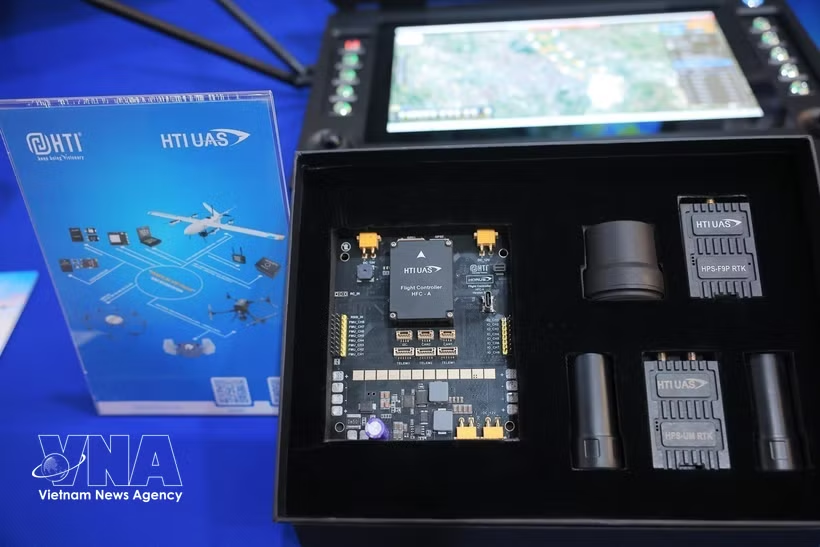
Hanoi (VNA) – Recognising the important role of specialised chips, Vietnam has taken concrete steps to master this technology to integrate more deeply into the global supply chain.
Specialised chips directly linked to technological self-reliance
Specialised semiconductor chips are designed to solve specific problems rather than serve general-purpose applications.
According to Nguyen Anh Tuan, Director of the National Centre for Semiconductor Chip Pilot Production Support under the Ministry of Science and Technology, developing specialised semiconductor chips is a suitable pathway for leveraging Vietnam’s strengths and gradually moving deeper into the global semiconductor value chain.
Choosing specialised chips does not mean narrowing Vietnam’s ambitions. Rather, it allows the country to focus resources on areas where it has real demand, a market, an emerging chip design workforce and a sufficiently large electronics industry to create end products.
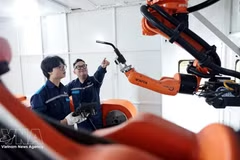
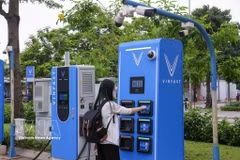
Vietnam needs to start with practical applications such as AI cameras, IoT devices, power grids, charging stations, robots, UAVs, telecommunications, healthcare and digital identification. From there, it can determine appropriate chip architectures, manufacturing technologies, packaging solutions, testing standards and commercialisation roadmaps.
If developed successfully, specialised chips can create value at multiple levels, Tuan said.
More importantly, specialised chips are directly linked to technological self-reliance. Self-reliance does not mean doing everything domestically, but mastering critical stages such as product requirements, system architecture, design, verification, testing data and the ability to choose partners in the supply chain.
For critical systems, Vietnam needs the capacity to control designs, assess reliability, verify origins and switch suppliers when supply chains are disrupted. This provides a foundation for protecting data, maintaining essential services and safeguarding national security in the new situation.
State and businesses working together
Despite their significant potential, the gap between a chip design and a chip that can operate reliably in an end product remains substantial. Each pilot production run is costly and carries technical risks, while small orders often struggle to access packaging and testing services.
Once a chip sample is produced, businesses still need to complete software, circuit boards, reliability assessment, certification and product integration. Without a first customer, businesses find it difficult to invest, while customers are reluctant to place orders without a tested chip.
Decision No. 1018/QD-TTg issued in 2024 sets out tasks to promote the development and use of specialised chips in areas including high-tech agriculture, automation, consumer electronics and digital transformation.
The 2026 action plan of the National Steering Committee for Semiconductor Industry Development also prioritises the development and use of specialised chips and calls for at least three strategic semiconductor chip lines to be selected for a product development programme.
The Ministry of Science and Technology is finalising a dossier for submission to the Prime Minister for the issuance of a list of specialised chips in sectors and fields prioritised for State procurement. The draft comprises 20 chip groups based on demand from ministries, sectors, businesses, research institutes, universities and experts. The list will provide a basis for orienting research, generating market signals and focusing resources on products with development potential in Vietnam.
The ministry is also developing a comprehensive support programme covering research, design, pilot production, testing and evaluation of specialised chips. The mechanism will share risks at the initial stage, manage projects based on technical milestones, and encourage counterpart funding and business participation.
Public investment, digital transformation, infrastructure development and strategic technology programmes will provide markets for Vietnamese-made chips through procurement mechanisms. Alongside procurement, Vietnam will develop standards, testing laboratories, certification mechanisms and reliability assessment procedures.
The aim is to bring quality products into use rather than create a closed market or lower quality requirements. Major economic groups investing in key industries and nationally important infrastructure projects also represent a significant potential market for Vietnamese specialised chips.
Domestic technology companies have also been proactive in investing in chip manufacturing. Early in 2026, Viettel Group broke ground on Vietnam’s first high-tech semiconductor chip manufacturing plant, covering 27ha at Hoa Lac Hi-Tech Park. The plant is scheduled to complete construction and receive technology transfer by the end of 2027, with pilot production expected to begin in 2028.
Geleximco Group is also carrying out investment procedures for a chip manufacturing plant in Hung Yen, with groundbreaking scheduled for November 2026 and commercial production expected in early 2028.
Developing Vietnam’s semiconductor industry will undoubtedly face many challenges. But with the right direction, strong policies, close coordination between the State and businesses, and support from international partners, specialised semiconductor chips can become a high-value-added sector, strengthening technological self-reliance and helping Vietnam move further up the global semiconductor value chain./.
See more
VNEAT strengthens Vietnam-Taiwan technology, expert connections
Nguyen Van Nam, representative of the Vietnam Economic and Cultural Office in Taipei (VECO), and Prof. Yuei-An Liou, Honorary Chairman of VNEAT, spoke highly of the association's role as a bridge, while affirming VECO's active support for activities aimed at connecting intellectual resources and developing the Vietnamese expert community in Taiwan, China.
Digital services bring transformation closer to people
Nearly two years after the Politburo issued Resolution No. 57-NQ/TW on December 22, 2024, on breakthroughs in science and technology, innovation and national digital transformation, localities have been focusing on solutions that address specific needs and deliver tangible benefits.
Hanoi to host TECHFEST Vietnam 2026 in November
TECHFEST 2026 will adopt an open-air format to encourage public participation and direct interaction with startups, businesses and investors. Key activities will include an opening ceremony, startup product exhibitions, technology demonstrations and the final round of the national innovative startup talent competition.
Vietnam, Japan promote cooperation in semiconductor sector
VJSS-2026 provides a platform for scientists, experts and businesses to discuss the latest advances across a wide range of areas, from chip design, semiconductor components and materials to manufacturing, packaging and testing technologies, artificial intelligence and quantum computing.
Nuclear power development key to green growth, national energy security
Politburo Resolution No. 70-NQ/TW, dated August 20, 2025, on ensuring national energy security through 2030 with a vision to 2045, identifies firmly ensuring national energy security as a fundamental and important prerequisite for national development. It calls for adequate, stable and high-quality energy supplies for socio-economic development, national defence and security, improved living standards and environmental protection.
Vietnam launches national generative AI competition for university students
“AI Arena: Viet Nam 2026" contest aims to improve students’ ability to use generative AI, design prompts and develop products. Using Google Gemini and Google AI Studio, contestants will analyse problems, develop ideas and create proof-of-concept products within a limited time.
Strategic “Make in Vietnam” products: Businesses at the core
The list of six priority strategic technology products set out in the Prime Minister's Decision No. 2815/QD-TTg demonstrates an important shift in policy-making thinking, with businesses playing the central role in the innovation ecosystem and serving as the core element in the country’s goal of double-digit growth in the new era.
Expert suggests pathways for Vietnam to make breakthroughs in plant biotechnology
One approach Vietnam should prioritise is the application of Big Data, AI and bioinformatics in genetic resource research, thereby shortening the time needed to identify genes of economic value.
Vietnam seeks to build safe AI future with China, ASEAN
Deputy Minister of Science and Technology Hoang Minh said a safe AI future must be built on each country's governance capacity and trust among partners. Vietnam, therefore, wishes to work with China and ASEAN member states to contribute to such a future for the benefit of the people and the prosperity of the region.
Vietnamese students compete in Global HackAtom 2026 finals in Russia
Participation in the international finals of Global HackAtom 2026 in Russia from September 11–17 offers Vietnamese students an opportunity to compete directly with peers from leading Russian universities with long-standing traditions in nuclear science, including Tomsk Polytechnic University and the National Research Nuclear University MEPhI.
AI contest to be organised in Vietnam
Jointly organised by Sea Limited and OpenAI, the contest is expected to provide participants with hands-on experience in artificial intelligence, while also offering a platform to exchange ideas and connect with members of the country’s fast-growing AI and developer community.
Vietnam, France step up cooperation in science, innovation
A delegation from the Communist Party of Vietnam (CPV) Central Committee’s Commission for Policy and Strategy paid a working visit to France from September 13-16, focusing on exchanging experience in science and technology, innovation, startup ecosystems and human resources development.
Digital transformation promotes sustainable development in Mekong Delta
Experts said the Mekong Delta region does not lack data, but valuable information collected by government agencies, universities, businesses, projects and communities is scattered across different locations and formats, making it difficult to access, compare and use effectively.
Population data, DNA technology aid efforts to identify fallen soldiers
Under the direction of the Government and the Ministry of Public Security, the ministry’s Police Department for Administrative Management of Social Order (C06) has led efforts to review and standardise information on martyrs and their relatives, collect DNA samples from relatives, and build and manage a DNA database. It also coordinates with forensic agencies to compare DNA data and identify the remains of fallen soldiers.
Integrated planning needed for urban e-vehicle charging networks: expert
The rapid growth of EVs is creating new infrastructure challenges for cities, requiring charging networks to be planned according to travel demand, power supply capacity and available urban space.
Controlled sandboxes needed to speed up application of new technologies
Although the Political Bureau’s Resolution No. 57-NQ/TW allows pilot schemes for new practical issues and accepts risks and delays in science, technology and innovation, concerns over risks and responsibility persist.
‘Ban Sac’ 2026 brings Vietnamese cultural values to life in digital space
“Ban Sac” is an online platform combining culture, digital communications and artificial intelligence (AI), running from September 15 to October 31 on its official website, www.bansac.vn.
VNA accelerates digital transformation, builds modern information ecosystem
Digital technology may change how journalism is practiced, but the core mission of journalists at a news agency remains unchanged: serving the nation and the people while ensuring a flow of official and reliable information that helps build public trust in the Party’s leadership.
Vietnam steps up semiconductor talent training to meet market demand
Vietnam needs to step up semiconductor workforce training to meet growing market demand and enhance its capacity to participate in the global technology value chain, experts said, highlighting the importance of closely linking training with businesses, production and technological research.
Vietnam seeks to boost education and technology cooperation with France
Education and training, science and technology, and high-quality human resources are key areas of cooperation in Vietnam-France relations, said Politburo Member, Secretary of the Communist Party of Vietnam Central Committee, and Chairman of its Commission for Organisation Nguyen Duy Ngoc while visiting the Institut Polytechnique de Paris on September 11.