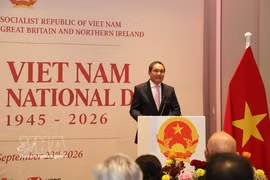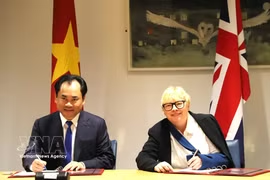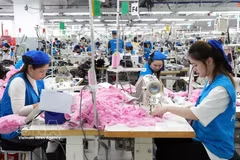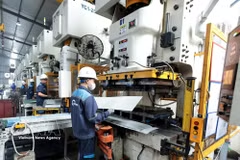
Ho Chi Minh City (VNA) – As Vietnam enters a new phase of growth-model transformation, with a focus on improving productivity, added value and competitiveness towards its goal of becoming a developed, high-income country by 2045, the UK business community sees room for bilateral cooperation to expand beyond trade and investment into technology, innovation, human resources and capital market development.
Matt Ryland, Executive Director of the British Chamber of Commerce Vietnam (BritCham Vietnam), said bilateral trade reached 10 billion GBP (13.2 billion USD) in the 12 months to the end of March 2026, up 8.8% year-on-year. The growth has been underpinned by the UK-Vietnam Free Trade Agreement (UKVFTA), the UK’s accession to the Comprehensive and Progressive Agreement for Trans-Pacific Partnership (CPTPP), and the elevation of bilateral ties to a Comprehensive Strategic Partnership in October 2025.
Ryland said the positive results demonstrate strong momentum in bilateral trade and investment, and create greater room for UK businesses to accompany Vietnam’s development.
BritCham serves not only as a business networking platform but also as a channel for policy dialogue through the British Corporate Advocacy Council (BCAC). The mechanism enables businesses to engage directly with regulators, identify issues in the business environment and propose solutions.
In 2026, BCAC has worked with the Vietnam International Financial Centre (VIFC) on the roadmap for developing the VIFC in Ho Chi Minh City and Da Nang. It also held discussions with the Ministry of Finance and participated in a number of high-level public-private dialogues.
According to BritCham Vietnam, these activities aim to promote a transparent and predictable business environment, enabling companies to make better use of opportunities arising from Vietnam’s new development phase.
Alongside growing trade and investment, the quality of contributions by the foreign-invested sector is becoming increasingly important as Vietnam shifts towards a productivity- and value-added-driven growth model.
Nguyen Linh Chi, Head of Corporation Communications at Unilever Vietnam, said that investment capital, production, exports and job creation remain important contributions by FDI enterprises to Vietnam’s economy. However, the sector can generate greater long-term value in the next stage of development.
FDI companies can bring technology and innovation closer to the domestic economy, invest in people and skills, strengthen domestic supply chains, and share standards, capabilities and management experience with Vietnamese businesses, she noted.
These factors are particularly significant as Vietnam seeks higher-quality growth, with technological capacity, human resources and deeper participation in global value chains becoming increasingly important. From the perspective of UK-Vietnam cooperation, these are also areas of growing interest to UK businesses alongside traditional trade and investment activities.
BritCham Vietnam is scheduled to organise the UK-Vietnam Business Forum 2026 on October 29 in Ho Chi Minh City. The forum will focus on Vietnam’s growth-model transformation and the role of UK-Vietnam business cooperation during this process.
The event will feature a business roundtable, UK-Vietnam business exhibition, thematic sessions and a Gala programme, alongside B2B meetings organised under the UK-Vietnam Trade Mission to help businesses explore markets and pursue concrete cooperation opportunities.
BritCham Vietnam said the combination of policy dialogue, exhibitions and business networking is expected to provide a platform for companies from both countries to address long-term economic issues and turn business connections into practical trade and investment opportunities./.
See more
Vietnam International Financial Centre in Da Nang ranked 71st globally
VIFC-DN’s debut at 71st marks a notable international milestone for a financial centre still under development, reflecting the foundations that the centre and Da Nang are gradually building to connect with international capital flows, financial institutions and markets.
Public investment disbursement reaches 55.5% of 2026 target
As of September 24, eight ministries and central agencies and 20 localities had disbursed funds at or above the national average.
Vietnam’s manufacturing sector maintains growth in September: S&P Global
The report showed that the Vietnam Manufacturing PMI fell to 51.9 in September from 53.3 in August, indicating a smaller improvement in the health of the sector at the end of the third quarter. Nonetheless, business conditions have strenghtened in each of the past 15 months.
Policy push opens new space for private sector growth
Tran Thanh Huong, Deputy Head of the Policy, Business Environment and International Cooperation Division at the Ministry of Finance (MoF)'s Department of Private Enterprise and Collective Economy Development, said business formation has jumped since the Politburo issued Resolution 68-NQ/TW on private sector development on May 1, 2025. About 297,500 firms were newly established or resumed operations in 2025, and nearly 206,400 did so in the first eight months of 2026.
Hanoi sees strong growth in nine-month FDI attraction
The Hanoi Department of Finance reported that foreign-invested enterprises in Hanoi generally maintained stable production and business operations in September, with many continuing to expand investment, increase capital and develop markets. Investment activity was concentrated mainly in real estate, wholesale and retail trade, information and communications, professional, scientific and technical activities, and business support services.
Ho Chi Minh City jumps 17 places in Global Financial Centres Index
In GFCI 39, Ho Chi Minh City rose 11 places, from 95th to 84th. Across the two 2026 editions, it has gained 28 places, from 95th to 67th.
Ho Chi Minh City seeks high-quality FDI inflows
In the competition to attract high-quality FDI, Ho Chi Minh City's advantages lay not only in its market size, infrastructure and incentives, but also in its ability to build a living and working environment attractive enough to draw and retain international experts.
Vietnam, Singapore step up capital market connectivity
A Vietnamese official suggested exchanges, businesses and intermediaries from the two countries strengthen connections and gradually establish an ecosystem supporting the issuance and listing of depositary receipt (DR) products.
Reference exchange rate continues downward on October 1
The State Bank of Vietnam set the daily reference exchange rate at 25,624 VND/USD on October1, down 3 VND from the previous day.
Events to link craft villages with agritourism to boost rural economy
The 22nd Vietnam Craft Village Fair, the 2026 Week for Promoting and Connecting Agricultural and Rural Tourism, and the 2026 Vietnam Handicraft Competition will be held at the Agricultural Exhibition Centre in Hanoi from October 8 to 12.
New development space opens for commodity derivatives market
The project aims to establish and develop the commodity derivatives market based on market principles and in a transparent, safe and efficient manner, in line with international practices. It seeks to strengthen links with the physical commodities market and better meet the needs of production, business, import – export activities and price risk hedging.
Asahi Mutual Life Insurance aims hire 1,000 staff in Vietnam
The recruitment drive will take place alongside the completion of Asahi Mutual Life Insurance’s acquisition of Vietnam’s MVI Life, announced in December 2025. The deal will be the Japanese insurer’s first overseas acquisition in its history and is subject to approval by Vietnamese regulators.
FTSE upgrade broadens capital options for property firms
Over the longer term, deeper connections with international capital could provide additional room for property companies with sound fundamentals and appropriate financial structures.
Vietnamese businesses seek stronger export capacity in digital era
Besides product quality, brand building, compliance with import-market regulations, sustainable development and digital technology are becoming increasingly important to businesses seeking to improve competitiveness and expand markets.
Vietnam, India move to deepen business, e-commerce connectivity
Economic and investment cooperation between Vietnam and India now spans a wide range of areas, with both sides targeting 25 billion USD in bilateral trade by 2030.
Vietnamese businesses advised to compete on quality in Australian market
Australia has strong purchasing power and diverse demand for Vietnamese products, from industrial goods, machinery and equipment, textiles and footwear to wood products, agricultural and aquatic products and processed food. Two-way trade reached 9.79 billion USD in the first seven months of 2026, up 20% year-on-year, while Vietnam’s exports to Australia surged 30%.
Dong Thap tightens fishing vessel management to combat IUU fishing
Since 2024, Dong Thap has recorded no fishing vessels violating foreign waters. The province has also strengthened vessel monitoring at ports and coordinated inspections of vessels that lose VMS signals at sea.
Vietnam sets roadmap to take businesses global
GoGlobal aims to support the private sector in establishing a stronger, more effective and sustainable presence in foreign markets. By 2030, the programme targets training at least 10,000 businesses, providing internationalisation consulting to 1,000, supporting 100 firms in overseas investment, and helping 100 businesses join regional or global value chains.
Sun PhuQuoc Airways launches Hanoi–Hong Kong route
This is SPA’s second service connecting Hong Kong with Vietnam, following the launch of a direct Hong Kong–Phu Quoc route on May 22 this year.
Tighter livestream controls to curb counterfeit goods online
Under the stricter process, checks now cover not only products but also sellers, businesses, promotional content and livestream participants. Content creator and affiliate marketer Vo Truong Duy said that sellers are required to provide products and relevant documents for verification before livestreams. Information on distributors, product declarations, labels and ingredients must be consistent.