Vietnamese-learning app presented to community in RoK

The initiative aims to support language learning among children growing up in more than 100,000 Vietnamese-Korean multicultural families, while helping preserve Vietnamese cultural identity and strengthen their ties with their homeland.

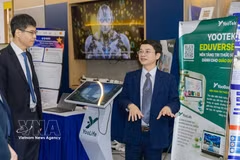
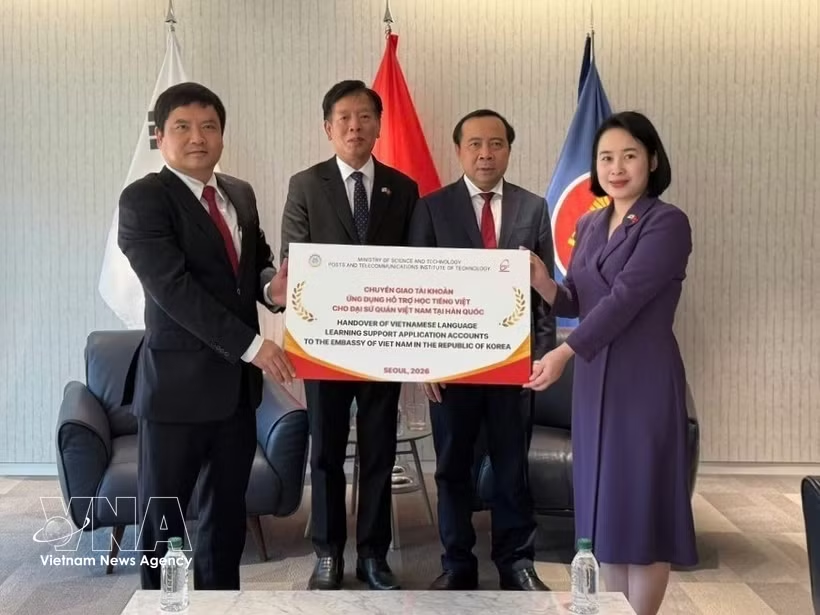
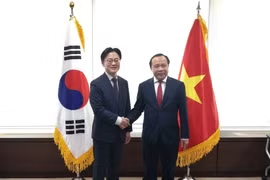
Minister of Science and Technology Vu Hai Quan (second, right) witnesses Director of the Posts and Telecommunications Institute of Technology Dang Hoai Bac presenting the Vietnamese-learning app to representatives of the Vietnamese Embassy in the Republic of Korea. (Photo: VNA)

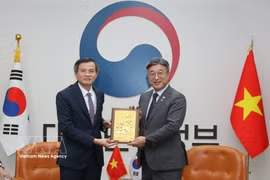
Seoul (VNA) - Minister of Science and Technology Vu Hai Quan on October 1 witnessed the handover of a Vietnamese-language learning app developed by the Posts and Telecommunications Institute of Technology (PTIT) to the Vietnamese Embassy in the Republic of Korea (RoK).

​The initiative aims to support language learning among children growing up in more than 100,000 Vietnamese-Korean multicultural families, while helping preserve Vietnamese cultural identity and strengthen their ties with their homeland.

​Using digital technology and interactive learning methods, the app enables children to learn Vietnamese in a flexible and engaging way.

​At the handover ceremony, Quan highlighted the role of science, technology and innovation in addressing practical social needs, including supporting Vietnamese communities abroad.

​He said the development and deployment of technology products for overseas Vietnamese communities not only created technological value but also helped connect people, preserve cultural identity and promote Vietnamese cultural values internationally.

​The Vietnamese Embassy in the RoK said it would coordinate with Vietnamese organisations, educational institutions and other relevant groups to introduce the app to families in need. It would also collect user feedback to improve the app's content and features, making it more practical and accessible to Vietnamese children in multicultural environments.

​The handover was part of a series of cooperation and diplomatic activities of the Ministry of Science and Technology led by Minister Vu Hai Quan in Seoul, covering digital technology, artificial intelligence (AI), semiconductors, nuclear safety and technology applications serving Vietnamese communities overseas.

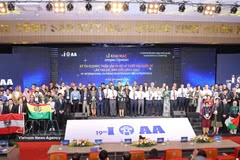
​Earlier on October 1, the Vietnam-RoK Digital Technology Forum 2026 was held at the Vietnamese Embassy, drawing more than 100 delegates and representatives of technology companies from both countries.

​Addressing the forum, Quan said science, technology and digital transformation are becoming an important pillar of the Vietnam-RoK Comprehensive Strategic Partnership.

​He called on the two sides to promote a spirit of “co-creation,” moving from conventional outsourcing towards joint research, product design, development and proof-of-concept (PoC) projects.

​The two sides should also connect digital infrastructure, AI and semiconductor technologies with manufacturing, linking research with high-quality human resource training and expanding into international markets, Quan noted.

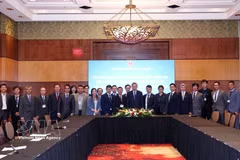
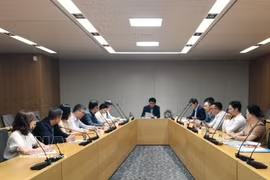
​Also on October 1, Minister Vu Hai Quan had a meeting with Korean Deputy Prime Minister and Minister of Science and ICT Bae Kyung-hoon in Seoul.

​The two sides discussed strategic cooperation in emerging technologies, including AI, semiconductors, quantum technology, new energy, information security and next-generation 5G/6G telecommunications.

​They agreed to continue effectively implementing the second phase of the Vietnam-Korea Institute of Science and Technology (VKIST) development project, with the aim of turning VKIST into a key industrial research centre connecting the two countries' innovation ecosystems.

​The two ministries also agreed to explore a comprehensive AI cooperation framework covering high-quality human resource training, the establishment of an AI Training Centre in Vietnam, pilot projects on responsible AI applications and experience sharing in digital government development.

Later the same day, Quan and the delegation visited the RoK's Nuclear Safety and Security Commission (NSSC) to exchange experience in nuclear safety regulation and capacity building in support of Vietnam's strategy for developing and applying nuclear energy through 2035, with a vision to 2050.

​Vietnam proposed the NSSC enhance support for the Vietnam Agency for Radiation and Nuclear Safety, particularly in independent regulatory systems, safety assessment, nuclear inspections and licensing procedures for advanced technologies.

​The two sides agreed to hold a thematic online workshop in October and develop a 2026-2030 cooperation plan based on their existing memorandum of understanding, contributing to deeper and more substantive bilateral cooperation in nuclear safety./.
VNA

See more

Prof. Dr. Nguyen Ngoc Diep (R), Director of the Australia-Vietnam Strategic Technologies Centre, introduces strategic technology products to delegates at the forum. (Photo: VNA)

Strategic technologies expand space for Vietnam - Australia cooperation

Vietnamese Deputy Minister of Science and Technology Tran Trung Tinh said that amid global uncertainties, strategic technologies are becoming a decisive driver of national competitiveness and sustainable development. Vietnam has identified science, technology, innovation and digital transformation as key strategic breakthroughs.

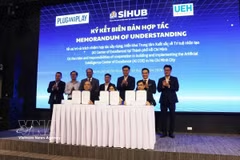
The signing ceremony of an MoU on the roles and responsibilities of cooperation in building and implementing the Artificial Intelligence Centre of Excellence (AI COE) in Ho Chi Minh City (Photo: VNA)

AI Centre of Excellence developed in Ho Chi Minh City

Under the MoU, the AI COE is envisioned as a platform bringing together the State, academia and businesses to promote research, incubation, startup acceleration and the practical application of AI in Ho Chi Minh City.

Vietnam accelerates innovation to boost growth, competitiveness

Vietnam accelerates innovation to boost growth, competitiveness

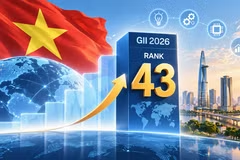
By 2030, Vietnam aims to rank among the world’s top 40 in the GII; raise total social investment in R&D to at least 2% of GDP, with non-State funding accounting for over 60%; increase international scientific publications by an average of 10% annually; and raise the number of patent applications and granted patents by an average of 16-18% annually.

Moving a jack-up rig to an offshore oil and gas drilling site (Photo: Petrovietnam)

Data, technology key to strengthening marine governance: experts

Key priorities include accelerating the use of AI, IoT, satellite data, autonomous vehicles and automated monitoring; developing a national marine data centre; investing in core technologies and high-quality human resources; and creating a market for marine technology products.

Da Nang city is actively attracting investment and talents (Photo: nhandan.vn)

Da Nang aims to become global city

Experts at the Da Nang Innovation Startup Festival (SURF) 2026 said that although Vietnam has a promising domestic market, international venture capital funds expect innovative startups seeking rapid growth to develop products to compete in international markets.

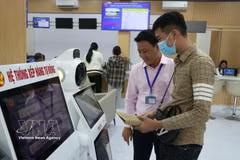
Digital technology applications in cultural and tourism in Ho Chi Minh City (Photo: VNA)

Ho Chi Minh City to develop specialised digital technology park

According to Su Ngoc Khuong, Senior Director of Investment at Savills Vietnam, infrastructure will become one of the key drivers shaping a new development cycle for the property market. Major transport projects are improving inter-regional connectivity and creating new growth poles along economic corridors.

General Secretary of the Communist Party of Vietnam Central Committee and President To Lam and representatives of the Canadian Vietnamese Scientists and Experts Association (CVSEA) on September 25. (Photo: VNA)

Top leader calls for greater contribution from Vietnamese experts in Canada

At a meeting with representatives of the Canadian Vietnamese Scientists and Experts Association (CVSEA) on September 25 (local time), the top leader praised the contributions and professional capabilities of Vietnamese experts and intellectuals in Canada, describing them as a valuable intellectual resource and an important bridge connecting Vietnam with Canada and the wider world.

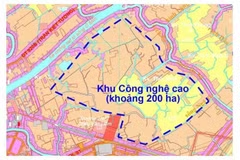
Map showing the proposed location for the Can Tho High-Tech Park. (Photo: People's Committee of Can Tho city)

Can Tho city to establish over 192 million USD hi-tech park

The Can Tho Hi-Tech Park is set to become a multifunctional economic-technical zone linking scientific research, strategic technology development, business incubation, high-quality human resources training and the production of high-value-added products.