National key laboratories must focus on strategic technologies: Deputy PM

The Ministry of Science and Technology was tasked with coordinating with ministries, sectors and localities to build a database and capacity map of laboratories and research and testing centres nationwide by November 2026, and assess the capacity of each facility.

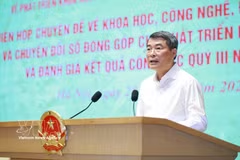
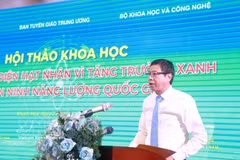
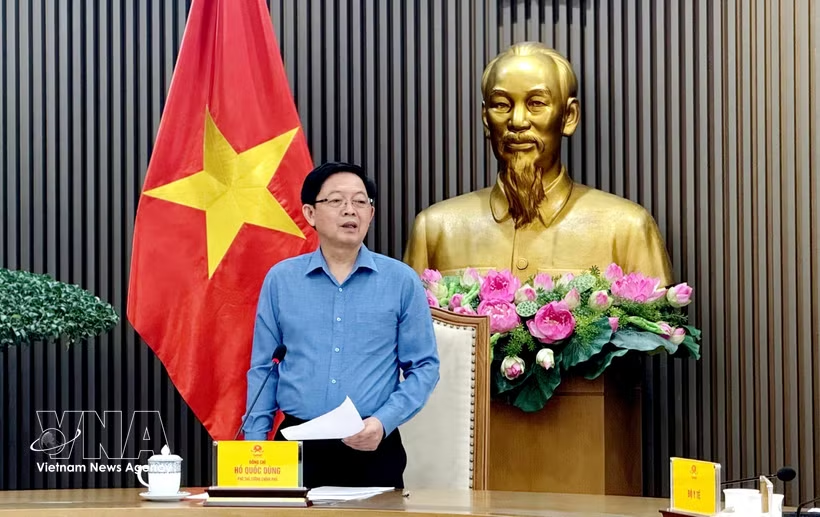
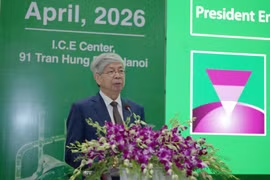
Deputy Prime Minister Ho Quoc Dung speaks at the meeting. (Photo: VNA)

Hanoi (VNA) – Deputy Prime Minister Ho Quoc Dung has requested the urgent selection and development of national key laboratories based on their capacity, practical needs, and potential to reach high standards, with a focus on strategic technology fields under Decision No. 1483/QD-TTg.

At a meeting on September 29, the Deputy PM asked the Ministry of Science and Technology and relevant agencies to review all key laboratories that have been operating for 10-15 years, identifying those requiring further investment, upgrading, shared use or other solutions.

Taking note of the opinions raised at the meeting, Dung asked the Ministry of Science and Technology and relevant ministries and agencies to review and remove bottlenecks in the science and technology market, and explore ways to directly connect research institutes and universities with businesses to identify needs and supply capacity and jointly address challenges in translating research results into production and business.

He asked for a fundamental shift from fragmented, separate investment to the development of shared research infrastructure, forming a complete chain from research and prototype development to testing, measurement, certification, pilot production and commercialisation.

Specific plans and roadmaps must be developed to achieve the targets set for 2030 under Decision No. 1483/QD-TTg, with priority projects selected for focused implementation and emerging obstacles promptly addressed, he stressed.
vnanet-tn.jpg
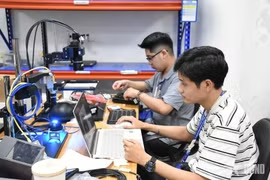
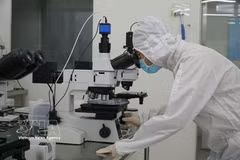
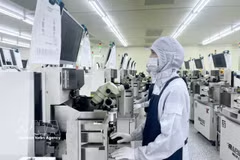
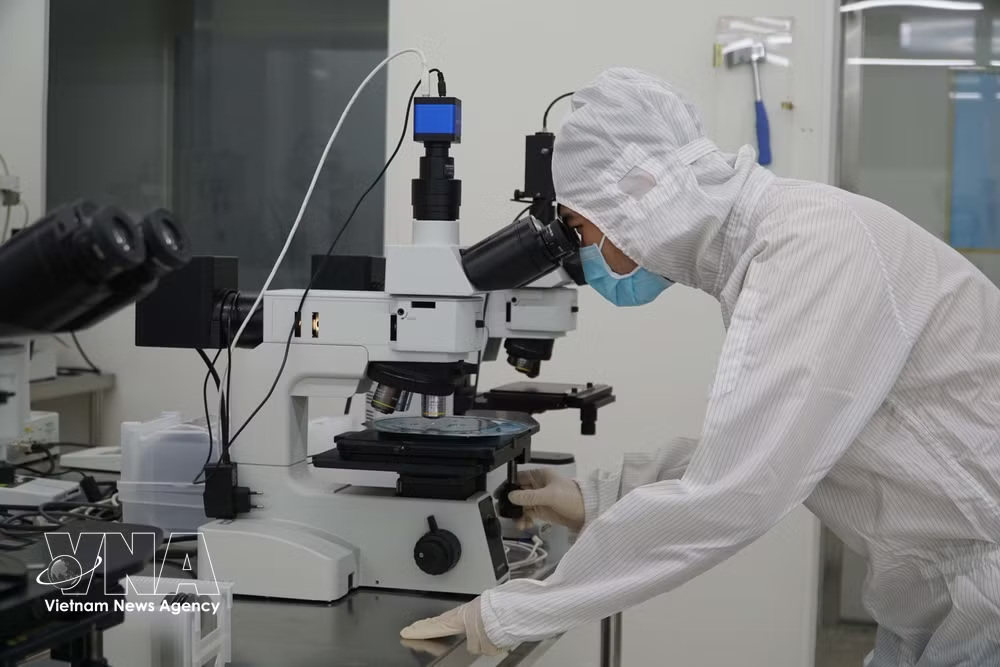
The semiconductor technology laboratory at the Saigon Hi-Tech Park's Research and Development Centre is equipped with modern facilities. (Photo: VNA)

Research institutes, universities, scientists and businesses should be given easier and more transparent access to shared research infrastructure, while autonomy should be linked with responsibility and output efficiency, he said.

The Ministry of Science and Technology was tasked with coordinating with ministries, sectors and localities to build a database and capacity map of laboratories and research and testing centres nationwide by November 2026, and assess the capacity of each facility.

The ministry, together with the Ministry of Finance, must also review problems related to investment, procurement, maintenance and operation, ensuring financial mechanisms cover the entire equipment lifecycle, from initial investment to operation, maintenance, repair and upgrading.

The Deputy PM also asked for appropriate governance and operation models for different types of laboratories and research and testing centres, with clear responsibilities for asset management, human resources, operation and shared use.

He stressed that basic research must be distinguished from applied research and activities aimed at commercialisation, and that financial and evaluation mechanisms for basic research should not mechanically require annual output products.

According to a report presented by Deputy Minister of Science and Technology Le Xuan Dinh at the meeting, a survey of 113 key facilities at 23 major institutions found nearly 1,200 specialised staff, more than 5,500 scientific publications over the past five years and 622 service and technology transfer contracts.

However, the system faces fragmented infrastructure and ageing equipment. Among 16 national key laboratories invested in during 2000-2013 with total funding of more than 966 billion VND (37.19 million USD), 78% of equipment is over 10 years old.

Decision No. 1483/QD-TTg, dated August 4, 2026, sets a target of upgrading, newly investing in, and putting into operation at least eight national key laboratories and four research and testing centres by 2030, focusing on strategic technologies.

A delegate from the Ministry of National Defence proposed closer inter-agency coordination to expedite the implementation of identified schemes and projects, while developing sector-specific databases and connecting them to the shared system coordinated by the Ministry of Science and Technology to prevent overlapping investment and resource waste./.
VNA

See more

Digital technology applications in cultural and tourism in Ho Chi Minh City (Photo: VNA)

Ho Chi Minh City to develop specialised digital technology park

According to Su Ngoc Khuong, Senior Director of Investment at Savills Vietnam, infrastructure will become one of the key drivers shaping a new development cycle for the property market. Major transport projects are improving inter-regional connectivity and creating new growth poles along economic corridors.

General Secretary of the Communist Party of Vietnam Central Committee and President To Lam and representatives of the Canadian Vietnamese Scientists and Experts Association (CVSEA) on September 25. (Photo: VNA)

Top leader calls for greater contribution from Vietnamese experts in Canada

At a meeting with representatives of the Canadian Vietnamese Scientists and Experts Association (CVSEA) on September 25 (local time), the top leader praised the contributions and professional capabilities of Vietnamese experts and intellectuals in Canada, describing them as a valuable intellectual resource and an important bridge connecting Vietnam with Canada and the wider world.

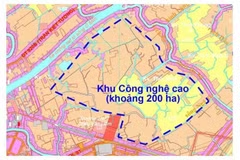
Map showing the proposed location for the Can Tho High-Tech Park. (Photo: People's Committee of Can Tho city)

Can Tho city to establish over 192 million USD hi-tech park

The Can Tho Hi-Tech Park is set to become a multifunctional economic-technical zone linking scientific research, strategic technology development, business incubation, high-quality human resources training and the production of high-value-added products.

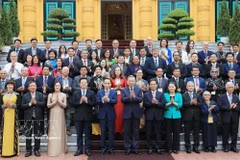
General Secretary of the Communist Party of Vietnam Central Committee and President To Lam with a delegation of outstanding overseas Vietnamese attending the 4th World Conference of Overseas Vietnamese and the 2024 forum of OV intellectuals and experts on August 23, 2024. (Photo: VNA)

Vietnam enlists OV in push for tech edge

The Ministry of Science and Technology has named the National Foundation for Science and Technology Development (NAFOSTED) as the focal point to gather research problems and match them with experts under national sci-tech schemes, said NAFOSTED Deputy Director Nguyen Phu Binh. Building on its existing AI network, NAFOSTED will build a system to track those problems alongside a database of Vietnamese scientists abroad.

A semiconductor technology laboratory of the SHTP Research and Development Centre is equipped with modern facilities (Photo: VNA)

Ho Chi Minh City builds comprehensive ecosystem to attract high-quality personel

Ho Chi Minh City is finalising a comprehensive policy framework for identifying, recruiting, deploying, remunerating, assessing, developing and retaining high-quality personnel. It will pursue three approaches – attraction, recruitment and selection – to expand the talent pool while effectively utilising capable personnel already within the system.

A discussion at the first Regional Student Talent Exchange Programme hosted by the Singapore Semiconductor Industry Association (SSIA) from September 23 to 25. (Photo: VNA)

Vietnam, Singapore expand cooperation in semiconductor workforce training

The two countries can complement each other and work closely together to develop human resources, SSIA Executive Director Ang Wee Seng said, stressing that the workforce must be able to adapt and reskill as technology evolves, particularly as advanced manufacturing moves towards AI-supported smart manufacturing.

The executive board of the Vietnamese Experts Association in Taiwan (VNEAT) for the 2026–2028 term makes its debut. (Photo: VNA)

VNEAT strengthens Vietnam-Taiwan technology, expert connections

Nguyen Van Nam, representative of the Vietnam Economic and Cultural Office in Taipei (VECO), and Prof. Yuei-An Liou, Honorary Chairman of VNEAT, spoke highly of the association's role as a bridge, while affirming VECO's active support for activities aimed at connecting intellectual resources and developing the Vietnamese expert community in Taiwan, China.

Members of the Phuong Quy 2 hamlet community digital technology team in Ngok Bay commune guides residents in submitting administrative applications online. (Photo: VNA)

Digital services bring transformation closer to people

Nearly two years after the Politburo issued Resolution No. 57-NQ/TW on December 22, 2024, on breakthroughs in science and technology, innovation and national digital transformation, localities have been focusing on solutions that address specific needs and deliver tangible benefits.

People try out virtual reality glasses at Techfest Vietnam 2025 in Hanoi. (Photo: VNA)

Hanoi to host TECHFEST Vietnam 2026 in November

TECHFEST 2026 will adopt an open-air format to encourage public participation and direct interaction with startups, businesses and investors. Key activities will include an opening ceremony, startup product exhibitions, technology demonstrations and the final round of the national innovative startup talent competition.

The semiconductor industry is directly linked to the competitiveness, technological autonomy and security of each country, requiring domestic capabilities to develop in tandem with international cooperation. (Illustrative photo: VNA)

Vietnam, Japan promote cooperation in semiconductor sector

VJSS-2026 provides a platform for scientists, experts and businesses to discuss the latest advances across a wide range of areas, from chip design, semiconductor components and materials to manufacturing, packaging and testing technologies, artificial intelligence and quantum computing.

Le Xuan Dinh, Deputy Minister of Science and Technology, addresses the event (Photo: VNA)

Nuclear power development key to green growth, national energy security

Politburo Resolution No. 70-NQ/TW, dated August 20, 2025, on ensuring national energy security through 2030 with a vision to 2045, identifies firmly ensuring national energy security as a fundamental and important prerequisite for national development. It calls for adequate, stable and high-quality energy supplies for socio-economic development, national defence and security, improved living standards and environmental protection.

Strategic “Make in Vietnam” products: Businesses at the core

Strategic “Make in Vietnam” products: Businesses at the core

The list of six priority strategic technology products set out in the Prime Minister's Decision No. 2815/QD-TTg demonstrates an important shift in policy-making thinking, with businesses playing the central role in the innovation ecosystem and serving as the core element in the country’s goal of double-digit growth in the new era.