Cross-border QR payments: Efforts must go beyond expanding coverage

Data from the State Bank of Vietnam’s Payment Department shows that Vietnam currently has more than 2.5 million domestic payment-accepting units. However, the number accepting VietQR Global remains relatively small, at around 154,000, or just over 6%.

A Singaporean tourist makes a payment via QR code in Vietnam (Photo: NAPAS)

Hanoi (VNA) – VietQR Global, which enables Vietnamese users to make payments in many countries, and vice versa, currently covers more than 6% of domestic payment acceptance points, leaving significant room for expansion. The challenge, however, is not only to broaden coverage and connect more markets, but also to drive greater volumes of actual transactions.

Behind simple QR scan lies complex payment infrastructure


A seemingly simple QR scan is powered by multiple layers of infrastructure and connectivity behind the scenes.

According to Nguyen Dang Hung, Deputy General Director of the National Payment Corporation of Vietnam (NAPAS), cross-border payment connectivity starts with building the necessary infrastructure. If banks and payment intermediaries establish direct connections with each individual country, the challenges extend beyond legal issues to settlement banks, liquidity and technical differences, ranging from QR standards and business processes to reconciliation, complaints handling, safety and security.

From the connectivity infrastructure, the challenge extends throughout the entire lifecycle of a transaction.

Pham Anh Tuan, Director of the State Bank of Vietnam’s Payment Department, said that cross-border payments involve a wide range of processes, including customer identification and authentication, switching, currency conversion, payment, settlement, risk management, fraud prevention, anti-money laundering, reconciliation, complaints handling and data protection, as well as coordination among entities operating under different national legal frameworks.

Completing technical connectivity is an important achievement, but it is not the final destination. A payment corridor only becomes truly meaningful when it is used regularly, supported by a sufficiently broad acceptance network, offers reasonable costs and a convenient user experience, and generates actual economic transactions,

Meanwhile, customers’ needs are quite straightforward. Tuan cited the example of Vietnamese people travelling or working abroad who want to use their familiar banking or payment apps. Likewise, international visitors to Vietnam expect to be able to make convenient payments at hotels, restaurants, shops, tourist attractions, transport services and even small household businesses.

Customers do not need to know how many systems a transaction passes through. What matters to them is whether they can make the payment, whether exchange rates and fees are transparent, whether the transaction is secure, and how their interests will be protected if a problem occurs.

On the other side, merchants and other payment-accepting businesses also need to see clear benefits from participating. Cross-border payments must be easy to deploy, reasonably priced and supported by transparent settlement procedures, while helping businesses reach more customers.

vnanet-qr.jpg
VietQR Global currently covers more than 6% of domestic payment acceptance points. (Illustrative photo: VNA)

Even as user demand grows, connectivity will struggle to deliver its full potential if the acceptance network remains too limited or participating businesses lack sufficient incentives.

Banks step up connectivity as payment borders disappear

Convenience for users can only translate into wider adoption when it is backed by a sufficiently extensive acceptance network. This is also a major area for VietQR Global to expand its coverage.

Data from the State Bank of Vietnam’s Payment Department shows that Vietnam currently has more than 2.5 million domestic payment-accepting units. However, the number accepting VietQR Global remains relatively small, at around 154,000, or just over 6%.

To expand coverage, commercial banks are actively rolling out VietQR Global across their merchant networks. Sacombank is among the pioneers working with the NAPAS to deploy cross-border QR payment solutions.

According to a Sacombank representative, foreign visitors can use payment apps from their home countries to pay in Vietnam, while Vietnamese travellers abroad can use the Sacombank Pay app to scan QR codes, making payments as convenient as they are at home.

This not only supports tourism development but also creates opportunities to boost business for millions of Vietnamese retailers, household businesses and enterprises.

Nguyen Vinh Tuyen, Deputy General Director of Nam A Bank, previously noted that customers can easily make cross-border transactions with a single QR scan, providing a fast, convenient and secure experience while removing barriers to payments outside their home country.

To date, more than 810,000 outbound payment transactions from Vietnam have been recorded, with a total value exceeding 760 billion VND. Meanwhile, more than 111,000 inbound transactions from overseas to Vietnam have been recorded, worth over 232 billion VND in total.

Nam A Bank, together with other credit institutions, is continuing to expand its payment acceptance network for international visitors.

According to Tuan, significant tasks remain ahead, including stepping up communications and guidance and launching promotional programmes to encourage small traders, household businesses and other payment-accepting units to add the necessary identification codes.

These efforts are expected to expand coverage and improve the effectiveness of bilateral payment connectivity projects./.


VNA

See more

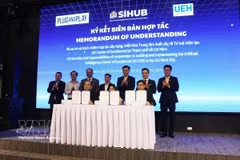
The signing ceremony of an MoU on the roles and responsibilities of cooperation in building and implementing the Artificial Intelligence Centre of Excellence (AI COE) in Ho Chi Minh City (Photo: VNA)

AI Centre of Excellence developed in Ho Chi Minh City

Under the MoU, the AI COE is envisioned as a platform bringing together the State, academia and businesses to promote research, incubation, startup acceleration and the practical application of AI in Ho Chi Minh City.

Vietnam accelerates innovation to boost growth, competitiveness

Vietnam accelerates innovation to boost growth, competitiveness

By 2030, Vietnam aims to rank among the world’s top 40 in the GII; raise total social investment in R&D to at least 2% of GDP, with non-State funding accounting for over 60%; increase international scientific publications by an average of 10% annually; and raise the number of patent applications and granted patents by an average of 16-18% annually.

Vietnamese Minister of Science and Technology Vu Hai Quan (right) and RoK Minister of Trade, Industry and Resources Kim Jung Kwan at their meeting on September 30 (Photo: vnexpress.net)

Vietnam seeks RoK help on nuclear power, AI

The Korean Ministry of Trade, Industry and Resources (MOTIR) was urged to share practical lessons from its nuclear sector with Vietnam, including institutional and policy frameworks governing the roles of policymaking and regulatory agencies, advanced nuclear power technology, experience in building a domestic nuclear supply chain, and long-term workforce training through specialised courses, hands-on work and staff exchanges.

Moving a jack-up rig to an offshore oil and gas drilling site (Photo: Petrovietnam)

Data, technology key to strengthening marine governance: experts

Key priorities include accelerating the use of AI, IoT, satellite data, autonomous vehicles and automated monitoring; developing a national marine data centre; investing in core technologies and high-quality human resources; and creating a market for marine technology products.

Da Nang city is actively attracting investment and talents (Photo: nhandan.vn)

Da Nang aims to become global city

Experts at the Da Nang Innovation Startup Festival (SURF) 2026 said that although Vietnam has a promising domestic market, international venture capital funds expect innovative startups seeking rapid growth to develop products to compete in international markets.

Digital technology applications in cultural and tourism in Ho Chi Minh City (Photo: VNA)

Ho Chi Minh City to develop specialised digital technology park

According to Su Ngoc Khuong, Senior Director of Investment at Savills Vietnam, infrastructure will become one of the key drivers shaping a new development cycle for the property market. Major transport projects are improving inter-regional connectivity and creating new growth poles along economic corridors.

General Secretary of the Communist Party of Vietnam Central Committee and President To Lam and representatives of the Canadian Vietnamese Scientists and Experts Association (CVSEA) on September 25. (Photo: VNA)

Top leader calls for greater contribution from Vietnamese experts in Canada

At a meeting with representatives of the Canadian Vietnamese Scientists and Experts Association (CVSEA) on September 25 (local time), the top leader praised the contributions and professional capabilities of Vietnamese experts and intellectuals in Canada, describing them as a valuable intellectual resource and an important bridge connecting Vietnam with Canada and the wider world.

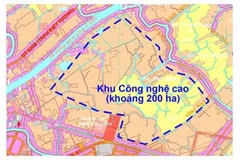
Map showing the proposed location for the Can Tho High-Tech Park. (Photo: People's Committee of Can Tho city)

Can Tho city to establish over 192 million USD hi-tech park

The Can Tho Hi-Tech Park is set to become a multifunctional economic-technical zone linking scientific research, strategic technology development, business incubation, high-quality human resources training and the production of high-value-added products.

General Secretary of the Communist Party of Vietnam Central Committee and President To Lam with a delegation of outstanding overseas Vietnamese attending the 4th World Conference of Overseas Vietnamese and the 2024 forum of OV intellectuals and experts on August 23, 2024. (Photo: VNA)

Vietnam enlists OV in push for tech edge

The Ministry of Science and Technology has named the National Foundation for Science and Technology Development (NAFOSTED) as the focal point to gather research problems and match them with experts under national sci-tech schemes, said NAFOSTED Deputy Director Nguyen Phu Binh. Building on its existing AI network, NAFOSTED will build a system to track those problems alongside a database of Vietnamese scientists abroad.