Hanoi (VNA) - Vietnam needs to turn marine data, knowledge and technology into stronger governance capacity, shifting from reactive management to forecasting and from experience-based management to data-driven governance, experts have said.
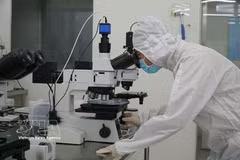
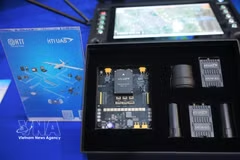
Prof. Dr. Mai Trong Nhuan from Vietnam National University, Hanoi, said countries with advanced marine capabilities are moving from manual surveys to automated and multi-platform monitoring systems combining remote sensing, monitoring buoys, IoT sensors, autonomous underwater vehicles, remotely operated vehicles and unmanned aerial vehicles with artificial intelligence (AI) and big data.
These technologies enable earlier detection of changes in temperature, water quality, currents and coastlines, while AI can analyse large volumes of data to forecast waves, pollution risks and ecosystem changes. Connecting vessel monitoring data with satellite data can also improve maritime surveillance and help control illegal, unreported and unregulated (IUU) fishing activities, Nhuan said.
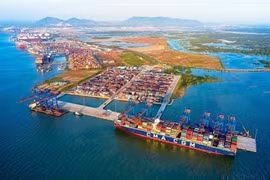
Assoc. Prof. Dr. Nguyen Tai Tue from the University of Science under Vietnam National University, Hanoi said more complete, updated and interconnected databases on marine resources and the environment would strengthen management decisions and reduce risks for investors in offshore wind power, marine aquaculture, seaports and other emerging sectors.
Le Anh Thang from the Northern Centre for Planning and Investigation of Marine Resources – Environment said greater use of automation, remote monitoring and unmanned equipment will help reduce offshore hazardous work while increasing the frequency and accuracy of data collection.
Vietnam has established digital databases on marine resources and the environment and is upgrading them for integration with national, ministerial and local databases. The Vietnam Administration of Seas and Islands’ digital transformation plan targets connecting 100% of relevant national and specialised databases by 2030, with at least 80% of monitoring, forecasting and warning activities based on real-time big-data analysis and AI.
The plan places data at the centre, calling for data to be “accurate, sufficient, clean, live, unified and shared”, while developing modern data centres, cloud computing, data lakehouses and IoT networks for automated data collection.
Experts noted that Vietnam still faces shortages of marine research vessels, synchronised data, strong research institutions and high-quality science and technology personnel, while the application of research results remains limited.
They called for closer integration of three areas: marine resource and environmental research, surveys and forecasting; integrated management; and development of a blue marine economy. They stressed that research data should directly support management, planning and monitoring, while practical requirements should generate new tasks for science and technology.
Key priorities include accelerating the use of AI, IoT, satellite data, autonomous vehicles and automated monitoring; developing a national marine data centre; investing in core technologies and high-quality human resources; and creating a market for marine technology products.
Experts also recommended stronger international cooperation in marine research, surveys, forecasting and disaster prevention, along with institutional reform, mobilisation of social resources and greater business participation in developing and applying marine technologies./.
See more
Strong science - technology promotion efforts drive Vietnam’s innovation ranking higher
Vietnam’s innovation output ranking also rose two places from 37th to 35th, helping the country meet the target set by the Government in Resolution No. 02/NQ-CP for 2026.
Da Nang aims to become global city
Experts at the Da Nang Innovation Startup Festival (SURF) 2026 said that although Vietnam has a promising domestic market, international venture capital funds expect innovative startups seeking rapid growth to develop products to compete in international markets.
National key laboratories must focus on strategic technologies: Deputy PM
The Ministry of Science and Technology was tasked with coordinating with ministries, sectors and localities to build a database and capacity map of laboratories and research and testing centres nationwide by November 2026, and assess the capacity of each facility.
Vietnam offers up to 150,000 USD to accelerate enterprise AI adoption
NATIF plans to select and sign contracts for about 15 key AI application projects in 2026. From 2027, the programme is expected to expand to around 50 projects annually.
Ho Chi Minh City to develop specialised digital technology park
According to Su Ngoc Khuong, Senior Director of Investment at Savills Vietnam, infrastructure will become one of the key drivers shaping a new development cycle for the property market. Major transport projects are improving inter-regional connectivity and creating new growth poles along economic corridors.
PM urges stronger contribution of science, technology to economic growth
Ministries, agencies and localities were also told to accelerate the development of national databases and digital infrastructure, with key databases on education, social security, personnel and health to be completed by November 30, 2026.
AI helps transform tourism experiences in digital era
Bui Thanh Tu, Marketing Director of Bestprice Travel, said treating data as an asset and applying AI to specific business needs have produced concrete results in the company’s travel operations.
Hanoi hosts International Olympiad on Astronomy and Astrophysics for first time
Vietnam is participating in IOAA 2026, which runs through October 5, with a 10-member team selected in accordance with regulations set by the Ministry of Education and Training.
Top leader calls for greater contribution from Vietnamese experts in Canada
At a meeting with representatives of the Canadian Vietnamese Scientists and Experts Association (CVSEA) on September 25 (local time), the top leader praised the contributions and professional capabilities of Vietnamese experts and intellectuals in Canada, describing them as a valuable intellectual resource and an important bridge connecting Vietnam with Canada and the wider world.
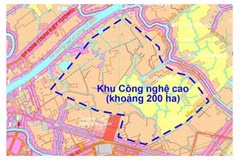
Can Tho city to establish over 192 million USD hi-tech park
The Can Tho Hi-Tech Park is set to become a multifunctional economic-technical zone linking scientific research, strategic technology development, business incubation, high-quality human resources training and the production of high-value-added products.
Science-technology diplomacy helps build bridge for Vietnam-Hong Kong (China) strategic cooperation: diplomat
Hong Kong's high-quality universities and research institutions, international financial centre, startup ecosystem and access to the Guangdong-Hong Kong-Macao Greater Bay Area (GBA) offer significant opportunities for collaboration with Vietnam.
Vietnam enlists OV in push for tech edge
The Ministry of Science and Technology has named the National Foundation for Science and Technology Development (NAFOSTED) as the focal point to gather research problems and match them with experts under national sci-tech schemes, said NAFOSTED Deputy Director Nguyen Phu Binh. Building on its existing AI network, NAFOSTED will build a system to track those problems alongside a database of Vietnamese scientists abroad.
Ho Chi Minh City builds comprehensive ecosystem to attract high-quality personel
Ho Chi Minh City is finalising a comprehensive policy framework for identifying, recruiting, deploying, remunerating, assessing, developing and retaining high-quality personnel. It will pursue three approaches – attraction, recruitment and selection – to expand the talent pool while effectively utilising capable personnel already within the system.
Hanoi–India hi-tech roundtable targets deals, talent, tech transfer
Discussions covered India’s technology and innovation ecosystem; Vietnam’s strategic priorities, potential and strengths; technology partnership models and specialised technologies; and cooperation in quality workforce training and technology transfer.
Vietnam, Singapore expand cooperation in semiconductor workforce training
The two countries can complement each other and work closely together to develop human resources, SSIA Executive Director Ang Wee Seng said, stressing that the workforce must be able to adapt and reskill as technology evolves, particularly as advanced manufacturing moves towards AI-supported smart manufacturing.
Vietnam takes steps towards mastery of specialised semiconductor chips
Developing specialised semiconductor chips is a suitable pathway for leveraging Vietnam’s strengths and gradually moving deeper into the global semiconductor value chain.
VNEAT strengthens Vietnam-Taiwan technology, expert connections
Nguyen Van Nam, representative of the Vietnam Economic and Cultural Office in Taipei (VECO), and Prof. Yuei-An Liou, Honorary Chairman of VNEAT, spoke highly of the association's role as a bridge, while affirming VECO's active support for activities aimed at connecting intellectual resources and developing the Vietnamese expert community in Taiwan, China.
Digital services bring transformation closer to people
Nearly two years after the Politburo issued Resolution No. 57-NQ/TW on December 22, 2024, on breakthroughs in science and technology, innovation and national digital transformation, localities have been focusing on solutions that address specific needs and deliver tangible benefits.
Hanoi to host TECHFEST Vietnam 2026 in November
TECHFEST 2026 will adopt an open-air format to encourage public participation and direct interaction with startups, businesses and investors. Key activities will include an opening ceremony, startup product exhibitions, technology demonstrations and the final round of the national innovative startup talent competition.
Vietnam, Japan promote cooperation in semiconductor sector
VJSS-2026 provides a platform for scientists, experts and businesses to discuss the latest advances across a wide range of areas, from chip design, semiconductor components and materials to manufacturing, packaging and testing technologies, artificial intelligence and quantum computing.