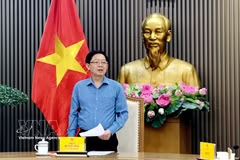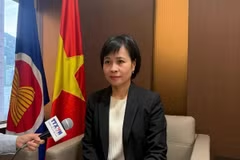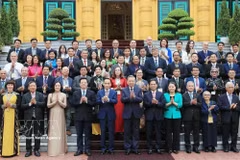
Seoul (VNA) – Vietnamese Minister of Science and Technology Vu Hai Quan held a series of meetings in the Republic of Korea (RoK) on September 30 to turn strategic cooperation orientations with Seoul and international partners into concrete outcomes in high-tech fields, particularly nuclear power, artificial intelligence (AI), innovation and high-quality workforce training.
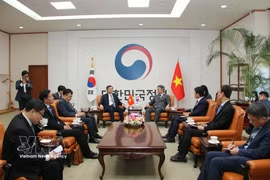
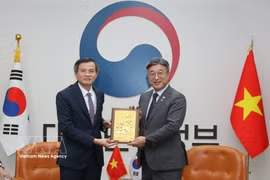
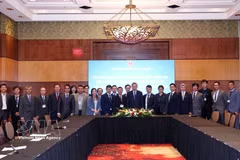
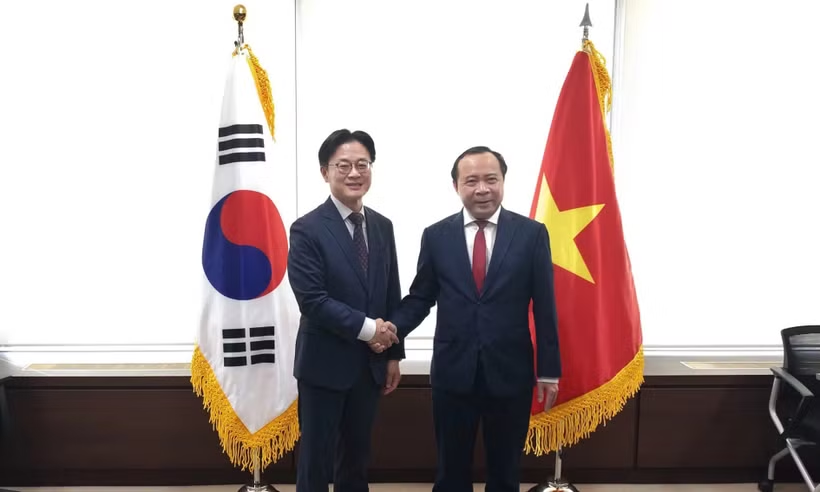
During a working session with RoK Minister of Trade, Industry and Resources Kim Jung Kwan in Seoul, Quan said Vietnam has made nuclear power a priority under its nuclear energy strategy through 2035, with a vision to 2050. The central task is to build enough national capacity to operate nuclear facilities safely, gradually master the technology and ensure sustainable development.
He asked the Korean Ministry of Trade, Industry and Resources (MOTIR) to share practical lessons from its nuclear sector, including institutional and policy frameworks governing the roles of policymaking and regulatory agencies, advanced nuclear power technology, experience in building a domestic nuclear supply chain, and long-term workforce training through specialised courses, hands-on work and staff exchanges.
Minister Kim, for his part, said the RoK has about 40 years of experience in nuclear power technology, with lessons from both successes and failures. He said the industry rests on three pillars of engineering and technological capacity, a comprehensive legal and management framework, and above all safety, which he called "non-negotiable".
The RoK, he said, wants comprehensive cooperation with Vietnam, including on the Ninh Thuan 2 nuclear power project. That will cover plant construction, operational experience, safety assurance, workforce training and supporting industries, and Seoul is ready to transfer technology to Vietnam.
On AI in manufacturing, Kim described a model in which MOTIR directly oversees the sector. He said success hinges on three factors, namely AI technology capacity, corporate determination to transform, and a governance mechanism linking the technology and manufacturing sectors.
He also presented the MX Alliance, which brings together the Government, companies, AI firms, research institutes and universities to drive AI adoption across industries.
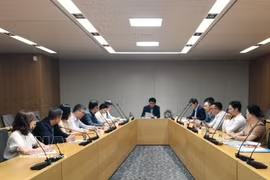
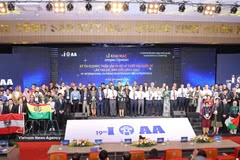
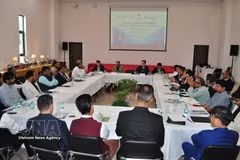
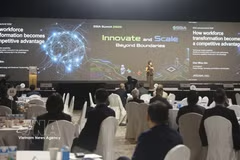
Quan later led a Vietnamese delegation to the 12th Global ICT Leadership Forum, co-hosted by the Korean Ministry of Science and ICT (MSIT) and the National Information Society Agency (NIA). This year's forum focused on practical cooperation in AI and digital transformation between the RoK and high-ranking delegations from Vietnam, the Philippines, Laos, Bhutan, Kyrgyzstan, Panama, Egypt and Uzbekistan.
Nguyen Khac Lich, Director of the Authority of Information and Communications Industry under the Ministry of Science and Technology, said Vietnam wants AI woven into the daily work of State agencies, businesses and citizens under its National AI Strategy through 2030, with a vision to 2045.
In the public sector, Vietnam is targeting weekly AI use by all officials and civil servants by 2030, while 60% of companies are expected to apply AI to improve efficiency. The Government also aims to raise the quality of public administrative services, he said.
Stressing AI sovereignty as a key pillar, he said Vietnam plans to control its own data, build computing infrastructure with about 500MW of capacity, develop at least eight Vietnamese-language large language models, set up at least five shared AI platforms and train 10,000 highly qualified AI specialists.
Vietnam proposed working with the RoK and the wider international community to pilot AI in specific public services, link research and business networks in both countries to develop language models and computing infrastructure, and cooperate on standards for testing and the safe, reliable governance of AI.
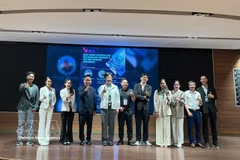
In the afternoon, Quan held a working session with the Korea Institute of Science and Technology (KIST). He asked KIST to focus on four areas, including upgrading joint research in strategic fields including semiconductors, AI, batteries and energy storage, advanced materials and biotechnology; creating mechanisms for shared use of research infrastructure and equipment among KIST, the Vietnam-Korea Institute of Science and Technology (VKIST) and Vietnamese institutes and universities; sending Vietnamese researchers to work at KIST and linking with the KIST School for long-term master's and doctoral training; and speeding up the VKIST R&D project for 2026-2033.
KIST President Oh Sang Rok called VKIST a distinctive symbol of bilateral cooperation and pledged maximum support to finish the project on schedule and make it a core R&D hub linking research institutes and businesses in both countries.
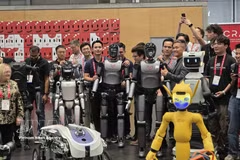
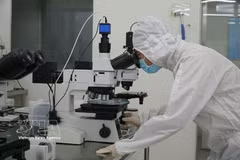
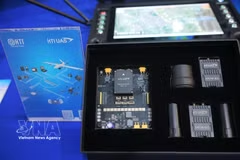
The delegation then toured KIST's advanced technology labs and production facilities, including those working on quantum chips, humanoid robots, and AI for locating missing persons and detecting disasters such as forest fires./.