Science ministry focuses on eliminating mobile signal dead zones in 273 villages

The Ministry of Science and Technology will launch a project to develop a system of national key research and testing centres and laboratories in October, while continuing to restructure national science and technology programmes towards more focused resource allocation.

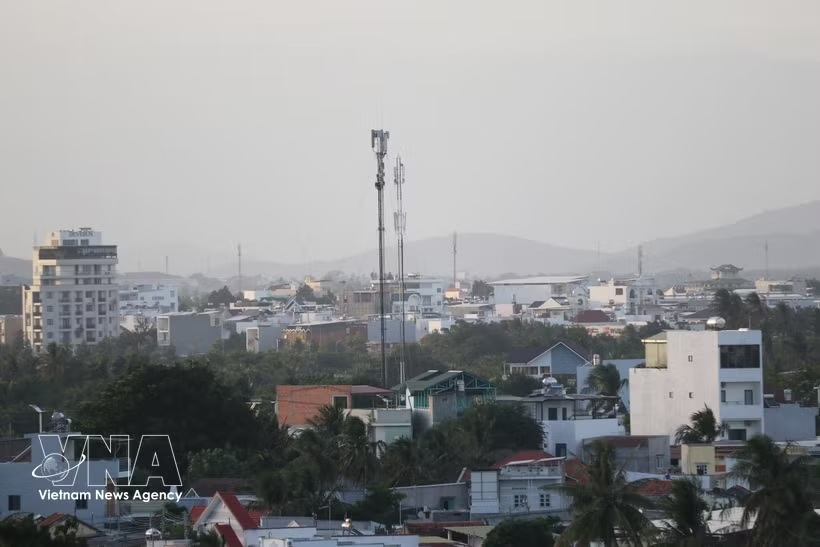
Telecommunications infrastructure serving mobile and internet services in Dong Hai ward, Khanh Hoa province. (Illustrative photo: VNA)

Hanoi (VNA) – The Ministry of Science and Technology is stepping up efforts to eliminate mobile signal dead zones and improve weak-signal coverage in 273 villages, the ministry said at its regular monthly press briefing on September 30 in Hanoi.

The ministry announced that in October it will work to complete four draft laws: the law amending and supplementing several articles of the Law on Metrology, the revised Law on Post, the law amending and supplementing several articles of the Law on Intellectual Property, and the law amending and supplementing several articles of the Law on Science, Technology and Innovation. It will also wrap up a decree that amends and supplements five existing decrees related to the implementation of the Law on Science, Technology and Innovation.

The ministry will also launch a project to develop a system of national key research and testing centres and laboratories in October, while continuing to restructure national science and technology programmes towards more focused resource allocation.

It will keep sharing data, launch the National Digital Architecture Framework, offer guidance on digital architecture frameworks at ministerial and provincial levels, and broaden the use of artificial intelligence to support public administration, focusing on safety, data quality, efficiency, and scalability.

The ministry will implement the National Strategy on Artificial Intelligence through 2030, with a vision to 2045, under Decision No. 1671/QD-TTg dated August 28, 2026, with a focus on strengthening capacity in AI research, development, mastery, and application.

In telecommunications, the ministry and relevant agencies will focus on addressing mobile signal dead zones in 273 villages and weak or no-signal coverage at 209 offices of State agencies and public education and healthcare facilities. They will also study the temporary deployment of satellite solutions combined with BTS stations in particularly disadvantaged areas.

Revenue from the digital technology industry in September was estimated at 770.77 trillion VND (29.69 billion USD), up 36% year-on-year. The figure for the first nine months of the year was estimated at 5.387 quadrillion VND, up about 32.1% year-on-year.

In data and digital transformation, the total number of transactions conducted through the National Data Exchange Platform (NDXP) reached 4.86 billion from its launch in 2020 to September 15, 2026.

Meanwhile, 34.575 million digital signature certificates were issued as of September. The ministry said 49.96% of the population aged 15-65 had digital signatures, equivalent to 34.575 million people out of a total of around 69.2 million.

Internet infrastructure has kept up its impressive growth. By September 15, the number of registered “.vn” national domain names hit 703,236, marking a 5.7% increase from the same time last year. IPv6 adoption reached 67%, placing Vietnam second in Southeast Asia and seventh in the world.

In the postal sector, September revenue was estimated at 9.26 trillion VND, up 22% year-on-year.

Vietnamese researchers produced 3,131 international publications indexed in the Scopus database in September. In industrial property, the Intellectual Property Office of Vietnam received 16,205 applications, processed 17,525, and granted 8,096 protection titles during the month./.

VNA
See more

Moving a jack-up rig to an offshore oil and gas drilling site (Photo: Petrovietnam)

Data, technology key to strengthening marine governance: experts

Key priorities include accelerating the use of AI, IoT, satellite data, autonomous vehicles and automated monitoring; developing a national marine data centre; investing in core technologies and high-quality human resources; and creating a market for marine technology products.

Da Nang city is actively attracting investment and talents (Photo: nhandan.vn)

Da Nang aims to become global city

Experts at the Da Nang Innovation Startup Festival (SURF) 2026 said that although Vietnam has a promising domestic market, international venture capital funds expect innovative startups seeking rapid growth to develop products to compete in international markets.

Digital technology applications in cultural and tourism in Ho Chi Minh City (Photo: VNA)

Ho Chi Minh City to develop specialised digital technology park

According to Su Ngoc Khuong, Senior Director of Investment at Savills Vietnam, infrastructure will become one of the key drivers shaping a new development cycle for the property market. Major transport projects are improving inter-regional connectivity and creating new growth poles along economic corridors.

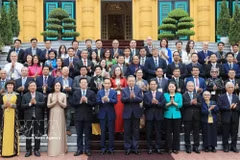
General Secretary of the Communist Party of Vietnam Central Committee and President To Lam and representatives of the Canadian Vietnamese Scientists and Experts Association (CVSEA) on September 25. (Photo: VNA)

Top leader calls for greater contribution from Vietnamese experts in Canada

At a meeting with representatives of the Canadian Vietnamese Scientists and Experts Association (CVSEA) on September 25 (local time), the top leader praised the contributions and professional capabilities of Vietnamese experts and intellectuals in Canada, describing them as a valuable intellectual resource and an important bridge connecting Vietnam with Canada and the wider world.

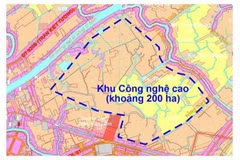
Map showing the proposed location for the Can Tho High-Tech Park. (Photo: People's Committee of Can Tho city)

Can Tho city to establish over 192 million USD hi-tech park

The Can Tho Hi-Tech Park is set to become a multifunctional economic-technical zone linking scientific research, strategic technology development, business incubation, high-quality human resources training and the production of high-value-added products.

General Secretary of the Communist Party of Vietnam Central Committee and President To Lam with a delegation of outstanding overseas Vietnamese attending the 4th World Conference of Overseas Vietnamese and the 2024 forum of OV intellectuals and experts on August 23, 2024. (Photo: VNA)

Vietnam enlists OV in push for tech edge

The Ministry of Science and Technology has named the National Foundation for Science and Technology Development (NAFOSTED) as the focal point to gather research problems and match them with experts under national sci-tech schemes, said NAFOSTED Deputy Director Nguyen Phu Binh. Building on its existing AI network, NAFOSTED will build a system to track those problems alongside a database of Vietnamese scientists abroad.

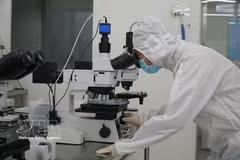
A semiconductor technology laboratory of the SHTP Research and Development Centre is equipped with modern facilities (Photo: VNA)

Ho Chi Minh City builds comprehensive ecosystem to attract high-quality personel

Ho Chi Minh City is finalising a comprehensive policy framework for identifying, recruiting, deploying, remunerating, assessing, developing and retaining high-quality personnel. It will pursue three approaches – attraction, recruitment and selection – to expand the talent pool while effectively utilising capable personnel already within the system.

A discussion at the first Regional Student Talent Exchange Programme hosted by the Singapore Semiconductor Industry Association (SSIA) from September 23 to 25. (Photo: VNA)

Vietnam, Singapore expand cooperation in semiconductor workforce training

The two countries can complement each other and work closely together to develop human resources, SSIA Executive Director Ang Wee Seng said, stressing that the workforce must be able to adapt and reskill as technology evolves, particularly as advanced manufacturing moves towards AI-supported smart manufacturing.

The executive board of the Vietnamese Experts Association in Taiwan (VNEAT) for the 2026–2028 term makes its debut. (Photo: VNA)

VNEAT strengthens Vietnam-Taiwan technology, expert connections

Nguyen Van Nam, representative of the Vietnam Economic and Cultural Office in Taipei (VECO), and Prof. Yuei-An Liou, Honorary Chairman of VNEAT, spoke highly of the association's role as a bridge, while affirming VECO's active support for activities aimed at connecting intellectual resources and developing the Vietnamese expert community in Taiwan, China.

Members of the Phuong Quy 2 hamlet community digital technology team in Ngok Bay commune guides residents in submitting administrative applications online. (Photo: VNA)

Digital services bring transformation closer to people

Nearly two years after the Politburo issued Resolution No. 57-NQ/TW on December 22, 2024, on breakthroughs in science and technology, innovation and national digital transformation, localities have been focusing on solutions that address specific needs and deliver tangible benefits.

People try out virtual reality glasses at Techfest Vietnam 2025 in Hanoi. (Photo: VNA)

Hanoi to host TECHFEST Vietnam 2026 in November

TECHFEST 2026 will adopt an open-air format to encourage public participation and direct interaction with startups, businesses and investors. Key activities will include an opening ceremony, startup product exhibitions, technology demonstrations and the final round of the national innovative startup talent competition.