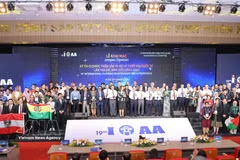
Ho Chi Minh City (VNA) – The National Technology Innovation Fund under the Ministry of Science and Technology plans to select 15 AI-based technology innovation tasks in 2026, with state funding of up to 3 billion (192,000 USD) per task, heard a workshop in Ho Chi Minh City on September 30.
The tasks will run for no more than 12 months, with state funding capped at half of total costs, while participating companies are required to provide at least half in cash.
The aim is not to multiply AI projects but to produce solutions that work in practice, help companies solve production and trade problems, and build a pool of engineers and experts with hands-on experience.
From 2027, the fund will back 50 tasks a year. Applicants must have a specific AI problem to solve, data ready to use, and a willingness to collaborate.
Projects qualify through one of three routes, namely replacing imported technology, mastering and localising technology, or legally acquiring it through transfer.
The fund also offers supportive interest rates for investments in technology application, transfer and innovation.
Deputy Minister of Science and Technology Hoang Minh, in his speech, said the grants share the risks in developing, testing and integrating technology, while interest subsidies lower the cost of capital for firms looking to invest, expand and move technology into production.
For 2027, Minh called on the fund to assemble a broader toolkit, including financial support vouchers, project funding, intellectual property (IP) development, productivity and quality upgrades, startup support, commercialisation of research results, and ecosystem development to assist with a stronger innovation-driven entrepreneurial culture.
He said these tools should work as a chain: technologies are mastered and refined, IP is created and put to use, products are standardised with better productivity and quality, companies get access to capital, and research results reach the market.
"The fund's success should be judged not by applications received or projects approved, but by technologies mastered, products commercialised, productivity gains, additional private capital raised and companies made stronger", Minh said.
The official added that companies preparing proposals should start from their own needs, pinpoint technology bottlenecks, assess their capacity to adopt new technology, confirm data readiness, specify their own contribution, define concrete outputs and set the metrics for measuring results.
He also urged universities, research institutes, experts and intermediaries to work more closely with firms. The gap between labs and markets will only narrow when scientists understand corporate demand, companies join technology development from the start, and intermediaries help with testing, assessment, IP, standards, access to capital and market links./.