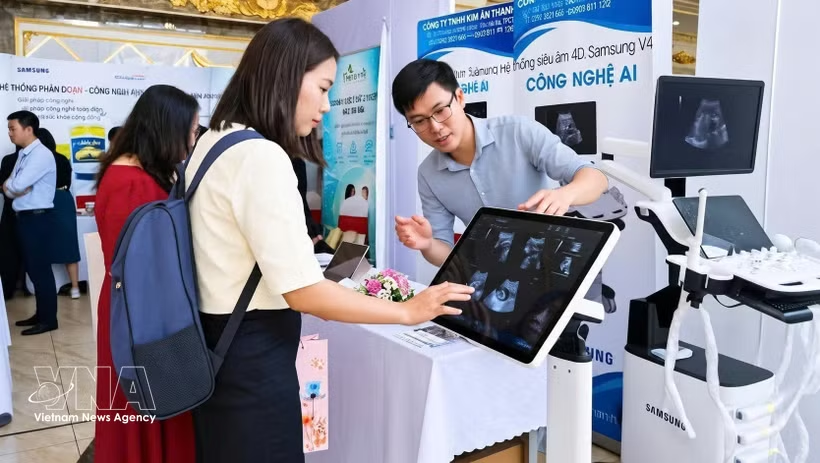
Hanoi (VNA) – Localities and healthcare facilities across Vietnam continued to roll out measures last week to expand access to healthcare, strengthen professional capacity and introduce advanced medical technologies, contributing to the goals set out in Politburo Resolution No. 72-NQ/TW on improving public health care.
From expanding health screening and strengthening grassroots healthcare to applying artificial intelligence (AI) and transferring advanced medical techniques, these efforts are helping build a more proactive and modern healthcare system that better meets people's needs for health protection, care and improvement.
In the southernmost province of Ca Mau, the Hoa Binh commune People's Committee, in coordination with the provincial Department of Health and Le Van Thinh Hospital in Ho Chi Minh City, launched the fifth phase of a campaign on September 15 to complete health check-ups and screening targets during a 45-day drive.
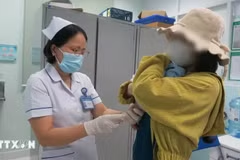
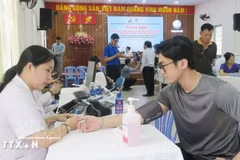
Residents were provided with general health check-ups, blood pressure measurements, blood glucose tests and screening for non-communicable diseases. They also received advice on nutrition and healthy lifestyles to help prevent diseases and identify potential health risks at an early stage.
In areas facing difficulties in accessing healthcare, the programme focuses on vulnerable groups, including older people, those with chronic diseases, informal workers and people at high risk of illness.
In addition to screening and health examinations, Le Van Thinh Hospital has developed follow-up treatment programmes for certain non-communicable diseases identified during the campaign. These include eye and thyroid surgery programmes, as well as plans to send medical staff to Ca Mau to provide treatment for local residents.
Ca Mau aims to complete free periodic health check-ups and screening for all eligible residents by October 31, 2026. Through the first four phases of the campaign, more than 1.61 million people, or approximately 75% of the province's population, had received free health screening.
In Ho Chi Minh City, Thanh An commune became the first locality to complete health check-ups and screening for its entire population on September 19. A total of 2,950 residents received examinations under a programme jointly organised by Tu Du Hospital – Facility 2, the local medical station and the authorities.
Specialist hospitals in the city also participated in the programme. Health examinations were arranged at home for older people, people with disabilities and those with limited mobility.
The residents' health data has been entered into electronic health records, enabling the local medical station to continue monitoring people with health risks and chronic diseases and connect them with hospitals when specialised treatment is required.
As of mid-September 2026, more than 4.5 million people, or approximately 35% of Ho Chi Minh City's population, had undergone health check-ups.
Advanced medical techniques brought to provincial hospitals
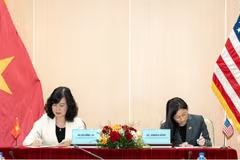
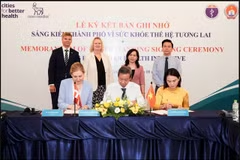
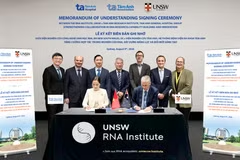
To strengthen diagnosis and treatment capacity, develop human resources and modernise the local healthcare system, the Vinh Long Department of Health signed a memorandum of understanding on cooperation in principle with the Ho Chi Minh City University of Medicine and Pharmacy on September 15.
The partnership focuses on four key areas: human resource training; technology transfer and professional support; digital transformation and smart healthcare; and scientific research and innovation.
Director of the university Associate Professor and Doctor Nguyen Hoang Bac said that in 2025, the hospital provided medical examinations for more than 147,500 patients, including over 48,000 residents of Vinh Long.
Improving treatment quality in local hospitals will help reduce the number of patients who need to be transferred to higher-level facilities, thereby limiting long-distance travel for patients and their families, he noted.
According to Director of the Vinh Long province’s Department of Health Ho Thi Thu Hang, following the province's administrative merger, the healthcare sector faces higher expectations for professional quality, emergency care, specialised treatment and coordination across the healthcare system.
The provincial health sector aims to develop a modern and smart healthcare system by strengthening grassroots healthcare, developing key hospitals and expanding specialised medical services through interconnected healthcare networks.
Vinh Long also plans to gradually master advanced medical techniques, procedures and technologies while building sustainable specialist teams capable of providing high-quality care locally.
Alongside technology transfer, the province is prioritising digital transformation to ensure that health data can accompany patients throughout their treatment and improve professional coordination between doctors and medical facilities, helping narrow geographical barriers to healthcare access.
Integrating AI and updating medical technologies
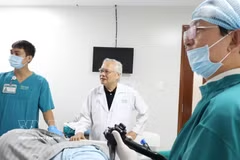
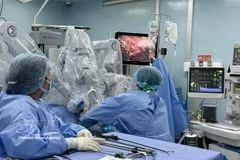
On September 17, Hue Central Hospital, in coordination with the Vietnam Association of Surgery and Endoscopic Surgery, held the 2026 National Conference on Surgery and Endoscopic Surgery in Hue, focusing on integrating AI into the development of endoscopic surgery.
The event brought together more than 700 domestic and international delegates.
Professor and Doctor Tran Binh Giang, Chairman of the association, said the conference covered key trends in modern surgery, including endoscopic and minimally invasive techniques, robotic surgery, 3D imaging and other supporting technologies.
AI is being increasingly applied in surgery, he said, but it does not replace surgeons. Instead, it should be integrated appropriately with clinical knowledge, experience, technical skills and medical ethics.
More than 260 presentations were selected for the conference, covering robotic surgery, AI-assisted clinical decision-making, medical literature analysis and surgical navigation. Other topics included 3D modelling and printing for surgical planning, as well as advanced techniques in gastrointestinal, hepatobiliary and pancreatic surgery, colorectal surgery, urology, obstetrics and gynaecology, orthopaedics and oncology.
In Can Tho, the Vietnam Association of Gastroenterology and the Hoan My Cuu Long Hospital organised a conference on September 17 to update knowledge and share experience in the latest advances in gastrointestinal endoscopy and the diagnosis and treatment of digestive and hepatobiliary-pancreatic diseases.
Experts said gastrointestinal endoscopy plays an increasingly important role in the early detection, diagnosis and treatment of diseases. Modern imaging technologies, such as narrow-band imaging (NBI), and interventional endoscopic techniques help doctors identify lesions more clearly and select appropriate treatment methods.
The conference also covered advances in endoscopic retrograde cholangiopancreatography (ERCP), the assessment of lesions using NBI and polyp removal techniques in the colorectum.
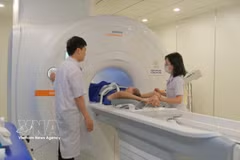
Investment in specialised facilities and equipment is also being strengthened in the Mekong Delta. Hoan My Cuu Long Hospital put its Gastroenterology and Endoscopy Centre into operation on August 11, 2026, following an investment of more than 57 billion VND (2.16 million USD) in infrastructure, equipment and endoscopy systems.
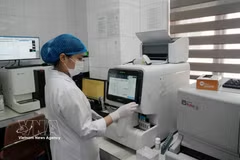
Meanwhile, the 29th Northern Vietnam Conference on Medical Biochemistry, held in Quang Ninh on September 18, attracted 1,000 experts, scientists, lecturers, doctors and technicians from across the country.
The conference featured 54 papers published in the Journal of Community Medicine and 33 in-depth presentations on practical research topics, including AI and machine learning in laboratory test forecasting, algorithms and biomarkers for risk stratification, non-invasive diagnosis of liver fibrosis, and research into cardiometabolic diseases, cancer, chronic kidney disease and laboratory quality control.
Associate Professor and Doctor Tran Thanh Vinh, Head of the Department of Biochemistry at Cho Ray Hospital, said the knowledge and experience shared at the event would help healthcare facilities improve laboratory management, the accuracy of test results and the quality of patient services.
Training, technology updates and professional exchanges across localities are helping healthcare workers gain access to and apply new techniques, gradually strengthening medical expertise and improving the quality of medical examinations and treatment.
From changes in approaches to healthcare delivery to advances in professional capacity and technology, these activities are laying the foundations for a modern, people-centred healthcare system.
The goals of Politburo Resolution No. 72-NQ/TW are being translated into practical action, with the aim of ensuring that every resident can access better and more convenient healthcare services./.