Da Nang: Satellite hospitals prove effective at grassroots level

The model is an important component of the roadmap to turn Da Nang into a specialised medical centre for the central and Central Highlands regions, with a number of key specialties, in line with the spirit of Politburo Resolution No. 72-NQ/TW dated September 9, 2025, on breakthrough solutions to strengthen the protection, care and improvement of people's health.

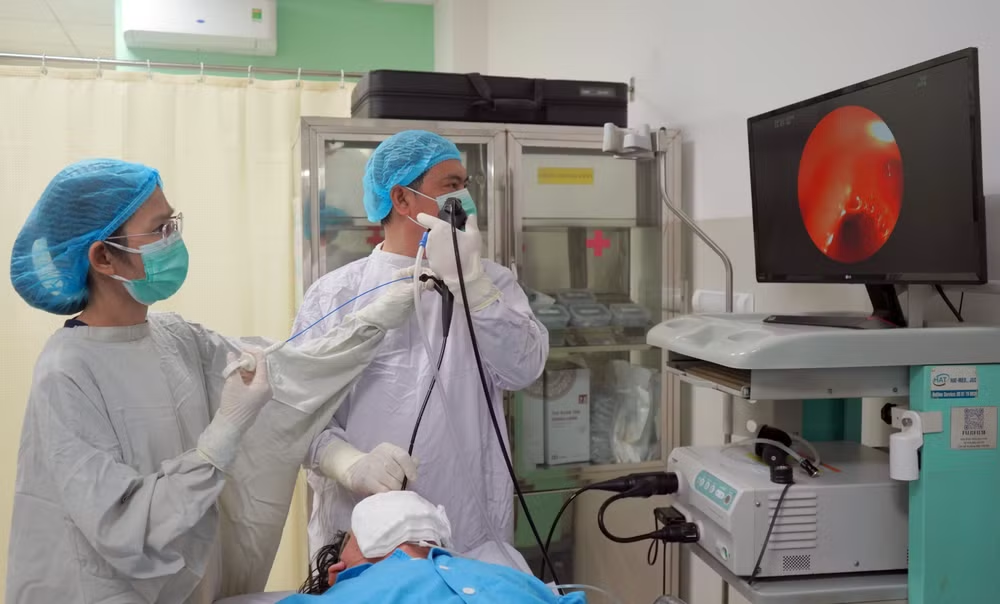
The Son Tra regional medical centre (Photo: benhviensontra.com.vn)

Da Nang (VNA) – The satellite hospital project was implemented by the central coastal city of Da Nang to enhance the capacity of grassroots healthcare facilities, enabling residents to access high-quality medical services in their own communities while easing pressure on higher-level hospitals.

The model is an important component of the roadmap to turn Da Nang into a specialised medical centre for the central and Central Highlands regions, with a number of key specialties, in line with the spirit of Politburo Resolution No. 72-NQ/TW dated September 9, 2025, on breakthrough solutions to strengthen the protection, care and improvement of people's health.

The project was carried out by the municipal health sector in two phases, from 2019-2021 and 2023-2025, focusing on practical training, technical transfer and enhanced two-way medical consultation. The techniques transferred include gastrointestinal endoscopy, general and obstetric-gynaecological laparoscopic surgery, fracture fixation, emergency and intensive care, neonatal care, caesarean sections, prenatal diagnostic ultrasound, breast and thyroid ultrasound, and palliative care for cancer patients.

Mastering these techniques has significantly reduced unnecessary referrals, particularly in trauma, gastrointestinal and obstetric-paediatric cases.

Bringing advanced techniques to grassroots facilities

During the 2023-2025 period, the Son Tra regional medical centre was approved to organise 18 practical training courses. It subsequently conducted 10 of the 18 courses, fulfilling 55.6% of the target. During this period, 10 doctors and four nurses received training and gained exposure to advanced techniques across various specialties.

Dr Huynh Van Do, in charge of the planning and professional affairs division at the centre, said it had actively coordinated with core hospitals to carry out technical transfers according to the project's roadmap. Of 33 technical areas scheduled for transfer, 17 have been successfully implemented.

The recipient units have gradually applied the newly transferred techniques in medical examination and treatment, helping improve the professional capacity of medical staff, expand the centre's existing range of technical services, reduce referrals for certain diseases and improve the quality of healthcare services at the grassroots level.
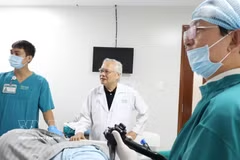
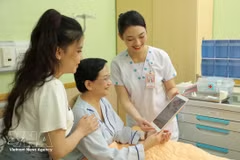
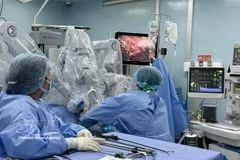
Medical workers examine a patient at Da Nang Hospital. (Photo published by VNA)

Medical workers examine a patient at Da Nang Hospital. (Photo published by VNA)

Dr Huynh Quoc Tam, Head of the Surgery Department at the centre, said that under the satellite hospital project, the facility had received professional support and technical transfers from core hospitals through hands-on training. As a result, doctors at the grassroots level have been able to perform surgery on several complicated cases.

While the referral rate stood at 14.2% in 2022, it had fallen to 9.5% by 2025, he added.

Investing in human resources for satellite facilities

The Ministry of Health has approved the project for 2026-2030, aiming to develop at least 200 additional satellite hospitals nationwide and regularly implement safe, effective and sustainable techniques and technical packages at grassroots facilities.

The project also aims to develop the satellite hospital network into an important component of the national medical examination and treatment system, contributing to comprehensive improvements in the professional capacity, management capacity and service quality of healthcare facilities.

In the central economic hub, those selected as core hospitals participating in the project include Da Nang Hospital, Da Nang Hospital for Women and Children, Da Nang Traditional Medicine Hospital and the Da Nang oncology hospital, among others.

Dr Nguyen Canh Viet, Director of the Hai Chau regional medical centre, said the facility had been selected as a satellite unit of Da Nang Hospital. Building on its existing foundation, the centre had proactively prepared human resources, upgraded infrastructure and proposed the procurement of medical equipment to be ready to receive transferred techniques.

Dr Pham Tran Xuan Anh, Deputy Director of Da Nang Hospital, said that during the 2023-2025 period, the hospital had organised more than 40 training courses and transferred hundreds of techniques to lower-level facilities under the satellite hospital project. The model proved effective as the referral rate at grassroots hospitals and medical facilities in the former Da Nang city fell by more than 50%.

According to the municipal Department of Health, training and technical transfers from higher-level hospitals to regional medical centres are producing clear results. Local healthcare facilities are continuously improving their examination and treatment capacity, reducing referrals and strengthening public confidence in their services./.
VNA

See more

Illustrative image (Photo: daibieunhandan.vn)

Ho Chi Minh City digitises 99.4% of hospital records

As of July 2026, 163 of the city's 164 hospitals, or 99.4%, adopted electronic medical records, the report said. About 64% of public hospitals and 65% of private hospitals now run the technology across their entire operations

Yersin International Clinic in Ho Chi Minh City. (Photo: VNA)

Ho Chi Minh City eyes more foreign medical tourists

Director of the municipal Department of Health Tang Chi Thuong said a key prerequisite for attracting foreign patients is a strategy to develop centres of medical excellence. He proposed selecting hospitals and specialties with strong expertise for investment towards international standards, particularly in competitive fields such as cardiology, oncology, robotic surgery, assisted reproduction, paediatrics, dentistry, cosmetic medicine, specialised health check-ups, traditional medicine and rehabilitation.

A nurse from Children's Hospital No. 1, Ho Chi Minh City, collects a blood sample for HIV testing from an infant. (Illustrative photo: VNA)

Health cooperation adds fresh momentum to Vietnam-US relations

Through this MOU, the US Department of State, working with Congress, plans to provide 98.75 million USD in life-saving global health assistance over the next five years, including 21.385 million USD in dedicated Global Health Security funding, to support Vietnam’s transition to full country ownership of its HIV/AIDS and tuberculosis programmes while strengthening its capacity to detect and respond to emerging and re-emerging infectious disease threats.

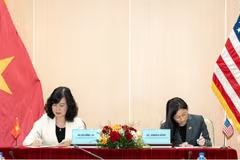
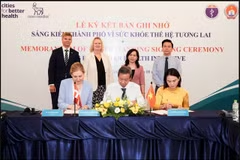
Minister of Health Dao Hong Lan and US Ambassador to Vietnam Jennifer McNamara Wick sign the memorandum of understanding on health cooperation. (Photo: US Embassy in Vietnam)

Vietnam, US launch five-year health cooperation

The cooperation will also support Vietnam in strengthening its healthcare capacity and gradually enhancing self-reliance in HIV/AIDS and tuberculosis prevention and control programmes, as well as in responding to emerging and re-emerging infectious diseases.

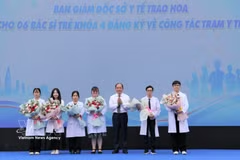
Director of the Ho Chi Minh City Department of Health Tang Chi Thuong (third, right) presents flowers to congratulate six young doctors who have volunteered to work at grassroots-level health stations (Photo: VNA)

Ho Chi Minh City strengthens grassroots healthcare workforce

Ho Chi Minh City's Department of Health on September 10 reviewed a pilot programme combining hospital-based practice with work at grassroots health stations and organised the fourth healthcare job fair, attracting nearly 1,000 candidates and 94 recruiters offering 806 positions.

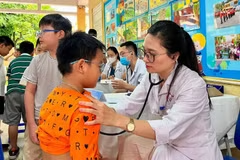
Children undergo health screening. (Photo: Dong Da General Hospital in Hanoi)

Vietnam to screen students nationwide for five health risks from 2028

Vietnam will launch nationwide screening for five groups of school-related diseases and health conditions among students from preschool through high school from 2028, including overweight and obesity, refractive errors, spinal curvature, oral diseases and mental health disorders.

A doctor provides dental checkup for a student. (Photo: VNA)

Free health checkups for children ahead of new school year

According to the Hanoi Department of Health, the city has 4,776 educational institutions with more than 2.2 million preschool and school students. The health campaign will run from August 18 to September 4, targeting 100% coverage before the new school year begins.

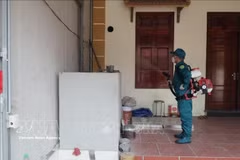
Spraying insecticide to prevent dengue fever in Dan Hoa commune, Hanoi. (Photo: VNA)

Hanoi steps up dengue prevention as cases rise

According to the Hanoi Centre for Disease Control (CDC), 316 dengue cases were recorded across 74 communes and wards in the city from August 7-14, up 81 from the previous week. Eleven new outbreaks were also reported, bringing the total number since the beginning of 2026 to 63, with 24 still active.

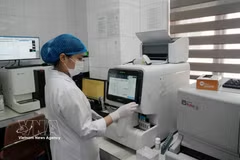
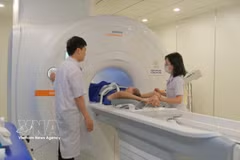
Screening and early cancer detection using advanced medical equipment at a healthcare facility (Photo: VNA)

Vietnam targets Southeast Asia’s leading medical tourism position by 2030

Medical tourists to Vietnam currently mainly comprise overseas Vietnamese and visitors from Cambodia, Laos, the Republic of Korea, Japan, Australia and several European countries. Popular services include cosmetic dentistry, assisted reproduction, aesthetic medicine, general health check-ups and some advanced medical specialties.

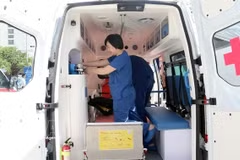
An ambulance from the pre-hospital emergency care service in Phu Quoc special zone in An Giang province. (Photo: VNA)

Pre-hospital emergency care system to be launched nationwide

From 2027, the national pre-hospital emergency management platform will be put into operation, connecting data with the 113, 114 and 115 emergency call systems to facilitate rapid emergency dispatch and improve public access to emergency services.