Hanoi steps up dengue prevention as cases rise

According to the Hanoi Centre for Disease Control (CDC), 316 dengue cases were recorded across 74 communes and wards in the city from August 7-14, up 81 from the previous week. Eleven new outbreaks were also reported, bringing the total number since the beginning of 2026 to 63, with 24 still active.

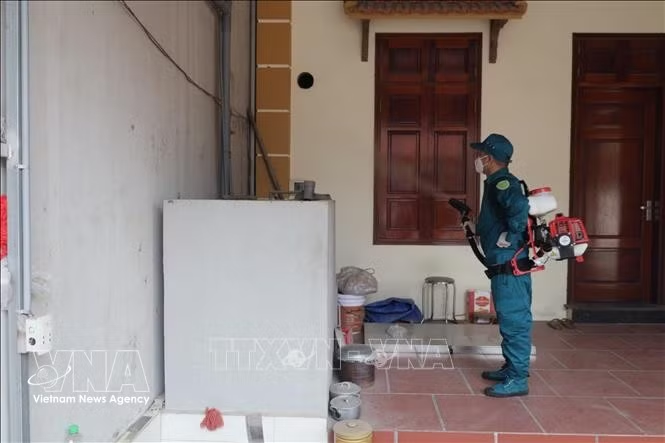
Spraying insecticide to prevent dengue fever in Dan Hoa commune, Hanoi. (Photo: VNA)

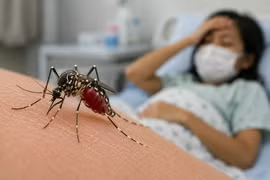
Hanoi (VNA) – Hanoi has activated an intensive campaign to prevent and control dengue fever amid a rapid increase in cases and growing risks of outbreaks across the city.

According to the Hanoi Centre for Disease Control (CDC), 316 dengue cases were recorded across 74 communes and wards in the city from August 7-14, up 81 from the previous week. Eleven new outbreaks were also reported, bringing the total number since the beginning of 2026 to 63, with 24 still active.

Health authorities warned that dengue is no longer following its previous seasonal pattern but is occurring year-round, with rapid and unpredictable developments. The approaching new school year, which will bring large numbers of students back to Hanoi, together with erratic weather, could further increase transmission. Deputy Director of the municipal Department of Health Vu Cao Cuong said the number of cases has risen sharply in recent weeks, with some patients developing severe symptoms. He also warned of the potential spread of hand, foot and mouth disease as the new academic year approaches.

Inspections have found that some outbreaks were detected too late, with cases reported more than seven days after symptom onset, resulting in the loss of the “golden time” for early intervention.

To strengthen prevention, Hanoi is expanding a proactive infectious disease control model piloted in Khuong Dinh ward and O Dien commune since July. The model shifts the focus from managing cases to managing risks, enabling authorities to identify areas at high risk before outbreaks occur. The city is establishing community teams led by village or residential group heads, with health workers providing technical guidance. Digital tools, including QR-code scanning, are being used to update mosquito breeding-site data in real time.

At a city-wide online meeting on August 17, Vice Chairwoman of the Hanoi People’s Committee Vu Thu Ha ordered all 126 communes and wards to activate the peak dengue prevention campaign and review their “four on-the-spot” response plans.

She called for practical environmental sanitation campaigns covering every household, alley, construction site and public place, while urging authorities to strengthen direct communication, improve early detection and ensure adequate personnel, equipment and chemicals.

The Hanoi CDC will continue close surveillance, rapidly investigate and contain outbreaks, while health and education authorities will coordinate to clean and disinfect schools before students return.

The city aims to ensure that at least 95% of households and relevant public areas in outbreak zones are thoroughly treated, helping prevent further spread of dengue fever./.

VNA
See more

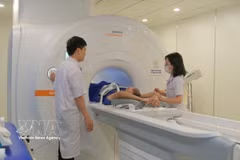
Screening and early cancer detection using advanced medical equipment at a healthcare facility (Photo: VNA)

Vietnam targets Southeast Asia’s leading medical tourism position by 2030

Medical tourists to Vietnam currently mainly comprise overseas Vietnamese and visitors from Cambodia, Laos, the Republic of Korea, Japan, Australia and several European countries. Popular services include cosmetic dentistry, assisted reproduction, aesthetic medicine, general health check-ups and some advanced medical specialties.

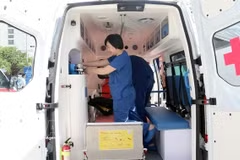
An ambulance from the pre-hospital emergency care service in Phu Quoc special zone in An Giang province. (Photo: VNA)

Pre-hospital emergency care system to be launched nationwide

From 2027, the national pre-hospital emergency management platform will be put into operation, connecting data with the 113, 114 and 115 emergency call systems to facilitate rapid emergency dispatch and improve public access to emergency services.

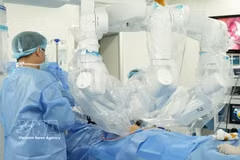
Foreign patients travel to Vietnam for robotic cancer surgery at one-tenth of US costs

Foreign patients travel to Vietnam for robotic cancer surgery at one-tenth of US costs

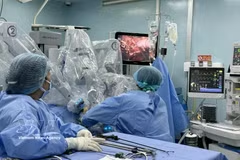
With robot-assisted surgery costing tens of thousands of dollars in the US and Singapore, a growing number of international patients are traveling to Vietnam for robotic cancer surgery, including procedures for prostate, gynecological and gastrointestinal cancers, using the US made da Vinci Xi system at costs starting from just 3,000 USD.

Under a phased rollout beginning in 2026, every resident in Ho Chi Minh City will receive at least one annual health check-up or health screening. (Photo: VNA)

Ho Chi Minh City develops integrated multi-tier healthcare system

Under the new model, healthcare is organised into interconnected levels based on people's needs rather than administrative boundaries. Patients can move seamlessly between levels while their electronic health records and treatment information remain connected through digital platforms, referral systems, telemedicine, electronic medical records, and integrated health databases.

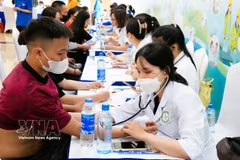
Doctors conduct heart and lung examinations for workers. (Photo: VNA)

Draft policy encourages people to prepare for old age from middle age

A draft circular guiding the implementation of the National Target Programme on Health Care, Population and Development (2026-2035) marks a shift from focusing solely on elderly care to encouraging healthy and independent ageing through early preparation. It covers healthy lifestyles, regular health check-ups, financial planning, suitable employment and home-based elderly care skills.

The meeting between the Vietnam Military Medical University delegation and leaders of the Lao Ministry of National Defence in Vientiane (Photo: VNA)

Vietnam, Laos deepen military medical cooperation

Since 1954, Vietnam Military Medical University has trained 687 Lao military medical personnel, including 322 doctors, 67 master's degree holders, 10 doctorate holders, and dozens of specialist physicians, alongside hundreds of pharmacists and medical technicians.

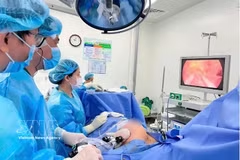
Vietnam's first penis transplant from a brain-dead donor is successfully performed at Viet Duc University Hospital. (Photo published by VNA)

Vietnam reaches new milestone in reconstructive transplant surgery

As the first operation of its kind in Vietnam, the hospital spent months developing treatment protocols, studying international experience and assembling a multidisciplinary team that included experts in transplantation, andrology, microsurgery, anaesthesia, immunology and pathology.

Dr. Nguyen Thanh Xuan is performing brain surgery on a patient (Photo published by VNA)

National strategy aims to build advanced medical ecosystem

Vietnam's adjusted healthcare network master plan for 2021–2030, with a vision to 2050, also outlines a regional structure covering the country's six socio-economic regions. It envisages 17 provincial general hospitals serving regional functions, at least one highly specialised hospital in each region, and at least one advanced medical facility in every province and city.