Dengue cases rise, outbreaks become more unpredictable

Vo Hai Son, Deputy Director of the ministry's Administration of Disease Prevention, said dengue fever is no longer following previous epidemiological trends. In 2025, infections remained elevated through November and December rather than declining at the end of the year as had traditionally been the case, indicating a shortening outbreak cycle.

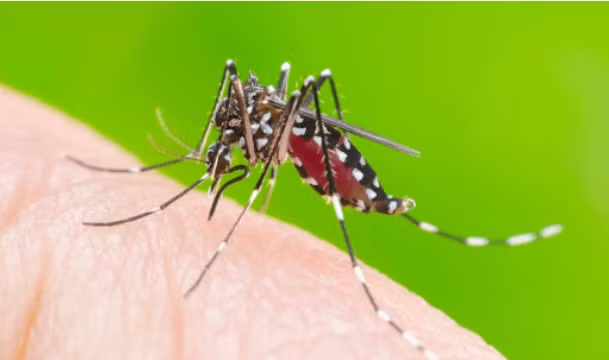
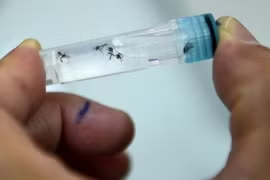
Illustrative photo: Internet

Hanoi (VNA) – Vietnam's health authorities are warning of increasingly complex dengue fever developments as infections surge, outbreak cycles become shorter and traditional seasonal patterns begin to shift, prompting calls for heightened vigilance and stronger disease prevention efforts.

According to the Ministry of Health (MoH), more than 50,000 dengue cases and five related deaths have been recorded nationwide since the beginning of the year, a 2.5-fold increase compared to the same period in 2025. The sharp rise suggests that outbreaks are occurring earlier and becoming harder to forecast.

Vo Hai Son, Deputy Director of the ministry's Administration of Disease Prevention, said dengue fever is no longer following previous epidemiological trends. In 2025, infections remained elevated through November and December rather than declining at the end of the year as had traditionally been the case, indicating a shortening outbreak cycle.

Weather conditions have also contributed to the spread of the disease. Extended periods of heat, humidity and rainfall have created favourable breeding conditions for mosquitoes, while the dominance of the DENV-2 serotype has been linked to a growing number of severe cases and hospital admissions.

Hanoi remains among the localities facing heightened risks due to its large population and rapid urbanisation. Since the beginning of 2026, the capital has recorded 337 cases across 93 wards and communes, higher than the figure reported during the same period last year. Although no major outbreaks have been identified, local health authorities have warned that case numbers could continue to rise and are maintaining close monitoring in affected areas.

Tran Nhu Duong, Deputy Director of the National Institute of Hygiene and Epidemiology, said an effective response depends on a three-pronged approach comprising enhanced surveillance and technical support from the health sector, active engagement by local authorities and stronger public awareness of prevention measures.

Meanwhile, Dao Huu Than, Deputy Director of the Hanoi Centre for Disease Control, emphasised that eliminating mosquitoes and larvae at household level remains the most practical and sustainable way to reduce transmission risks.

As dengue outbreaks become increasingly unpredictable and the risk of severe reinfection grows, health experts believe scientific and technological advances can strengthen prevention efforts. Angela Pratt, Representative of the World Health Organisation (WHO) in Vietnam, said the country has approved a dengue vaccine and is preparing pilot programmes to evaluate its effectiveness and feasibility before considering its inclusion in the national Expanded Programme on Immunisation.

However, health authorities stressed that vaccines and AI-powered early warning systems should be viewed as complementary tools rather than substitutes for traditional mosquito control measures.

Under the slogan “No larvae, no dengue”, the MoH has urged residents to regularly remove mosquito breeding sites, keep water containers covered, sleep under mosquito nets and seek prompt medical attention if a fever lasts more than two days, instead of attempting self-treatment at home./.
VNA

See more

At the launch of the 14th national red journey blood donation campaign in Ho Chi Minh City on June 11. (Photo: VNA)

National Red Journey blood donation campaign 2026 launched

Addressing the opening ceremony, Associate Professor, Dr. Nguyen Ha Thanh, Director of the NIHBT and head of the campaign’s organising committee, said the Red Journey is a symbol of dedication, compassion and social responsibility, and the campaign carries the hopes of millions of voluntary blood donors and helps bring life-saving opportunities to patients in urgent need of blood transfusions.

Da Nang will roll out a citywide health screening and periodic health check-up programme for all residents on July 1. (Illustrative photo: VNA)

Da Nang to launch citywide health screening programme on July 1

Director of the municipal Department of Health Tran Thanh Thuy said the city has developed a comprehensive plan for conducting free periodic health examinations and screening services throughout 2026, and prepared the necessary human resources, facilities and digital infrastructure to ensure effective implementation.

Students play football during a break atthe Hai Xuan Secondary School in Ninh Binh province . (Photo: VNA)

Vietnam targets annual health screening for all students by 2030

By 2030, all educational institutions are expected to have separate medical rooms equipped with essential medicines and healthcare equipment, adequate access to safe drinking water and sanitation facilities, and school meal services that comply with food safety regulations.

Staff from the Ho Chi Minh City First Aid Centre demonstrate first aid skills. (Photo: VNA)

Vietnam, France cooperate to build community first-aid network

The agreement focuses on establishing hundreds of first-aid stations across Long Chau’s pharmacy and vaccination network, standardising first-aid training for medical and pharmaceutical students, and expanding community health education activities nationwide.

In Hanoi, the temperature recorded in Lang Ha at 1 pm on May 26 reached 40 degrees Celsius. (Photo: VNA)

Proactive response needed to cope with extreme weather: Experts

Health experts warned that prolonged heat exposure could cause heatstroke, heat exhaustion and other serious health conditions. High-risk groups include the elderly, children, pregnant women, people working or exercising outdoors for long periods, and those suffering from chronic illnesses such as hypertension, chronic obstructive pulmonary disease, asthma and diabetes.

Ho Chi Minh City plans over 95 million USD for universal health screenings in 2026. (Illustrative photo: VNA)

Ho Chi Minh City earmarks over 95 million USD for universal health screenings in 2026

Ho Chi Minh City's free health examination programme, set to begin on May 25, is carried out at qualified healthcare facilities, mobile clinics at schools, factories and businesses, community-based screening sites arranged by local authorities, as well as through home visits to elderly residents, people living alone and those with limited mobility.

Healthcare workers are employed in an isolation and treatment area for patients infected with the Ebola virus in Entebbe, Uganda. (Photo: Xinhua/VNA)

Health Ministry calls for stronger preparedness against Ebola

Medical facilities were instructed to strengthen surveillance, especially for individuals who have travelled to or returned from outbreak-hit countries or areas within the previous 21 days. They were also asked to strictly enforce infection control measures, including protective procedures, screening, triage and isolation protocols for suspected or confirmed Ebola cases.