Ho Chi Minh cultural spaces shift focus from model-building to value promotion

A Ho Chi Minh cultural space can only truly live up to its purpose when these standards are translated into activities of each agency, organisation and residential community, said a lecturer at the Ho Chi Minh City Cadre Academy.

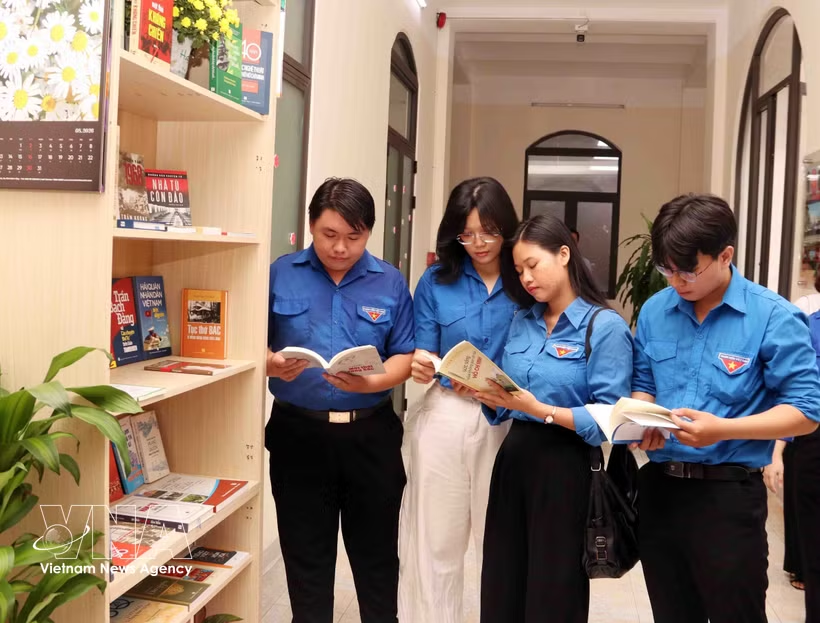
Youth union members read books introducing President Ho Chi Minh’s life, career and teachings at a cultural space dedicated to the late leader in Ho Chi Minh City. (Photo: VNA)

Ho Chi Minh City (VNA) – Building cultural spaces dedicated to President Ho Chi Minh is no longer limited to setting up exhibition models, but is being linked with Ho Chi Minh City's implementation of Politburo Directive No. 07-CT/TW on promoting the study and practice of the late leader’s thought, ethics, methodology and style in the new period of development.

The focus is on translating his thoughts and ethical values into standards of conduct in public service and daily life, while promoting them more widely in the digital environment.

Dr Nguyen Thi Thanh Huyen, a lecturer at the Ho Chi Minh City Cadre Academy, said a Ho Chi Minh cultural space is not simply an exhibition model. Rather, it is a cultural environment designed to ensure that his ideological, ethical and stylistic values are regularly present in social life, serving as a foundation for shaping the awareness and behaviour of officials, Party members and the people.

The transformation of awareness into action through experience, practice and education is a key distinction from traditional forms of communication and dissemination, she said.

Directive No. 07-CT/TW states that the study and practice of President Ho Chi Minh’s thought, ethics, methodology and style should be linked with building a culture of leadership, a culture of public service and a sense of responsibility in carrying out official duties, as well as standards of conduct among officials and Party members.

At the end of August, the municipal Party Committee issued a directive on continuing to build and promote the effectiveness of such cultural spaces in the new period of development. The move aims to make them a genuine spiritual foundation, driver of development and distinctive feature of the southern metropolis in the new era.

Huyen said that alongside developing physical spaces, the city needs to build a “space of values”. This is at the heart of efforts to establish ethical standards, cultural norms of behaviour, working styles and lifestyles among officials, Party members and the people.

A cultural space can only truly live up to its purpose when these standards are translated into activities of each agency, organisation and residential community, she said.

After three years of implementation, more than 7,840 models, competitions, programmes, projects and cultural institutions associated with such spaces have been established across the city. More than 3,560 libraries, book collections, reading spaces and thematic facilities devoted to the founder of modern Vietnam have also been developed, along with more than 3,900 cultural establishments incorporating content on studying and following his example.

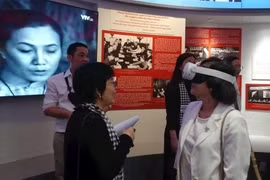
President Ho Chi Minh’s ideological, ethical and stylistic values have gradually become more deeply embedded in social life. The models established have taken diverse forms, including reading rooms, thematic libraries, areas displaying photographs and artefacts, learning corners devoted to the late leader, digital exhibitions, QR-code information systems, digital museums, 3D technology applications and multimedia communications products.

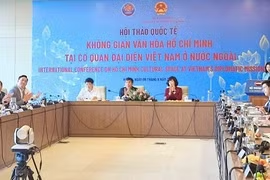
Dr Bui Thi Ngoc Trang, former Deputy Director of the Ho Chi Minh City Cadre Academy, stressed that the municipal Party Committee’s directive also calls for greater development of the spaces in the digital environment, identifying this as an important means of broadening access.

Particular attention is being paid to building a digital culture based on ethical standards and civility online, she said. The digital space may be highly modern, but the way people behave and communicate in it should still be rooted in fundamental values – showing care and respect for others, acting honestly and responsibly, and living for the benefit of the community.

Hong Kim Ngoc, head of the culture and arts division under the municipal Party Committee’s commission for publicity, noted that amid digital transformation, the spaces are no longer confined to physical locations but are expanding online through websites, social media platforms, digital databases, digital museums, QR codes and multimedia communications products.

This is creating opportunities for such values to reach a wider range of people, particularly younger generations./.

VNA
See more

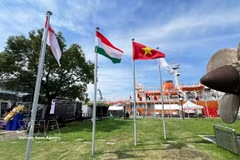
The national flag of Vietnam flies alongside the flags of other countries at the 2026 Asian Games. (Photo: VNA)

Vietnamese national flag flies at 2026 Asian Games

As the Vietnamese national anthem played, the red flag with a yellow star was raised at Nagoya Port, marking the official presence of the Vietnamese delegation at ASIAD 2026 and boosting the athletes’ morale ahead of the competitions.

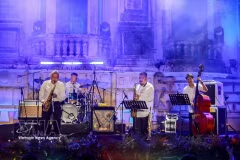
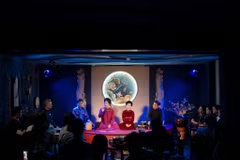
The Song Hong Jazz Band perform at the opening ceremony of the Hanoi International Jazz Festival 2026 on September 17. (Photo: VNA)

Hanoi International Jazz Festival 2026 kicks off

With open and free-of-charge activities held at both professional performance venues and public spaces, Hanoi Jazztival 2026 seeks to expand access to jazz and make the genre more visible in the capital’s urban cultural life.

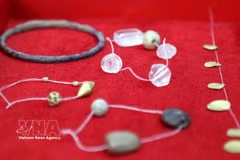
Glass beads, gold-coloured metal beads and leaf-shaped objects uncovered in the tombs. (Photo: VNA)

Archaeologists uncover artefacts in two 1,500-year-old tombs

Based on their structure, construction techniques and unearthed artefacts, the two tombs are identified as brick-built burial chambers. Such tombs, commonly known as brick tombs or Han tombs, were relatively widespread in areas along major rivers and waterways, including the Luc Dau, Bach Dang, Y Bich and Lam river systems, which served as important links between settlements and the sea.

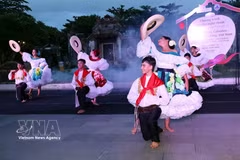
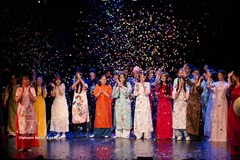
A performance staged by Colombian dancers at the artistic exchange in Hoi An town, Da Nang city, on September 16, 2026. (Photo: VNA)

Artistic exchange helps foster Vietnam-Colombia friendship

Co-organised by the Embassy of Colombia, the Da Nang Department of Foreign Affairs, the municipal Department of Culture, Sports and Tourism, and the Hoi An World Cultural Heritage Conservation Centre, the programme contributed to strengthening cultural exchanges, connecting young people and promoting friendship between the two countries.

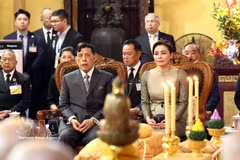
Thai King Maha Vajiralongkorn and Queen Suthida Bajrasudhabimalalakshana at the prayer ceremony (Photo: VNA)

Thai King, Queen visit Quan Su pagoda for prayer ceremony

The King and Queen offered candles and flowers, after which monks and Buddhists chanted prayers for their peace and well-being, and deeper progress in the Vietnam-Thailand Comprehensive Strategic Partnership as well, timed to the 50th anniversary of diplomatic ties.

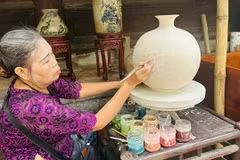
An artisan from Bat Trang Village demonstrates part of the ceramic making process. (Photo: baovanhoa.vn)

Hanoi's old streets and crafts available at Temple of Literature

Inspired by the streetscapes and their architecture, traditional craft streets and daily life of ancient Thang Long, the programme presents images and historical artefacts of Hanoi’s historic '36 Streets' while offering hands-on workshops with traditional craftspeople. It unfolds the story of a Hanoi rich in history and culture, yet dynamic and constantly evolving amid modern life.

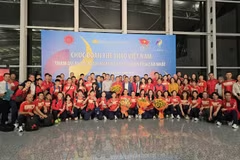
Vietnam sports delegation embarks on ASIAD 20 (Photo: baochinhphu)

Vietnamese sports delegation departs for ASIAD 20

Vietnamese teams are travelling to Japan in separate groups according to their competition schedules. Shooting, karate and sepak takraw are among the teams carrying high expectations after winning gold medals at ASIAD 19. The Vietnamese delegation is targeting at least four gold medals at ASIAD 20.

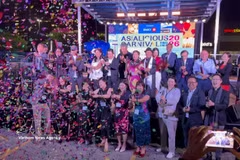
Members of the organisers set off fireworks to open the Asialicious Carnival 2026. (Photo: VNA)

Vietnam leaves strong imprint at Asian cultural festival in Canada

Vietnam’s presence at the event was highlighted through artistic performances and activities promoting Vietnamese tea and coffee. The song “Viet Nam trong toi la” (Vietnam in me) conveyed to Canadian audiences a message of national pride and the beauty of Vietnam and its people.

The “Brilliant Vietnam” Cultural Festival, held from June 26–28 in Prague, Czech Republic, attracts a large number of overseas Vietnamese. (Illustrative photo: VNA)

Great National Unity Festival to be held abroad for first time

The festival aims to promote the traditions of the VFF, affirm the value of the great national unity bloc, and strengthen ties between Vietnamese communities abroad and the homeland. It is also intended to foster patriotism and national pride, encourage the preservation of the Vietnamese language and cultural identity, and inspire overseas Vietnamese (OVs) to contribute to national development.