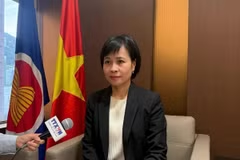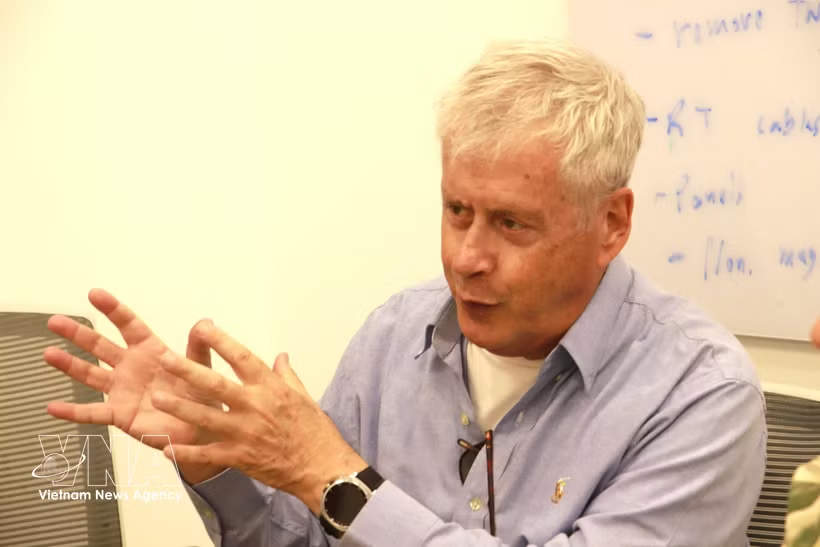
Tel Aviv (VNA) – Vietnam needs to build a national-level quantum ecosystem with close coordination among the Government, universities, technology companies, and industries in training, research, technology development, and commercialisation, said Dr Nissan Maskil, CEO of Qarakal Quantum.
In an interview granted to Vietnam News Agency correspondents in Israel, Maskil said Vietnam should place particular emphasis on developing human resources, research infrastructure, and technical capabilities, while gradually putting quantum technologies into practical use and moving toward commercialisation.
Israel’s experience showed that a competitive quantum industry could not rely solely on physics research or access to quantum computers developed overseas, he said, noting that countries should gradually build domestic capabilities in human resources, research, engineering, manufacturing, operation, application development, and quantum system expansion.
He proposed establishing a national or regional quantum computing centre equipped with an operational quantum computer as core infrastructure.
"The centre should serve as a shared platform connecting education, academic research, technology development, and industrial applications. Universities can use the system to educate and train the next generation of quantum scientists and engineers, while researchers gain direct access to real quantum hardware for developing and validating new algorithms, architectures, control methods, and applications," he said.
Universities could use the system to train scientists and engineers while accessing actual quantum hardware to test algorithms, architectures and control methods. Businesses could bring practical problems to the centre, test quantum applications, compare their performance with classical computing and conduct pilot projects before making commercial-scale investments.
The centre should provide access not only to the quantum processing unit (QPU), but to the complete computing environment: classical high-performance computing/AI resources, quantum software and development tools, digital twins and simulators, training programmes, application-development teams, and technical support.
According to Maskil, this model creates a continuous pathway from education to research, prototype, industrial pilot, and commercial deployment. The goal should go beyond a research centre to an innovation and commercialisation hub for quantum technology that trains human resources, advances research, supports businesses, generates intellectual property and fosters startups.
Regarding human resources, the CEO said Vietnam should invest simultaneously in education, universities, research infrastructure, engineering capabilities and industrial development. Drawing on Israel’s experience, he stressed that quantum technology requires national-level coordination among the Government, universities, research institutes, technology businesses, industries and international partners.
He noted that the quantum workforce could not consist solely of physicists, as the industry would also require electrical and mechanical engineers, cryogenics specialists, manufacturing engineers, materials scientists, programmers, algorithm experts, systems engineers and application specialists.
Vietnam could consider interdisciplinary training covering quantum physics and information, electrical and electronic engineering, computer architecture, software and algorithms, materials, semiconductors, manufacturing, mechanics and cryogenics, as well as applications in chemistry, materials, AI, optimisation, cybersecurity and finance, he said.
Maskil emphasised that training should be linked to actual quantum infrastructure, giving students and engineers opportunities to work with operational systems and understand their full lifecycle, from quantum physics and qubit design to fabrication, packaging, cryogenics, control, integration, calibration, software, algorithms and applications.
Universities could cooperate through a national centre and share quantum computers, laboratories, manufacturing capabilities, software environments and training programmes, he added.
"For Vietnam, industry should therefore participate from the beginning. Semiconductor, telecommunications, AI, electronics, materials, chemical, pharmaceutical, financial, aerospace, and defence organisations can bring real industrial problems into the national quantum centre," he noted.
Businesses should be involved from the outset in identifying needs, training, research and testing. Meanwhile, universities, quantum companies, and industry can then jointly develop proof-of-concept projects and progressively move successful technologies toward commercialisation.
Vietnam could develop a national quantum programme linked to a quantum technology and computing centre. The centre would provide shared infrastructure while universities will focus on training and research, technology companies on system development and technical expertise, and industries on application needs and market demand.
Regarding potential cooperation with Vietnam, Maskil said one option is to establish a quantum computing centre involving Vietnamese scientists, engineers and technical personnel from installation and integration to system operation.
Under this model, Vietnamese teams could gradually take on greater roles in designing, engineering, integrating and operating subsequent generations of quantum computers. Meanwhile, Israel could contribute technology, architecture, technical experience, simulation capabilities and software.
"The long-term goal is not simply to bring a quantum computer to Vietnam, but to work together so that Vietnam develops the capability to design, integrate, operate, improve, and eventually contribute to building the next generations of quantum computers fabrication locally," the expert said./.
See more
National cybersecurity architecture framework issued
The framework aims to establish a national master plan for technologies, data and defence processes, and specify shared cybersecurity components under the National Digital Architecture Framework.
Cross-border QR payments: Efforts must go beyond expanding coverage
Data from the State Bank of Vietnam’s Payment Department shows that Vietnam currently has more than 2.5 million domestic payment-accepting units. However, the number accepting VietQR Global remains relatively small, at around 154,000, or just over 6%.
AI Centre of Excellence developed in Ho Chi Minh City
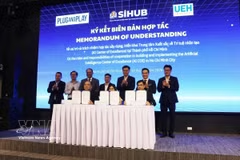
Under the MoU, the AI COE is envisioned as a platform bringing together the State, academia and businesses to promote research, incubation, startup acceleration and the practical application of AI in Ho Chi Minh City.
Vietnam accelerates innovation to boost growth, competitiveness
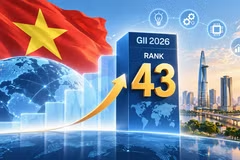
By 2030, Vietnam aims to rank among the world’s top 40 in the GII; raise total social investment in R&D to at least 2% of GDP, with non-State funding accounting for over 60%; increase international scientific publications by an average of 10% annually; and raise the number of patent applications and granted patents by an average of 16-18% annually.
Vietnam seeks RoK help on nuclear power, AI
The Korean Ministry of Trade, Industry and Resources (MOTIR) was urged to share practical lessons from its nuclear sector with Vietnam, including institutional and policy frameworks governing the roles of policymaking and regulatory agencies, advanced nuclear power technology, experience in building a domestic nuclear supply chain, and long-term workforce training through specialised courses, hands-on work and staff exchanges.
Up to 192,000 USD available for each AI technology innovation task
The tasks will run for no more than 12 months, with state funding capped at half of total costs, while participating companies are required to provide at least half in cash.
Science ministry focuses on eliminating mobile signal dead zones in 273 villages
The Ministry of Science and Technology will launch a project to develop a system of national key research and testing centres and laboratories in October, while continuing to restructure national science and technology programmes towards more focused resource allocation.
Data, technology key to strengthening marine governance: experts
Key priorities include accelerating the use of AI, IoT, satellite data, autonomous vehicles and automated monitoring; developing a national marine data centre; investing in core technologies and high-quality human resources; and creating a market for marine technology products.
Strong science - technology promotion efforts drive Vietnam’s innovation ranking higher
Vietnam’s innovation output ranking also rose two places from 37th to 35th, helping the country meet the target set by the Government in Resolution No. 02/NQ-CP for 2026.
Da Nang aims to become global city
Experts at the Da Nang Innovation Startup Festival (SURF) 2026 said that although Vietnam has a promising domestic market, international venture capital funds expect innovative startups seeking rapid growth to develop products to compete in international markets.
National key laboratories must focus on strategic technologies: Deputy PM
The Ministry of Science and Technology was tasked with coordinating with ministries, sectors and localities to build a database and capacity map of laboratories and research and testing centres nationwide by November 2026, and assess the capacity of each facility.
Vietnam offers up to 150,000 USD to accelerate enterprise AI adoption
NATIF plans to select and sign contracts for about 15 key AI application projects in 2026. From 2027, the programme is expected to expand to around 50 projects annually.
Ho Chi Minh City to develop specialised digital technology park
According to Su Ngoc Khuong, Senior Director of Investment at Savills Vietnam, infrastructure will become one of the key drivers shaping a new development cycle for the property market. Major transport projects are improving inter-regional connectivity and creating new growth poles along economic corridors.
PM urges stronger contribution of science, technology to economic growth
Ministries, agencies and localities were also told to accelerate the development of national databases and digital infrastructure, with key databases on education, social security, personnel and health to be completed by November 30, 2026.
AI helps transform tourism experiences in digital era
Bui Thanh Tu, Marketing Director of Bestprice Travel, said treating data as an asset and applying AI to specific business needs have produced concrete results in the company’s travel operations.
Hanoi hosts International Olympiad on Astronomy and Astrophysics for first time
Vietnam is participating in IOAA 2026, which runs through October 5, with a 10-member team selected in accordance with regulations set by the Ministry of Education and Training.
Top leader calls for greater contribution from Vietnamese experts in Canada
At a meeting with representatives of the Canadian Vietnamese Scientists and Experts Association (CVSEA) on September 25 (local time), the top leader praised the contributions and professional capabilities of Vietnamese experts and intellectuals in Canada, describing them as a valuable intellectual resource and an important bridge connecting Vietnam with Canada and the wider world.
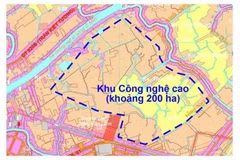
Can Tho city to establish over 192 million USD hi-tech park
The Can Tho Hi-Tech Park is set to become a multifunctional economic-technical zone linking scientific research, strategic technology development, business incubation, high-quality human resources training and the production of high-value-added products.
Science-technology diplomacy helps build bridge for Vietnam-Hong Kong (China) strategic cooperation: diplomat
Hong Kong's high-quality universities and research institutions, international financial centre, startup ecosystem and access to the Guangdong-Hong Kong-Macao Greater Bay Area (GBA) offer significant opportunities for collaboration with Vietnam.
Vietnam enlists OV in push for tech edge
The Ministry of Science and Technology has named the National Foundation for Science and Technology Development (NAFOSTED) as the focal point to gather research problems and match them with experts under national sci-tech schemes, said NAFOSTED Deputy Director Nguyen Phu Binh. Building on its existing AI network, NAFOSTED will build a system to track those problems alongside a database of Vietnamese scientists abroad.