National cybersecurity architecture framework issued

The framework aims to establish a national master plan for technologies, data and defence processes, and specify shared cybersecurity components under the National Digital Architecture Framework.

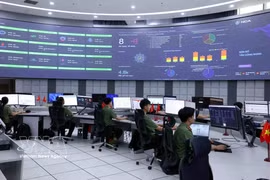
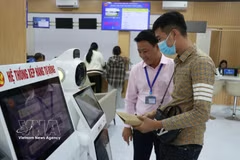
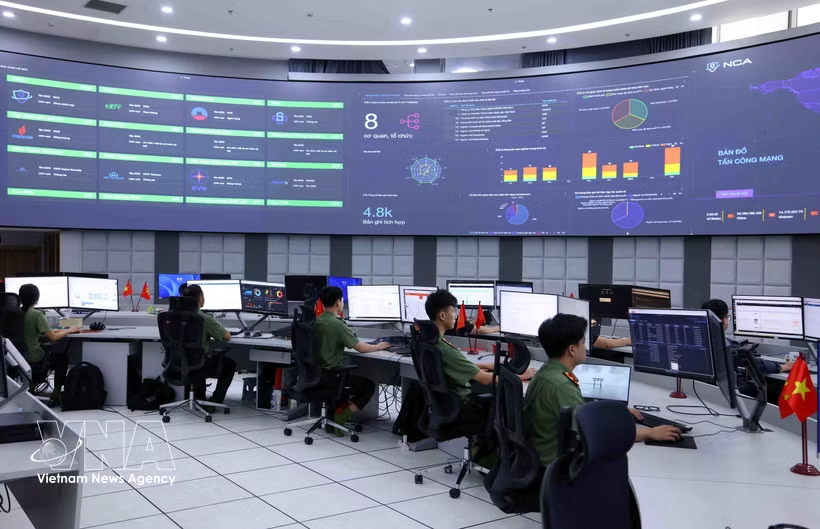
The National Cybersecurity Architecture Framework sets out basic requirements for connectivity and sharing of cybersecurity monitoring data, while avoiding duplicate investment in shared cybersecurity components already provided. (Illustrative photo: VNA)

Hanoi (VNA) – The Prime Minister signed Decision No. 1875/QD-TTg on September 30, issuing the National Cybersecurity Architecture Framework, Version 1.0.

The framework aims to establish a national master plan for technologies, data and defence processes, and specify shared cybersecurity components under the National Digital Architecture Framework. It follows the principles of shared use and shared resources while avoiding unnecessary and overlapping investment as stipulated in Articles 6 and 30 of the Government's Decree No. 331/2026/ND-CP.

The National Cybersecurity Architecture Framework includes a national cybersecurity operations platform for unified monitoring, coordination and command of cybersecurity incident response; a national cyber defence platform serving as a protective shield for the digital perimeter and critical systems; end-point data security and safety infrastructure to protect devices and end users at agencies and organisations; and specialised cybersecurity systems among the national shared digital platforms.

The document clearly identifies shared cybersecurity components across the entire political system, providing a basis for agencies and localities to develop and deploy technological solutions while ensuring consistency in connection and data standards.

The framework sets out basic requirements for connectivity and sharing of cybersecurity monitoring data, while avoiding duplicate investment in shared cybersecurity components already provided. It also defines minimum cybersecurity requirements based on the level of information systems.

It provides a reference architecture for ministries and ministry-level agencies; People's Committees of provinces and cities; socio-political organisations using state budget funds; State-owned enterprises and non-business public units operating information systems of importance to national security; and agencies of the Party, National Assembly, Office of the President, Vietnam Fatherland Front Central Committee, People's Courts and People's Procuracies.

Specific technical requirements for cybersecurity components at each level of information systems are governed by Decree No. 331/2026/ND-CP and National Standard TCVN 14423:2026 on cybersecurity, information systems and basic requirements. They are therefore not repeated in the National Cybersecurity Architecture Framework.

Four-layer national architecture

The National Cybersecurity Architecture Framework is designed based on an active defence approach and integrated with the National Digital Architecture Framework. It consists of two main groups: the National Cybersecurity Architecture as the “pillar component”, and cybersecurity components in the digital architecture frameworks of agencies and organisations as “satellite components”.

The architecture comprises four closely linked functional layers, creating a comprehensive cybersecurity ecosystem covering monitoring infrastructure, strategic data, operational platforms, and command and management.

The four layers are shared cybersecurity infrastructure across the political system; shared data across the political system; shared cybersecurity application and operational platforms across the political system; and interaction and measurement channels.

The framework also provides a conceptual reference model for People's Committees of provinces and cities to incorporate cybersecurity components into their provincial-level digital architecture frameworks.

A separate reference model applies to Party agencies, the National Assembly, the Vietnam Fatherland Front, Government agencies (including ministries and ministry-level agencies), important State-owned enterprises, and other agencies and organisations within the political system./.

VNA
See more

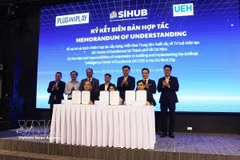
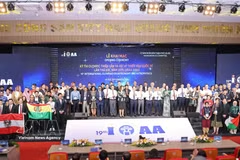
The signing ceremony of an MoU on the roles and responsibilities of cooperation in building and implementing the Artificial Intelligence Centre of Excellence (AI COE) in Ho Chi Minh City (Photo: VNA)

AI Centre of Excellence developed in Ho Chi Minh City

Under the MoU, the AI COE is envisioned as a platform bringing together the State, academia and businesses to promote research, incubation, startup acceleration and the practical application of AI in Ho Chi Minh City.

Vietnam accelerates innovation to boost growth, competitiveness

Vietnam accelerates innovation to boost growth, competitiveness

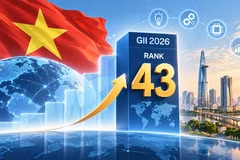
By 2030, Vietnam aims to rank among the world’s top 40 in the GII; raise total social investment in R&D to at least 2% of GDP, with non-State funding accounting for over 60%; increase international scientific publications by an average of 10% annually; and raise the number of patent applications and granted patents by an average of 16-18% annually.

Vietnamese Minister of Science and Technology Vu Hai Quan (right) and RoK Minister of Trade, Industry and Resources Kim Jung Kwan at their meeting on September 30 (Photo: vnexpress.net)

Vietnam seeks RoK help on nuclear power, AI

The Korean Ministry of Trade, Industry and Resources (MOTIR) was urged to share practical lessons from its nuclear sector with Vietnam, including institutional and policy frameworks governing the roles of policymaking and regulatory agencies, advanced nuclear power technology, experience in building a domestic nuclear supply chain, and long-term workforce training through specialised courses, hands-on work and staff exchanges.

Moving a jack-up rig to an offshore oil and gas drilling site (Photo: Petrovietnam)

Data, technology key to strengthening marine governance: experts

Key priorities include accelerating the use of AI, IoT, satellite data, autonomous vehicles and automated monitoring; developing a national marine data centre; investing in core technologies and high-quality human resources; and creating a market for marine technology products.

Da Nang city is actively attracting investment and talents (Photo: nhandan.vn)

Da Nang aims to become global city

Experts at the Da Nang Innovation Startup Festival (SURF) 2026 said that although Vietnam has a promising domestic market, international venture capital funds expect innovative startups seeking rapid growth to develop products to compete in international markets.

Digital technology applications in cultural and tourism in Ho Chi Minh City (Photo: VNA)

Ho Chi Minh City to develop specialised digital technology park

According to Su Ngoc Khuong, Senior Director of Investment at Savills Vietnam, infrastructure will become one of the key drivers shaping a new development cycle for the property market. Major transport projects are improving inter-regional connectivity and creating new growth poles along economic corridors.

General Secretary of the Communist Party of Vietnam Central Committee and President To Lam and representatives of the Canadian Vietnamese Scientists and Experts Association (CVSEA) on September 25. (Photo: VNA)

Top leader calls for greater contribution from Vietnamese experts in Canada

At a meeting with representatives of the Canadian Vietnamese Scientists and Experts Association (CVSEA) on September 25 (local time), the top leader praised the contributions and professional capabilities of Vietnamese experts and intellectuals in Canada, describing them as a valuable intellectual resource and an important bridge connecting Vietnam with Canada and the wider world.

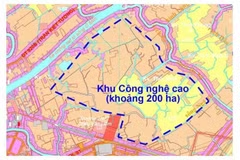
Map showing the proposed location for the Can Tho High-Tech Park. (Photo: People's Committee of Can Tho city)

Can Tho city to establish over 192 million USD hi-tech park

The Can Tho Hi-Tech Park is set to become a multifunctional economic-technical zone linking scientific research, strategic technology development, business incubation, high-quality human resources training and the production of high-value-added products.

General Secretary of the Communist Party of Vietnam Central Committee and President To Lam with a delegation of outstanding overseas Vietnamese attending the 4th World Conference of Overseas Vietnamese and the 2024 forum of OV intellectuals and experts on August 23, 2024. (Photo: VNA)

Vietnam enlists OV in push for tech edge

The Ministry of Science and Technology has named the National Foundation for Science and Technology Development (NAFOSTED) as the focal point to gather research problems and match them with experts under national sci-tech schemes, said NAFOSTED Deputy Director Nguyen Phu Binh. Building on its existing AI network, NAFOSTED will build a system to track those problems alongside a database of Vietnamese scientists abroad.