Vietnam’s F&B market recovers amid intensifying competition

Industry revenue reached an estimated 432.7 trillion VND (16.7 billion USD) in the first six months of 2026, up from 406.1 trillion VND a year earlier, according to a report released by iPOS.vn and Nestlé Professional on September 9.

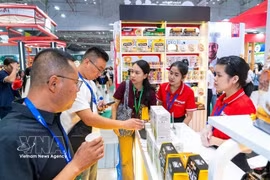
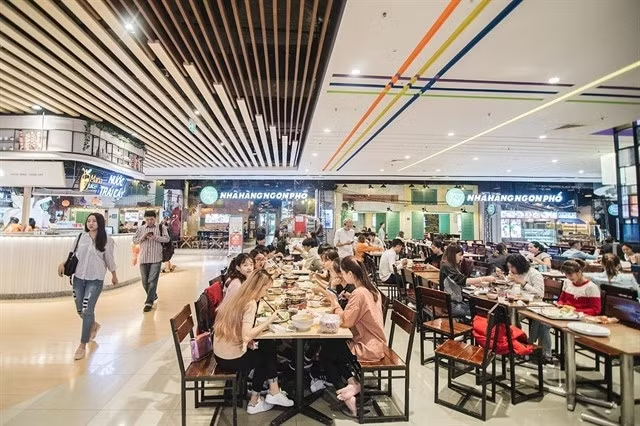
The number of food service outlets rises to about 329,200 by the end of the second quarter, from around 299,900 a year earlier. (Photo: thuongtruong.com.vn)

Hanoi (VNS/VNA) – Vietnam’s food and beverage (F&B) industry posted 6.6% revenue growth in the first half of 2026, but a sharp rise in the number of outlets meant average revenue per store remained broadly flat and even edged down, highlighting intensifying competition despite signs of a market recovery.

Industry revenue reached an estimated 432.7 trillion VND (16.7 billion USD) in the first six months of 2026, up from 406.1 trillion VND a year earlier, according to a report released by iPOS.vn and Nestlé Professional on September 9.

But the number of food service outlets rose to about 329,200 by the end of the second quarter from around 299,900 a year earlier, adding nearly 30,000 outlets to the market.

That means a larger share of total industry revenue is being spread across a significantly greater number of businesses, leaving many individual operators with little improvement in sales despite headline growth in the overall market.

The divergence underscores the pressure facing Vietnam’s F&B sector after a year of intense consolidation, as new outlets increasingly compete for the same pool of consumers.

Nguyen Do Anh Quan, brand director at iPOS.vn, said the first half of the year is typically a period of significant market consolidation.

“After the Lunar New Year holiday, outlets with weak cash flows or an unstable operating foundation often have to leave the market,” Quan said.

The total number of outlets declined just 0.1% from the end of 2025, suggesting closures have slowed while new openings have been sufficient to offset most businesses leaving the market, he said.

“This can also be seen as a sign that the market is gradually becoming more stable, while F&B businesses are beginning to operate in a more structured, professional and planned manner,” Quan said.

The revenue growth also needs to be viewed against seasonal and price factors. The 2025 Lunar New Year fell on January 29, splitting the peak shopping season between December 2024 and January 2025. In 2026, Lunar New Year fell on February 17, nearly three weeks later, meaning most of the peak consumption period fell within the first half of this year.

Consumer prices rose 4.4% year-on-year on average in the first half of 2026. This suggests that part of the 6.6% increase in F&B revenue reflected higher prices and broader macroeconomic factors, rather than a corresponding increase in real consumer demand.

The strain on individual businesses is reflected in a survey of 481 F&B operators across 15 provinces and cities. About 43% reported lower revenue than a year earlier. Of these, 27.5% recorded declines of 5 to 20% but remained in operation, while 15.2% suffered declines of more than 20% and faced significant difficulties.

At the other end of the spectrum, 20.2% of businesses reported revenue growth of more than 5%, while 37.1% saw relatively stable revenue.

The figures suggest that consumer spending has not disappeared from the market, but is being allocated more selectively. Even businesses operating in the same area and facing similar cost structures and customer demographics can post sharply different results.

Vu Thanh Hung, CEO of iPOS.vn, was quoted by Dau tu (Investment) newspaper as saying that consumers were still eating and drinking outside the home and were even spending more, but were becoming more selective and demanding experiences that justified the money they spent.

“Total spending has not left the market, it has simply changed destinations,” Hung said.

He said the reallocation of consumer spending helps explain why businesses operating under similar conditions have achieved markedly different results over the past six months.

The divergence is particularly visible between food and beverage businesses. While the share of outlets reporting declining revenue was broadly similar in the two segments, food businesses recorded stronger growth. Some 25.6% of food businesses reported growth of more than 5%, compared with 15.8% among beverage outlets.

Food businesses can rely on demand for meals, group dining and bundled products to increase average bill values. Beverage outlets, by contrast, face intense competition for each upsizing decision, additional topping or attempt to persuade customers to choose a higher-priced drink.

Pressure is also coming from a growing number of mass-market and low-cost models. Some 88.5% of surveyed owners said they had clearly seen such models emerge around their business areas, while about 58.2% said they had actually felt the pressure.

Some 35.4% of outlets kept their existing sales approach and accepted losing some customers, while 22.8% proactively cut prices, introduced promotions or added lower-priced products.

The trend suggests low-cost models have not yet forced the entire market into across-the-board price cuts, but are gradually taking customers away from outlets that are slow to adapt./.

VNA

See more

Illustrative image (Photo: VNA)

New investor demands spur overhaul of Hai Phong’s industrial ecosystem

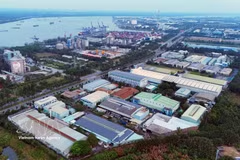
Foreign direct investment into Hai Phong remained among the strongest in Vietnam in the first nine months of 2026. Registered capital is estimated at more than 3.638 billion USD, or 93.3% of the full-year target of 3.9 billion USD. The inflow is helping the city pursue double-digit economic growth for the year.

Illustrative image (Photo: VNA)

Policy push opens new space for private sector growth

Tran Thanh Huong, Deputy Head of the Policy, Business Environment and International Cooperation Division at the Ministry of Finance (MoF)'s Department of Private Enterprise and Collective Economy Development, said business formation has jumped since the Politburo issued Resolution 68-NQ/TW on private sector development on May 1, 2025. About 297,500 firms were newly established or resumed operations in 2025, and nearly 206,400 did so in the first eight months of 2026.

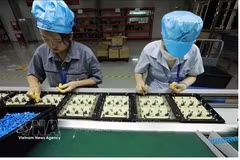
Producing components for office equipment at SWCC Showa Vietnam Co., Ltd. in Bac Thang Long Industrial Park. Hanoi (Photo: hanoimoi.vn)

Hanoi sees strong growth in nine-month FDI attraction

The Hanoi Department of Finance reported that foreign-invested enterprises in Hanoi generally maintained stable production and business operations in September, with many continuing to expand investment, increase capital and develop markets. Investment activity was concentrated mainly in real estate, wholesale and retail trade, information and communications, professional, scientific and technical activities, and business support services.

Foreign direct investment (FDI) flows into Ho Chi Minh City are ramping up fast. (Illustrative photo: VNA)

Ho Chi Minh City seeks high-quality FDI inflows

In the competition to attract high-quality FDI, Ho Chi Minh City's advantages lay not only in its market size, infrastructure and incentives, but also in its ability to build a living and working environment attractive enough to draw and retain international experts.

The meeting between Chairwoman of the State Securities Commission of Vietnam (SSC) Vu Thi Chan Phuong and Lim Tuang Lee, Assistant Managing Director of the Capital Markets Group under the Monetary Authority of Singapore (MAS), in Hanoi on September 30 (Photo: SSC)

Vietnam, Singapore step up capital market connectivity

A Vietnamese official suggested exchanges, businesses and intermediaries from the two countries strengthen connections and gradually establish an ecosystem supporting the issuance and listing of depositary receipt (DR) products.

Vietnam’s commodity derivatives market has gradually taken shape and become a tool helping businesses manage risks arising from price fluctuations. (Photo: doanhnghiephoinhap.vn)

New development space opens for commodity derivatives market

The project aims to establish and develop the commodity derivatives market based on market principles and in a transparent, safe and efficient manner, in line with international practices. It seeks to strengthen links with the physical commodities market and better meet the needs of production, business, import – export activities and price risk hedging.

Asahi Mutual Life Insurance aims hire 1,000 staff in Vietnam

Asahi Mutual Life Insurance aims hire 1,000 staff in Vietnam

The recruitment drive will take place alongside the completion of Asahi Mutual Life Insurance’s acquisition of Vietnam’s MVI Life, announced in December 2025. The deal will be the Japanese insurer’s first overseas acquisition in its history and is subject to approval by Vietnamese regulators.

The conference is jointly organised by the Ho Chi Minh City Investment and Trade Promotion Centre (ITPC), the Australian Consulate General in Ho Chi Minh City, the Vietnam Trade Office in Australia and the Australian Chamber of Commerce Vietnam (AusCham) on September 30. (Photo: VNA)

Vietnamese businesses advised to compete on quality in Australian market

Australia has strong purchasing power and diverse demand for Vietnamese products, from industrial goods, machinery and equipment, textiles and footwear to wood products, agricultural and aquatic products and processed food. Two-way trade reached 9.79 billion USD in the first seven months of 2026, up 20% year-on-year, while Vietnam’s exports to Australia surged 30%.