Mechanisms needed to connect Vietnamese intellectual resources worldwide with national development needs

Vietnamese intellectuals in Australia and New Zealand expressed a desire to contribute to their homeland not only through consultations, but also through specific projects, tasks and cooperation mechanisms.

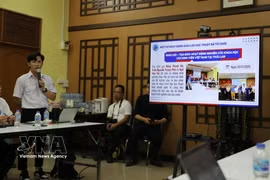
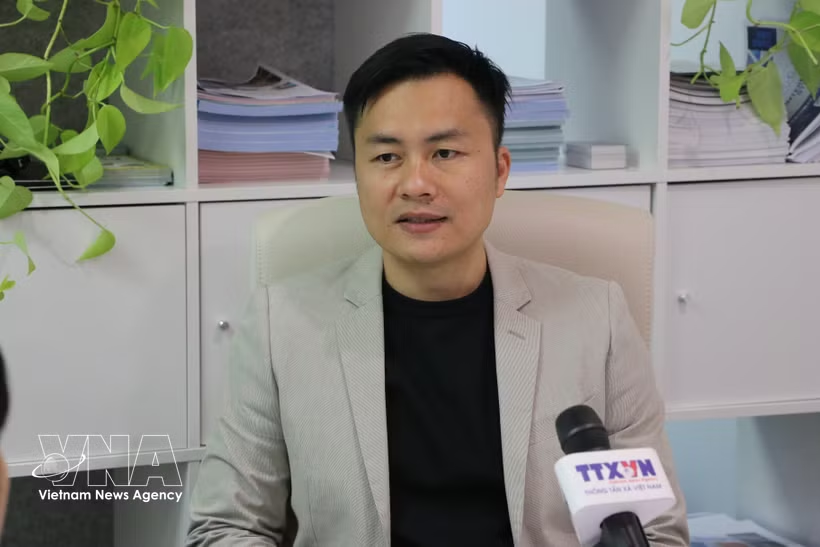
Nguyen Tuan Nghia, Chairman of the New South Wales chapter of Vietnam-Australia Scholars & Experts Association, speaks to the Vietnam News Agency. (Photo: VNA)

Sydney (VNA) – Recent meetings between General Secretary of the Communist Party of Vietnam (CPV) Central Committee and President To Lam and Vietnamese communities, experts and scientists during his State visits to Australia and New Zealand in August underscored the need to connect the intellectual resources of Vietnamese people overseas more regularly and effectively with national development.

During the meetings, Vietnamese intellectuals in both countries expressed a desire to contribute not only through consultations, but also through specific projects, tasks and cooperation mechanisms.

Speaking to Vietnam News Agency reporters in Sydney, Dr. Nguyen Tuan Nghia, an artificial intelligence (AI) expert and Chairman of the New South Wales chapter of Vietnam-Australia Scholars & Experts Association (VASEA), said many Vietnamese experts are working directly in leading science and technology ecosystems around the world.

The challenge, he said, is to create mechanisms that connect these resources with specific needs in Vietnam.

He proposed moving from general calls for contributions to a system of “targeted commissioning”, under which each science and technology task would clearly identify the problem to be addressed, the lead organisation, resources, timeline and expected results. With such information available, overseas experts could quickly determine whether they could contribute and whom they should work with.

A similar approach was suggested by Huynh Tan Dat, Chairman of the Vietnamese Students Association in Australia (SVAU). He said a clear focal point was needed to connect overseas intellectual resources with partners in Vietnam, from identifying needs to developing cooperation.
vnanet-ha.jpg
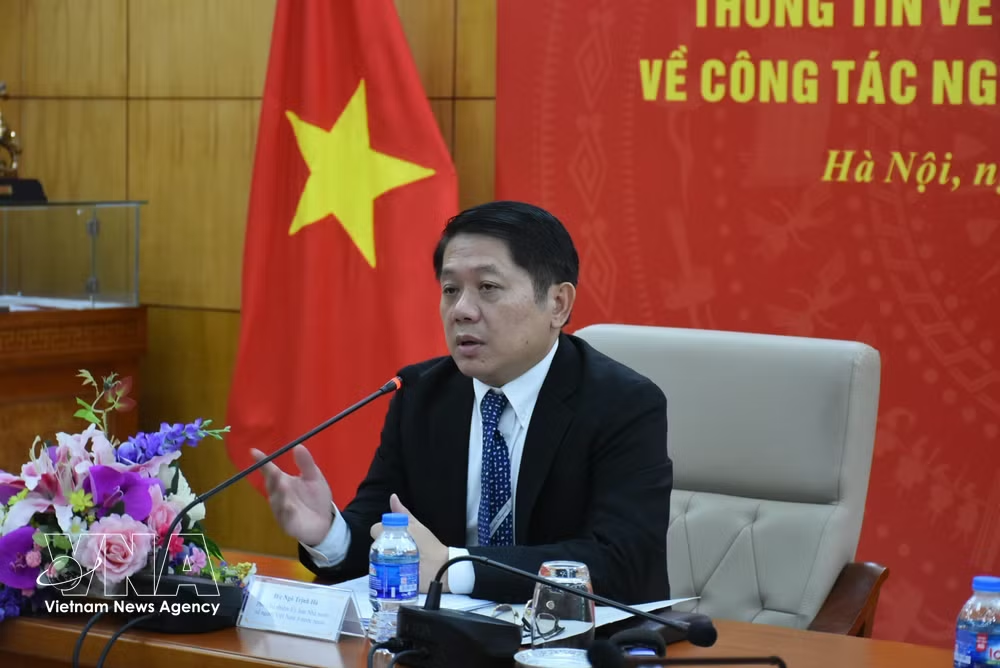
Deputy Chairman of the State Committee for Overseas Vietnamese under the Ministry of Foreign Affairs Ngo Trinh Ha speaks to the press about Resolution No. 23-NQ/TW. (Photo: VNA)

Deputy Chairman of the State Committee for Overseas Vietnamese under the Ministry of Foreign Affairs Ngo Trinh Ha said Resolution No. 23-NQ/TW, issued by the Politburo on August 2, 2026, represents a new development in the approach to overseas Vietnamese affairs. The resolution identifies overseas Vietnamese not only as a community to be mobilised and supported, but also as those directly participating in national development. It highlights OV resources including knowledge, science and technology, education, culture, management experience and international networks.

According to Ha, experts and intellectuals do not necessarily have to return to live permanently in Vietnam to contribute. They can participate from their countries of residence through research, consultancy, technology transfer and professional networks.

Nghia noted that most Vietnamese experts overseas have already established careers and families, making prolonged or frequent returns to Vietnam difficult. He therefore called for more flexible forms of engagement, such as visiting professorships, co-leading research projects, serving in expert councils or working as project-based advisers. He also highlighted the need to reduce administrative barriers involving contracts, cross-border payments, recognition of qualifications, taxation and intellectual property.

From New Zealand, Prof. Dr. Nguyen Hoang Minh, Vice Chairman of the Vietnamese Knowledge Network in New Zealand, said effective cooperation depends on connecting “the right people at the right time”. Each initiative, he said, should clearly identify who is responsible, when it will be implemented and how results will be measured.

In science and technology, he said, Vietnamese universities and businesses need to bring specific challenges to the right research groups, technologies and international partners. Overseas Vietnamese intellectual networks can serve as bridges in this process.

He suggested measuring success not simply by the number of seminars organised or agreements signed, but by the number of people trained, technologies put into use and long-term partnerships established. He also stressed the importance of placing young people at the centre of cooperation, with training focused on practical problem-solving skills and international professional networks.

Dat pointed to a technology competition organised by Vietnamese students in New South Wales in September, where about two-thirds of the judges were second-generation Vietnamese working for major Australian companies.

Although some spoke little Vietnamese, they actively provided mentoring and support to students.

He suggested studying the establishment of a network or association for young people of Vietnamese origin in Australia, with activities in English or bilingually and a focus on career guidance, student mentoring, professional networking, science and technology, and culture.

Another proposal is an official information system providing research and employment opportunities in Vietnam. Young Vietnamese researchers graduating from Australian universities often lack comprehensive information about positions, selection criteria, research conditions and remuneration in Vietnam.

The views from Australia and New Zealand show strong interest among overseas Vietnamese intellectuals in contributing to the homeland. Resolution No. 23-NQ/TW provides a framework for making greater use of overseas Vietnamese resources. The next step, experts said, is to translate this approach into clear focal points, specific tasks and flexible forms of cooperation, so that geographical distance becomes less of a barrier to contributing to national development./.
VNA

See more

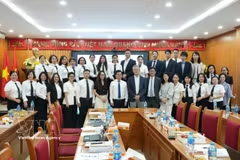
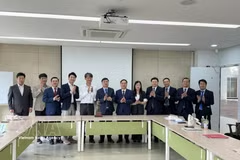
The delegation from the Nanko patent attorney club of Japan and officials and judges of the People's Court of Hanoi - Region 2 pose for a group photo (Photo: VNA)

Vietnam, Japan promote exchanges on law and justice

Speaking at the working session, Chief Judge of the People’s Court of Hanoi - Region 2 Hoang Ngoc Thanh said the meeting provided an opportunity for the two sides to share practical experience in judicial activities, thereby enhancing mutual understanding of the laws and practices governing the settlement of IP-related cases in Vietnam and Japan.

Representatives of the Hungary-Vietnam Friendship Association and the Vietnamese Association in Hungary pose for a group photo. (Photo: VNA)

Vietnam-Hungary friendship meeting promotes people-to-people exchanges

Vietnam always values and remembers the meaningful contributions made by Hungarian friends during Vietnam’s struggle for national independence and reunification. The sincere bonds nurtured across generations have provided a special foundation for the friendship between the two countries.

500-day campaign helps heal the wounds of war through meaningful acts

500-day campaign helps heal the wounds of war through meaningful acts

Three decades after establishing diplomatic relations, alongside figures on trade, investment, and increasingly broad cooperation frameworks, another quiet but profound change has taken place. People who once stood on opposite sides of the war are now working together to search for the missing, return memorabilia, share records and help Vietnamese families recover traces of loved ones that seemed to have been erased by time.

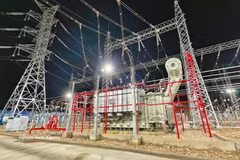
The An Giang Power Company and relevant units completed three key power projects in August. (Photo: VNA)

APEC 2027: Power infrastructure prepares for surging growth

Following directions from Vietnam Electricity (EVN), Southern Power Corporation (EVNSPC), the Southern Power Project Management Board, the An Giang Power Company and relevant units completed three key power projects in August, laying a solid foundation for long-term power supply in Phu Quoc one year ahead of the APEC 2027 Economic Leaders’ Week.

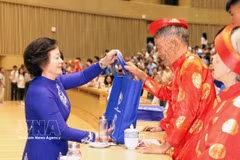
​Deputy Prime Minister and Chairwoman of the National Committee for the Elderly Pham Thi Thanh Tra (L) presents gifts to the elderly. (Photo: VNA)

2026 Action Month for the Elderly kicks off in Hai Phong

Policies for older people should be integrated into broader strategies for socio-economic and human development, social security, and quality of life, Deputy Prime Minister Pham Thi Thanh Tra said, stressing the importance of early, long-term planning so that today’s generations can look forward to a healthy, active, and happy old age.

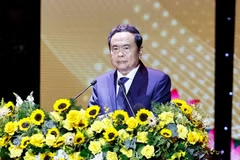
National Assembly President Tran Thanh Man speaks at the ceremony marking the 150th birth anniversary of Huynh Thuc Khang in Da Nang on October 1. (Photo: VNA)

Patriot Huynh Thuc Khang’s 150th birth anniversary marked in Da Nang

National Assembly President Tran Thanh Man, in his speech, called Huynh Thuc Khang an outstanding patriotic scholar of early 20th-century Vietnam. As a journalist, political activist and senior State leader, he combined patriotism, integrity, brainpower, courage, independent thinking and reform spirit.

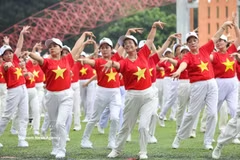
A mass dance performance featuring the highest number of the elderly in 2026 (Photo: VNA)

Vietnam expands support for older people as population ages faster

Deputy Prime Minister Pham Thi Thanh Tra, Chairwoman of the National Committee on the Elderly, said the focus has so far been mainly on attention, support and care for older people. It must now shift toward treating them as a resource and a driver of sustainable development.

Ha Dinh Huong, Standing Deputy Director General of VNMAC, speaks at the workshop in Hanoi on September 30. (Photo: VNA)

Vietnam uses GIS for priority setting in post-war bomb, mine clearance

The study in Quang Ngai combines wartime bombing data, field survey results, population density, land-use planning and other socio-economic factors to develop priority maps. It demonstrates the potential of GIS to improve the efficiency of efforts to address the consequences of bombs, landmines and unexploded ordnance (UXO) in Vietnam.

Soldiers prepare to conduct the burial ceremony for the remains of a martyr at the Quang Tri Martyrs' Cemetery. (Photo: VNA)

Quang Tri holds solemn memorial service for 30 martyrs

At the ceremony, delegates laid wreaths, offered incense, and observed a minute of silence in tribute to the fallen soldiers who sacrificed their youth and lives for national independence and freedom and the people’s happiness.

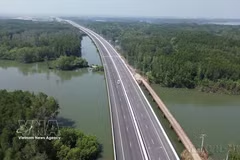
A view of Ben Luc–Long Thanh Expressway section passing through the mangrove forest in Dong Nai province (Photo: VNA)

Corridor expressway links Mekong Delta with Long Thanh int’l airport

The 57.8-km expressway, invested in by Vietnam Expressway Corporation (VEC), runs through the Mekong Delta province of Long An, Ho Chi Minh City and Dong Nai. Its endpoint connects with National Highway 51 and the Bien Hoa-Vung Tau Expressway, about 10 km from Long Thanh International Airport.

People have access to appropriate care, rehabilitation and support services within their communities (Photo: VNA)

Vietnam moves to adapt to rapid population ageing, expand silver economy

The International Day of Older Persons 2026, themed “The Age of Longevity: Rethinking Systems for Longer Lives,” highlights the need to develop healthcare, social security, labour-market and social-service systems in response to increasing life expectancy. For Vietnam, rapid population ageing is not only a demographic issue but also a development challenge.