Int’l cooperation helps address nuclear power workforce shortages

Decision No. 1012/QD-TTg on training and developing human resources for nuclear power development sets a requirement for around 1,920 personnel for the Ninh Thuan 1 nuclear power plant and around 1,980 for Ninh Thuan 2 by 2033 and 2035.

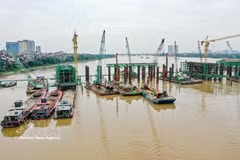
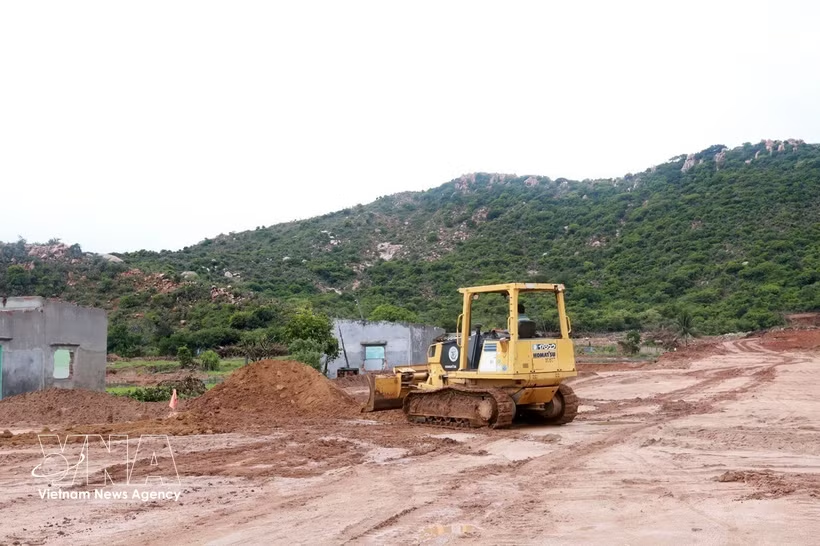
Construction is underway on the resettlement area serving the Ninh Thuan 2 nuclear power plant project (Photo: VNA)

Hanoi (VNA) – Building, developing and operating a nuclear power plant over several decades requires more than choosing appropriate technology and constructing the facility. It requires a comprehensive legal framework, management capacity, nuclear safety and security, human resources and international cooperation, with human resources being one of the decisive factors.

Shortage of specialised personnel

Decision No. 1012/QD-TTg on training and developing human resources for nuclear power development sets a requirement for around 1,920 personnel for the Ninh Thuan 1 nuclear power plant and around 1,980 for Ninh Thuan 2 by 2033 and 2035.

Decision No. 893/QD-TTg focuses on training, developing, and improving human resources for state management, research, application, and technical support in atomic energy. The goal is that by 2030, all central and local state management staff would be fully trained to carry out their roles. Additionally, at least 50% of personnel at the national radiation and nuclear safety regulatory agency should be capable of contributing to drafting legislation, inspecting, and overseeing safety and security at nuclear power plants.

Duong Thanh Tung, head of the Training, Research and Deployment Division at the Nuclear Training Centre under the Vietnam Atomic Energy Institute, said the Government has issued human resource development schemes for different groups, reflecting growing training needs. However, specialised nuclear power training faces major challenges, particularly in terms of lecturers and facilities.

The Vietnam Atomic Energy Institute currently has only around 10 nuclear power experts and specialists in related fields who are able to teach, most of whom are approaching retirement age, he said.

The Nuclear Training Centre, which previously provided short-term training for personnel for the Ninh Thuan nuclear power project, is now expanding its programmes to help prepare personnel for future plant operations. It has organised nuclear power courses for Petrovietnam officials and trained doctoral students in fields directly linked to nuclear power workforce needs.

Regarding long-term human resources for the nuclear power programme, Nguyen Hoang Linh, Director General of the Department of Radiation and Nuclear Safety, also pointed to the shortage of specialised nuclear power lecturers. Vietnam needs to develop a domestic pool of lecturers and experts, but this remains challenging due to the nature of specialised training and limited numbers of experts.
vnanet-hatnhan1.jpg
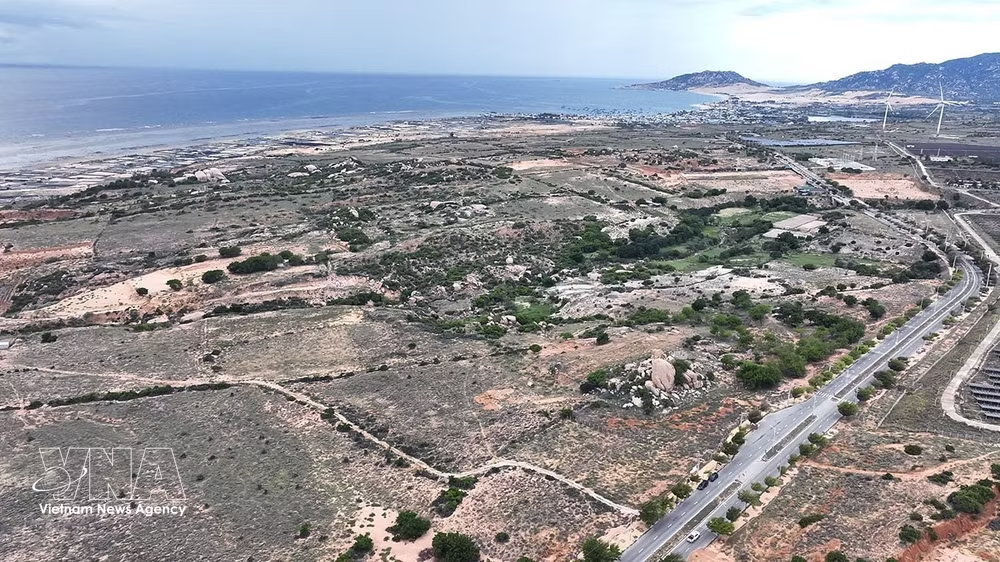
The construction site for the Ninh Thuan 1 Nuclear Power Plant, located in Phuoc Dinh commune, Khanh Hoa province (Photo: VNA)

In particular, as Vietnam’s nuclear power programme is being revived, the requirement is not only to meet the country’s workforce needs but also to ensure that personnel meet standards set by the International Atomic Energy Agency (IAEA). This is an important foundation for Vietnam to implement its nuclear power programme safely and effectively.

Promoting international cooperation to build specialised expertise

As the focal agency for implementing Decision No. 893/QD-TTg, the Department of Radiation and Nuclear Safety is coordinating with relevant agencies to develop an overall plan and carry out tasks according to the roadmap. Initial priorities include assessing workforce needs and developing training plans and curricula for specialised fields.

Given the limited domestic resources, international cooperation is an important solution to gradually address human resource shortages. Long-term investment and appropriate mechanisms are needed to develop and retain a pool of experts.

The department will negotiate and sign agreements and send personnel for training and internships at reputable nuclear facilities abroad. It will also continue to strengthen cooperation with the IAEA and countries with developed nuclear industries to implement training, professional development and expert exchange programmes, helping prepare human resources for nuclear power development.

Xavier Perrette, Vice President for International Relations at France's National Institute of Nuclear Sciences and Technologies (INSTN), also stressed the need to build human resource capacity for the nuclear programme.

Drawing on experience in implementing nuclear power training programmes in Asia, the Middle East, Africa and Europe, Xavier Perrette said human resources training should begin early, follow a long-term plan and be aligned with each stage of the programme, from management, design and construction to operation, safety supervision and radioactive waste management.

Pham Tuan Hiep, Secretary General of VietNuc - Vietnam Nuclear Professional Network with around 200 members, has provided training support for nuclear power project managers and State officials working in technical safety and institutional management. Its experts, who have direct experience in the nuclear industry in countries with developed nuclear power sectors, can also share lessons from nuclear programmes around the world.

The VietNuc expert network can help supplement practical experience among domestic personnel and serve as a bridge enabling Vietnamese experts abroad and international specialists to contribute their knowledge and experience to Vietnam’s nuclear power programme, gradually building a pool of specialised experts.

According to Hiep, to develop research experts capable of building and leading strong specialist teams, scientists have proposed that Vietnam link long-term training with major nuclear research institutions around the world.

At the same time, domestic university-level training should be strengthened, with curricula based on actual workforce needs and the competency requirements of individual positions. As an immediate priority, Vietnam should develop several core nuclear power training programmes meeting international standards, providing a foundation for graduates to pursue specialised training tailored to specific positions./.
VNA

See more

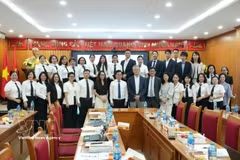
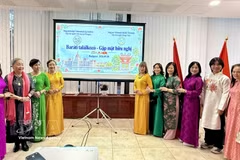
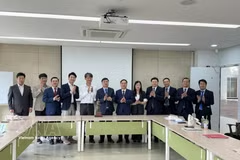
The delegation from the Nanko patent attorney club of Japan and officials and judges of the People's Court of Hanoi - Region 2 pose for a group photo (Photo: VNA)

Vietnam, Japan promote exchanges on law and justice

Speaking at the working session, Chief Judge of the People’s Court of Hanoi - Region 2 Hoang Ngoc Thanh said the meeting provided an opportunity for the two sides to share practical experience in judicial activities, thereby enhancing mutual understanding of the laws and practices governing the settlement of IP-related cases in Vietnam and Japan.

Representatives of the Hungary-Vietnam Friendship Association and the Vietnamese Association in Hungary pose for a group photo. (Photo: VNA)

Vietnam-Hungary friendship meeting promotes people-to-people exchanges

Vietnam always values and remembers the meaningful contributions made by Hungarian friends during Vietnam’s struggle for national independence and reunification. The sincere bonds nurtured across generations have provided a special foundation for the friendship between the two countries.

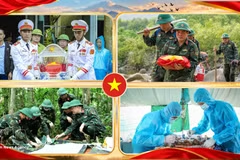
500-day campaign helps heal the wounds of war through meaningful acts

500-day campaign helps heal the wounds of war through meaningful acts

Three decades after establishing diplomatic relations, alongside figures on trade, investment, and increasingly broad cooperation frameworks, another quiet but profound change has taken place. People who once stood on opposite sides of the war are now working together to search for the missing, return memorabilia, share records and help Vietnamese families recover traces of loved ones that seemed to have been erased by time.

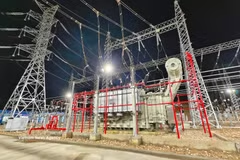
The An Giang Power Company and relevant units completed three key power projects in August. (Photo: VNA)

APEC 2027: Power infrastructure prepares for surging growth

Following directions from Vietnam Electricity (EVN), Southern Power Corporation (EVNSPC), the Southern Power Project Management Board, the An Giang Power Company and relevant units completed three key power projects in August, laying a solid foundation for long-term power supply in Phu Quoc one year ahead of the APEC 2027 Economic Leaders’ Week.

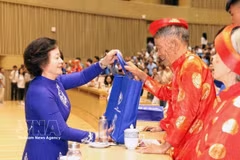
​Deputy Prime Minister and Chairwoman of the National Committee for the Elderly Pham Thi Thanh Tra (L) presents gifts to the elderly. (Photo: VNA)

2026 Action Month for the Elderly kicks off in Hai Phong

Policies for older people should be integrated into broader strategies for socio-economic and human development, social security, and quality of life, Deputy Prime Minister Pham Thi Thanh Tra said, stressing the importance of early, long-term planning so that today’s generations can look forward to a healthy, active, and happy old age.

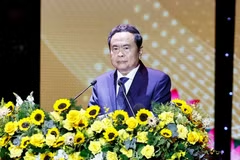
National Assembly President Tran Thanh Man speaks at the ceremony marking the 150th birth anniversary of Huynh Thuc Khang in Da Nang on October 1. (Photo: VNA)

Patriot Huynh Thuc Khang’s 150th birth anniversary marked in Da Nang

National Assembly President Tran Thanh Man, in his speech, called Huynh Thuc Khang an outstanding patriotic scholar of early 20th-century Vietnam. As a journalist, political activist and senior State leader, he combined patriotism, integrity, brainpower, courage, independent thinking and reform spirit.

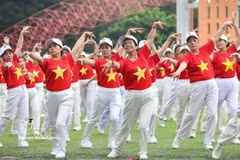
A mass dance performance featuring the highest number of the elderly in 2026 (Photo: VNA)

Vietnam expands support for older people as population ages faster

Deputy Prime Minister Pham Thi Thanh Tra, Chairwoman of the National Committee on the Elderly, said the focus has so far been mainly on attention, support and care for older people. It must now shift toward treating them as a resource and a driver of sustainable development.

Ha Dinh Huong, Standing Deputy Director General of VNMAC, speaks at the workshop in Hanoi on September 30. (Photo: VNA)

Vietnam uses GIS for priority setting in post-war bomb, mine clearance

The study in Quang Ngai combines wartime bombing data, field survey results, population density, land-use planning and other socio-economic factors to develop priority maps. It demonstrates the potential of GIS to improve the efficiency of efforts to address the consequences of bombs, landmines and unexploded ordnance (UXO) in Vietnam.

Soldiers prepare to conduct the burial ceremony for the remains of a martyr at the Quang Tri Martyrs' Cemetery. (Photo: VNA)

Quang Tri holds solemn memorial service for 30 martyrs

At the ceremony, delegates laid wreaths, offered incense, and observed a minute of silence in tribute to the fallen soldiers who sacrificed their youth and lives for national independence and freedom and the people’s happiness.

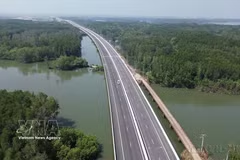
A view of Ben Luc–Long Thanh Expressway section passing through the mangrove forest in Dong Nai province (Photo: VNA)

Corridor expressway links Mekong Delta with Long Thanh int’l airport

The 57.8-km expressway, invested in by Vietnam Expressway Corporation (VEC), runs through the Mekong Delta province of Long An, Ho Chi Minh City and Dong Nai. Its endpoint connects with National Highway 51 and the Bien Hoa-Vung Tau Expressway, about 10 km from Long Thanh International Airport.

People have access to appropriate care, rehabilitation and support services within their communities (Photo: VNA)

Vietnam moves to adapt to rapid population ageing, expand silver economy

The International Day of Older Persons 2026, themed “The Age of Longevity: Rethinking Systems for Longer Lives,” highlights the need to develop healthcare, social security, labour-market and social-service systems in response to increasing life expectancy. For Vietnam, rapid population ageing is not only a demographic issue but also a development challenge.