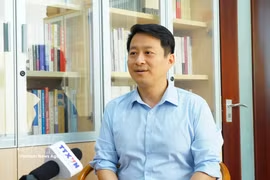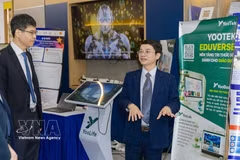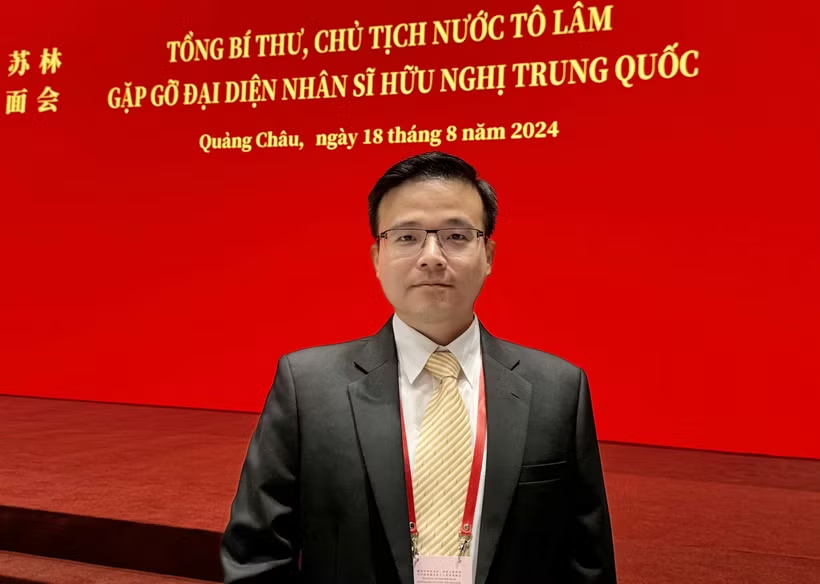
Beijing (VNA) – Politburo Resolution No. 23-NQ/TW on overseas Vietnamese affairs is a timely and sound policy, Duong Cam Vinh, PhD in Mechanical Engineering from Tsinghua University and general director of a smart technology company in China said.
Vinh, a Vietnamese who has studied and worked in China for many years, said that the resolution, together with statements of General Secretary of the Communist Party of Vietnam Central Committee and President To Lam on attracting Vietnamese intellectuals and talent, particularly in artificial intelligence (AI), shows that the Party and State regard the overseas Vietnamese community as an important resource for national development.
Speaking to Vietnam News Agency correspondents in China, Vinh said that what impressed him most was the clear message that Vietnamese people can contribute to national development wherever they live and work.
In the past, many believed that contributing to the country meant returning home to work long term.
The resolution offers a broader approach, with contributions possible through knowledge, experience or by connecting businesses, universities and research institutes in Vietnam and abroad. Individual contributions may be small, but when multiplied, they can create significant strength, he said.
Vinh also welcomed the Party and State’s strong focus on AI development. In the era of large AI models, AI is no longer limited to technology corporations but is rapidly entering factories, farms and schools.
“Ultimately, competition in AI is the one for talent,” he said, adding that by mobilising Vietnamese intellectuals working at technology centres around the world, Vietnam could narrow the development gap and potentially move ahead in some areas.
Vinh recalled an experience in late 2023 when, as an alumnus of Ho Chi Minh City University of Technology (HCMUT) and later a doctoral researcher at Tsinghua University, he helped facilitate an exchange between Tsinghua’s Suzhou Institute of Environmental Innovation and HCMUT's Faculty of Environment and Natural Resources.
The experience showed him that cooperation can begin with a single meeting and with someone who understands both sides, in terms of language and working culture. Overseas Vietnamese can serve as a bridge between the two sides, he said.
However, implementation is key to turning the resolution into reality. Vinh said the biggest challenge was not willingness to contribute but knowing what Vietnam needs and whom to contact. Specific and sustained mechanisms for connecting overseas Vietnamese with domestic institutions would help turn the resolution into practical results, he added.
Based on his experience in China, Vinh said attracting talent, particularly in AI, requires three things: real problems to solve, flexible mechanisms for participation, and major projects capable of bringing talent together.
First, Vietnam should publish lists of technical needs from businesses and research institutes, clearly identifying problems and contact points.
In industry, AI specialists can help improve productivity and quality in factories. In agriculture, they can apply large AI models to improve farming and livestock production.
Second, flexible mechanisms should allow overseas Vietnamese to contribute without having to return home permanently. Vietnam could enable individual experts or small teams to undertake projects remotely while also training domestic engineers.
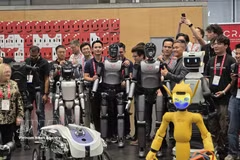
Third, major national projects should be developed to mobilise talent. One priority, Vinh suggested, is a Vietnamese large language model (LLM) developed domestically.
He described an LLM as the “brain” of the AI era and a new productive force. Developing and mastering the technology would help reduce dependence on foreign platforms and technologies.
Such a project could also help ensure the accuracy of knowledge about Vietnam’s history and culture and reduce the risk of distorted information. It would require experts in Vietnamese-language data, model training and fine-tuning, large-scale computing infrastructure, AI evaluation and safety, as well as linguists and historians.
In the long term, talent must be nurtured from an early age, Vinh said. Schools and families should guide children to use AI to ask questions, develop critical thinking and learn independently rather than simply copy answers.
“When conditions allow, I am ready to take part in remote technical exchanges, train engineers and connect businesses from the two countries, particularly in industrial vision and AI,” he said./.