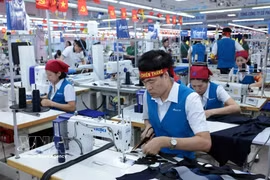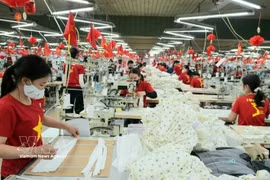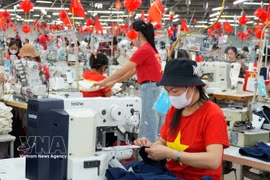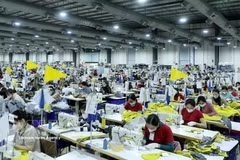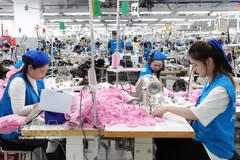
Hanoi (VNA) – Facing global market volatility, rising costs and increasingly stringent international trade standards, Vietnam’s textile and garment industry is stepping up efforts to retain orders, diversify markets, increase the localisation of raw materials and accessories, and accelerate green and digital transformation.
These efforts are laying the foundation for greater production efficiency and competitiveness, with the sector targeting export revenue of 47–47.5 billion USD in 2026.
As of September 15, preliminary data showed that the sector’s export turnover had reached 33.66 billion USD, a result industry representatives attributed to progress based on three strategic pillars
First, the sector is continuing to diversify its markets, partners, customers and products. Vietnamese textile and garment products are now present 137 countries and territories. The US remains the largest market, accounting for about 40% of total overseas shipments, followed by traditional markets such as the EU, the Republic of Korea, Japan, China and ASEAN, as well as promising emerging markets in Africa and the Middle East.
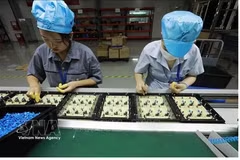
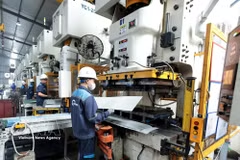
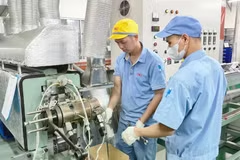
Second, enterprises are accelerating the application of technology, automation, robotics and artificial intelligence (AI) to management and production. These technologies are helping improve productivity, optimise production processes and enhance operational efficiency.
Third, the sector is strengthening links across the value chain to build sustainable supply chains, enabling businesses to support one another and improve overall competitiveness.
Chairman of the Vietnam Textile and Apparel Association (VITAS) Vu Duc Giang said the sector’s performance reflects the combined impact of flexible strategies, enterprises’ adaptability and progress in green and digital transformation.
Looking towards 2026–2030, with a vision to 2035, Giang stressed that digital and green transformation are no longer options but essential requirements for textile and garment enterprises.
In digital transformation, they are investing heavily in infrastructure and applying AI and robotics to production. According to VITAS, investment in these areas currently accounts for around 65–68% of total investment at many enterprises.
At the same time, green transformation has become a long-term priority in line with the Government’s net-zero emissions target for 2050. Enterprises are gradually investing in renewable energy, including rooftop solar power, upgrading wastewater treatment systems and increasing the use of environmentally friendly materials.
Giang called on localities to develop specialised industrial parks with concentrated wastewater treatment systems meeting international standards. This will help attract secondary investors in textile and dyeing and gradually address bottlenecks in domestic supplies of raw materials and accessories.
Amid competition from major production centres such as Bangladesh and India, he said Vietnam has its own advantages, particularly in the mid- and high-end segments.
Rather than competing mainly on price, Vietnamese businesses are targeting orders requiring advanced technical skills, high-quality workmanship, fast delivery and strict quality standards. A stable socio-economic environment and Vietnam’s participation in 17 new-generation free trade agreements (FTAs) also provide favourable conditions for deeper access to international markets.
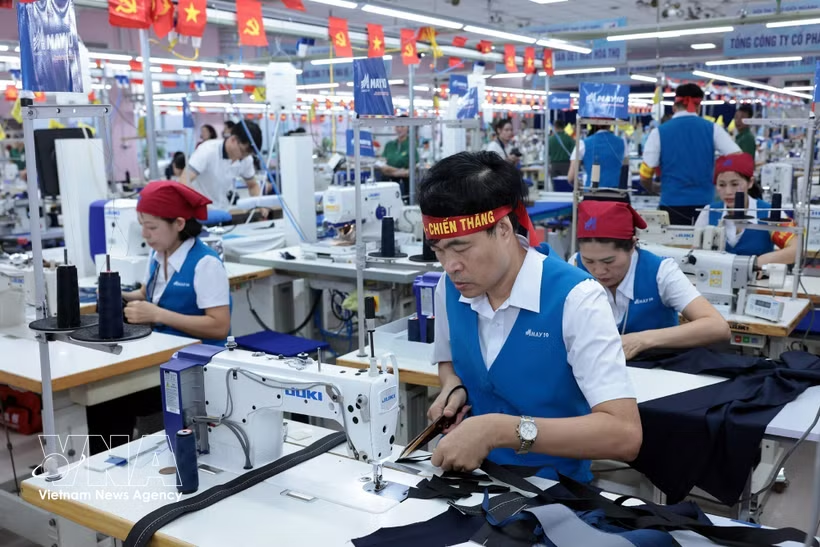
From the business perspective, Than Duc Viet, General Director of Garment 10 Corporation JSC, said the company is accelerating the use of technology and automation on production lines to improve productivity and meet increasingly demanding requirements on delivery times and quality.
Coordinated investment in digital and green transformation has helped Garment 10 maintain stable production, optimise operating costs and secure jobs for workers, he said.
Thanks to proactive negotiations and improved competitiveness, the firm has secured orders through the end of 2026 and is negotiating contracts for the first quarters of 2027.
Meanwhile, Cao Huu Hieu, General Director of the Vietnam National Textile and Garment Group (Vinatex), said the focus for the final months of the year is on tight cost control, higher productivity, cash-flow management and high-value-added orders.
Several major Vinatex members, including Garment 10, Nha Be Garment and Hue Textile – Garment, have secured orders through the end of the year.
However, Hieu noted that having orders does not mean pressure has eased as customers continue to seek longer delivery periods, push harder on prices and shift towards products with more complex technical requirements.
Businesses therefore need to actively coordinate orders across the system to maximise production capacity while preparing early for 2027.
With current progress and enterprises’ proactive approach, the industry considers its 2026 export target of 47–47.5 billion USD achievable. If market conditions improve in the fourth quarter, turnover could even approach 48 billion USD./.
See more
Vietnam targets Argentina to boost cashew exports
Vietnam's processed cashew exports to Argentina exceeded 270 tonnes in 2025, a 1.7-fold surge from 2024, with a value approaching 1.2 million USD.
Vietnam, RoK share experience in budget management, regional connectivity
At a meeting with Busan Vice Mayor for Administrative Affairs Kim Kyung Duk, the two sides exchanged experience in budget management, the decentralisation of local budgets, mechanisms for support from the central budget, policies to attract private-sector investment in technical infrastructure, and governance and financial mechanisms serving regional connectivity.
Vietnam remains growth bright spot in Southeast Asia
A report jointly released by US global management consulting firm Bain & Company, Singaporean financial services group DBS and Singapore-based strategic consultancy Vriens & Partners said Vietnam remained a leading growth market in Southeast Asia, with baseline growth projected at 6.2%.
Austrian businesses optimistic about long-term investment prospects in Vietnam
The trust built and successful cooperation models of Austrian businesses in Vietnam provide a solid foundation for expanding connections, especially in helping small- and medium-sized enterprises in Vorarlberg explore the Vietnamese market, production partners and supply sources.
Reference exchange rate bounces back on October 2
The opening-hour buying and selling rates at major commercial banks also rebounded from the October 1 trading session.
Vietnam’s agro-forestry-fishery exports rise 7.8% in nine months
Vietnam’s agro-forestry-fishery exports maintained growth momentum in the first nine months of 2026 despite continued volatility in global markets, reaching 56.3 billion USD, up 7.8% year on year. The sector posted a trade surplus of 16.9 billion USD, an increase of 7.4%.
Vietnam’s F&B market recovers amid intensifying competition
Industry revenue reached an estimated 432.7 trillion VND (16.7 billion USD) in the first six months of 2026, up from 406.1 trillion VND a year earlier, according to a report released by iPOS.vn and Nestlé Professional on September 9.
Vietnam’s pepper exports top 1.3 billion USD, maintain growth momentum
The outlook for the pepper industry remains positive, but greater efforts are needed to standardise growing areas, improve product value and strengthen competitiveness.
New investor demands spur overhaul of Hai Phong’s industrial ecosystem
Foreign direct investment into Hai Phong remained among the strongest in Vietnam in the first nine months of 2026. Registered capital is estimated at more than 3.638 billion USD, or 93.3% of the full-year target of 3.9 billion USD. The inflow is helping the city pursue double-digit economic growth for the year.
UK, Vietnamese businesses expand cooperation towards high-value growth
Vietnam-UK trade reached 10 billion GBP (13.2 billion USD) in the 12 months to the end of March 2026, up 8.8% year-on-year.
Vietnam International Financial Centre in Da Nang ranked 71st globally
VIFC-DN’s debut at 71st marks a notable international milestone for a financial centre still under development, reflecting the foundations that the centre and Da Nang are gradually building to connect with international capital flows, financial institutions and markets.
Public investment disbursement reaches 55.5% of 2026 target
As of September 24, eight ministries and central agencies and 20 localities had disbursed funds at or above the national average.
Vietnam’s manufacturing sector maintains growth in September: S&P Global
The report showed that the Vietnam Manufacturing PMI fell to 51.9 in September from 53.3 in August, indicating a smaller improvement in the health of the sector at the end of the third quarter. Nonetheless, business conditions have strenghtened in each of the past 15 months.
Policy push opens new space for private sector growth
Tran Thanh Huong, Deputy Head of the Policy, Business Environment and International Cooperation Division at the Ministry of Finance (MoF)'s Department of Private Enterprise and Collective Economy Development, said business formation has jumped since the Politburo issued Resolution 68-NQ/TW on private sector development on May 1, 2025. About 297,500 firms were newly established or resumed operations in 2025, and nearly 206,400 did so in the first eight months of 2026.
Hanoi sees strong growth in nine-month FDI attraction
The Hanoi Department of Finance reported that foreign-invested enterprises in Hanoi generally maintained stable production and business operations in September, with many continuing to expand investment, increase capital and develop markets. Investment activity was concentrated mainly in real estate, wholesale and retail trade, information and communications, professional, scientific and technical activities, and business support services.
Ho Chi Minh City jumps 17 places in Global Financial Centres Index
In GFCI 39, Ho Chi Minh City rose 11 places, from 95th to 84th. Across the two 2026 editions, it has gained 28 places, from 95th to 67th.
Ho Chi Minh City seeks high-quality FDI inflows
In the competition to attract high-quality FDI, Ho Chi Minh City's advantages lay not only in its market size, infrastructure and incentives, but also in its ability to build a living and working environment attractive enough to draw and retain international experts.
Vietnam, Singapore step up capital market connectivity
A Vietnamese official suggested exchanges, businesses and intermediaries from the two countries strengthen connections and gradually establish an ecosystem supporting the issuance and listing of depositary receipt (DR) products.
Reference exchange rate continues downward on October 1
The State Bank of Vietnam set the daily reference exchange rate at 25,624 VND/USD on October1, down 3 VND from the previous day.
Events to link craft villages with agritourism to boost rural economy
The 22nd Vietnam Craft Village Fair, the 2026 Week for Promoting and Connecting Agricultural and Rural Tourism, and the 2026 Vietnam Handicraft Competition will be held at the Agricultural Exhibition Centre in Hanoi from October 8 to 12.