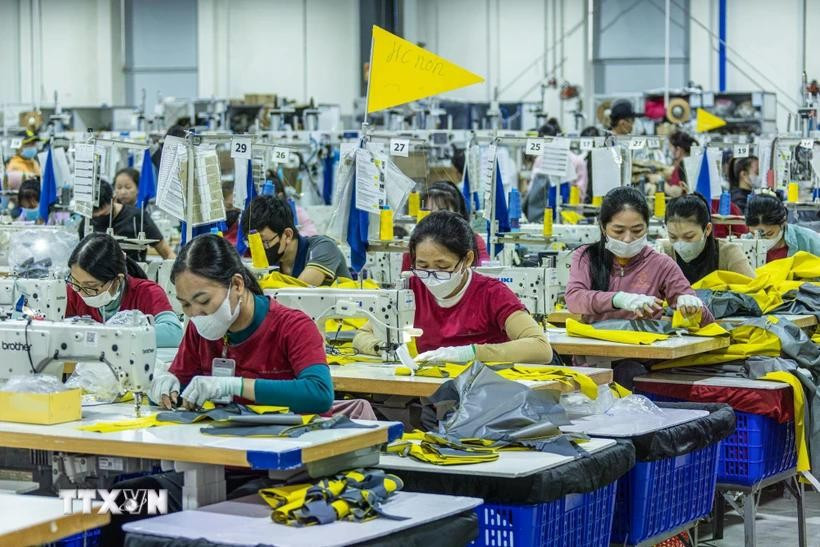
Hanoi (VNA) - Amidst global economic and political turbulence, Vietnam’s economy showed impressive resilience in the first quarter, growing by 6.93%, with a key highlight being foreign direct investment (FDI) attraction and disbursement.
However, in order to draw more FDI, experts underlined the need for comprehensive measures, including stronger reforms in all fields.
FDI - Bright spot in economic landscape
According to the National Statistics Office (NSO) under the Ministry of Finance, by March 31, total registered FDI into Vietnam had reached 10.98 billion USD, marking a 34.7% year-on-year increase. In the first three months of the year, 401 projects registered capital adjustments, up 44.8%, with the additional investment volume totalling nearly 5.16 billion USD - almost 5.1 times higher than the same period last year.
Additionally, there were 810 instances of foreign investors contributing capital or purchasing shares, an 11.6% increase, amounting to nearly 1.49 billion USD, up 83.7% compared to the first quarter of last year.
Notably, FDI disbursement hit 4.96 billion USD, a 7.2% rise, with the bulk channelled into the manufacturing and processing sectors, accounting for nearly 62% of total registered capital, up 26% year-on-year. This is the highest level of FDI disbursement recorded in the first quarter over the past five years, demonstrating Vietnam’s robust capacity to absorb and utilise foreign capital.
The increasing number of newly registered projects, capital adjustments, and capital contributions reflects the growing confidence among foreign investors, stated Phi Thi Huong Nga, head of the NSO’s Industry and Construction Statistics Department, asserting that Vietnam has continued to be viewed as a reliable and appealing investment destination.
However, new registered FDI in the first quarter reached only 4.33 billion USD, down 31.5% year-on-year. According to the Foreign Investment Agency, the situation improved in March, with newly registered capital surging by 66.5% compared to January and nearly 2.4 times that of February. The number of new projects also increased by 42.7% month-on-month and 18.4 times from February.
The overall decline was mainly due to a lack of large-scale projects, but the downturn in new capital registration showed signs of moderation, from the 48.4% in the first two months and 43.6% in January alone.
Encouragingly, the surge in adjusted capital (up 407%) and share purchases (up 83.7%) offset the fall in new registrations, especially since the average size of new projects was smaller. Overall, total FDI influx for Q1 rose 34.7%.
Dr. Nguyen Bich Lam, former General Director of the NSO, noted that despite a high number of newly licensed projects (850, up 11.5%), the total registered capital still declined. He stressed that with the average FDI project worth only 5 million USD, authorities must scrutinise investment proposals more carefully to prevent shell companies seeking to exploit Vietnam as a base for trade circumvention.
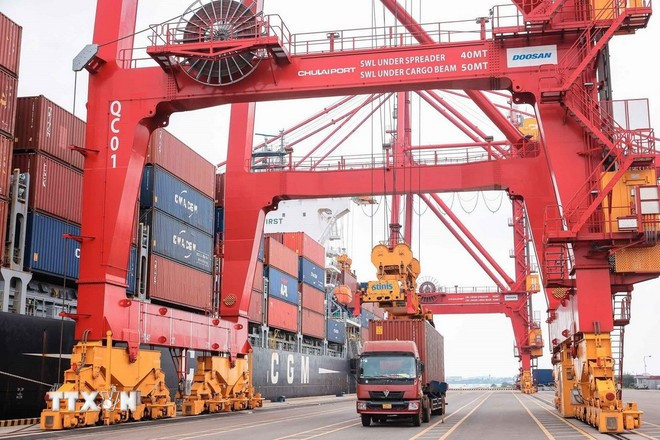
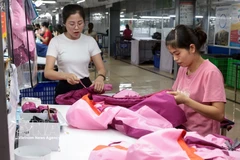
For the new US tariffs, Nga highlighted that the electronics, wood products, textiles, and footwear sectors - home to many FDI enterprises - could be hardest hit. In segments such as computers, electronics, machinery, and mobile phones, FDI companies account for around 93% of export turnover, so reciprocal tariffs may prompt some investors to relocate production, negatively impacting Vietnam’s export performance.
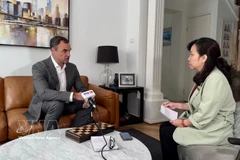
Bruno Jaspaert, Chairman of EuroCham, noted that European businesses have long appreciated Vietnam’s diplomatic flexibility, reinforced by the Government’s balanced yet decisive approach to global challenges.
As new tariff barriers emerge, EuroCham remains committed to ensuring that the voice of the European business community is heard and supported, helping Vietnam navigate these hurdles, he stated.
Clearing obstacles, enhancing competitiveness
To continue attracting FDI, Nga stressed the importance of further reforms in administrative and customs procedures, human resources development, and infrastructure upgrade. She also called for more incentives for high-tech and sustainable investments.
To mitigate negative impacts of US tariffs, she recommended enhancing bilateral dialogue, reinforcing Vietnam’s position as a fair and trustworthy trade partner, and actively exploring various measures to balance trade relations.
Despite global investment slowdowns, Vietnam remains highly attractive, said Jeong Jihoon, Vice President of the Republic of Korea Chamber of Commerce in Vietnam (KOCHAM). He cited Vietnam’s strategic location, robust logistics, and stable diplomacy as key advantages.
According to EuroCham, infrastructure development should be the Government’s top priority. Surveyed firms also called for streamlined procedures, relaxed visa and work permit rules for foreign professionals, and greater legal transparency and enforcement consistency.
Digitalisation of administrative procedures, improved coordination among government agencies, and more efficient market access processes were also highlighted as vital to accelerating investment.
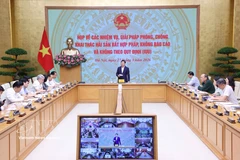
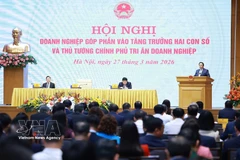
At a recent conference, Finance Minister Nguyen Van Thang reaffirmed the ministry’s commitment to addressing obstacles in attracting FDI by improving the business environment, cutting costs, and reducing red tape.
Efforts will also focus on boosting public-private partnerships in strategic sectors such as infrastructure, AI, semiconductors, science and technology, innovation, digital transformation, and renewable energy. The ministry will maintain policy dialogues to promptly address investor concerns and ensure a favourable investment climate./.