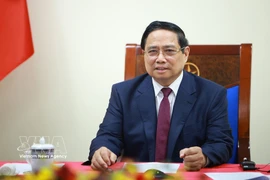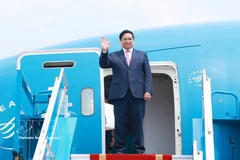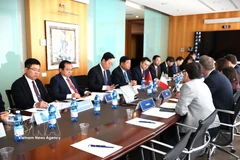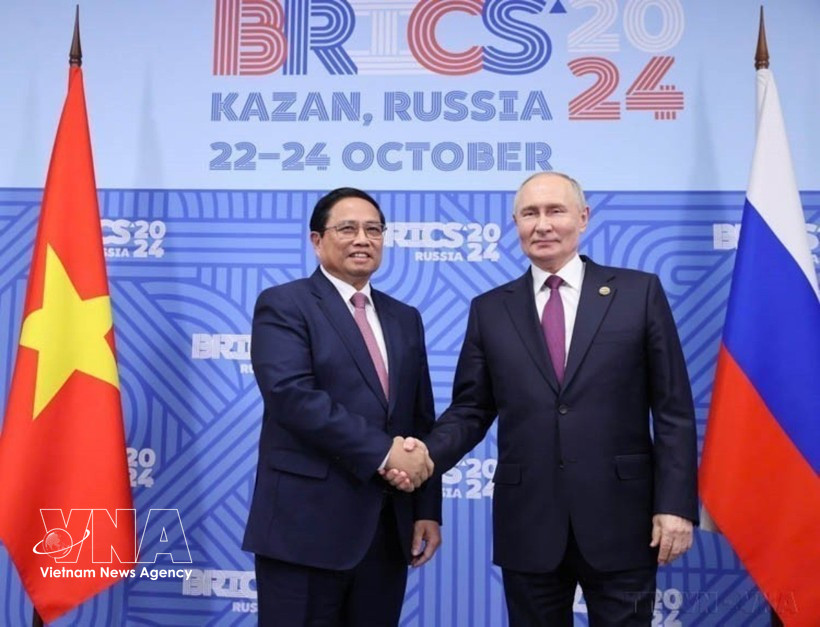
Hanoi (VNA) – As Vietnam and Russia upgraded bilateral ties to a comprehensive strategic partnership in 2012 and are implementing the free trade agreement between Vietnam and the Eurasian Economic Union (EAEU), the forthcoming official visit to Russia by Prime Minister Pham Minh Chinh is expected to open new opportunities to advance bilateral trade relations to a higher level.
Positive growth
According to the Department of Foreign Market Development under the Ministry of Industry and Trade (MoIT), Russia remains one of Vietnam’s key economic partners, particularly in industry and energy. Despite global economic and geopolitical uncertainties, bilateral trade has maintained a positive growth trend.
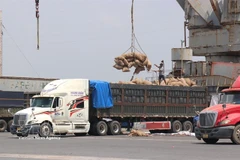
Statistics from the Department of Customs show that two-way trade reached 4.77 billion USD in 2025, up 4% compared with 2024. Textiles and garments accounted for Vietnam’s largest export turnover to Russia, valued at 504 million USD, followed by coffee at 462.3 million USD, and seafood at 214.5 million USD.
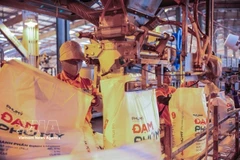
Vietnam primarily imports production inputs from Russia. Also last year, coal accounted for the largest share of such imports at 875 million USD (35%), followed by fertilisers 315.2 million USD and plastic materials at 130 million USD.
In the first two months of 2026, bilateral trade reached 700 million USD, down 5.1% year-on-year. However, this decline is regarded as short-term, with the overall long-term trajectory remaining stable growth.
By the end of 2025, Russia had 213 investment projects in Vietnam with total registered capital of nearly 996 million USD, ranking 28th among 153 countries and territories investing in the Southeast Asian country. Major sectors include mining, accommodation and food services, and manufacturing.
Conversely, Vietnam currently has around 18 investment projects in Russia worth approximately 1.64 billion USD. Russia ranks fourth among the 85 countries and territories receiving Vietnamese outward investment, mainly in mining, industry and real estate.
At the 14th session of the industry cooperation subcommittee under the Vietnam–Russia intergovernmental committee on economic, trade, and sci-tech cooperation, the two sides reached important agreements in areas including transport manufacturing, railway industry, mechanical engineering, pharmaceuticals and medical equipment, mining, chemicals and metallurgy.
Seven priority cooperation areas were identified, notably the automotive industry, electrical engineering and renewable-energy equipment, chemicals, metallurgy, radio electronics and digital technology, and railway engineering.
Broadening cooperation space
The MoIT noted that bilateral energy and oil-and-gas cooperation has expanded beyond exploration and crude extraction into high-technology, high-value fields. These include gas-fired power plants in Vietnam, liquefied natural gas (LNG) supply, renewable-energy infrastructure development, fuel production and modernisation of existing energy facilities.
Speaking at a Vietnam–Russia scientific forum on industrial, technological and innovation promotion, Trinh Minh Anh of the Vietnam Institute of Strategy and Policy for Industry and Trade highlighted renewable energy, particularly offshore wind, as a clear indicator of evolving bilateral relations. This cooperation carries not only economic significance but also symbolic value, demonstrating continuity of traditional friendship while opening a new chapter focused on global frontier sectors, he said.
Experts noted that Vietnam is at a pivotal stage in its energy transition, where renewable energy is no longer optional but strategically essential. With abundant resources, favourable geography and an improving investment climate, Vietnam is becoming an attractive destination for large-scale energy projects. Russia, meanwhile, possesses strong technological capabilities in core industries such as oil and gas, engineering, energy and science. This complementarity provides an ideal basis for deeper cooperation.
As both countries seek to restructure growth models and transition towards green, sustainable industries, Vietnam–Russia energy cooperation faces a rare window of opportunity.
Vietnam’s institutional reforms, logistics development, digital transformation and commitment to net-zero emissions are improving the investment environment. Meanwhile, Russia’s technological strengths and industrial experience further enhance the potential for high-quality collaboration.
To further boost bilateral trade, the ministry plans to refine and expand cooperation mechanisms, fully utilise existing agreements, particularly the EAEU-Vietnam FTA, and balance trade structures in line with each side’s needs and potential.
Priority will be given to flexible joint-venture models that maximise economic complementarity, alongside intensified trade promotion and business connectivity. An annual Vietnam–Russia trade and investment forum will serve as a stable dialogue channel for enterprises, trade-promotion bodies, chambers of commerce and official representatives.
The ministry will also organise specialised trade and investment missions to Russia, support participation in fairs, exhibitions and seminars, and help Vietnamese firms connect with major distribution networks, especially supermarket chains and large e-commerce platforms. Major domestic promotion events such as Vietnam Expo and FoodExpo will continue to be widely publicised to attract Russian businesses seeking partnerships, investment opportunities and supply sources in Vietnam./.
See more
De Heus–Hung Nhon alliance eyes high-tech agricultural chain in Can Tho
Promoting their strengths in animal feed, breeding and integrated global supply chains, Hung Nhon Group and the Netherlands’ De Heus outlined a strategy to develop a closed-loop ecosystem covering breeding, feed production, farming, processing and export.
Deputy PM orders sweeping administrative reform, cutting red tape by half
The Ministry of Finance and the central bank must take full responsibility before the Government and the Prime Minister, stressing that agencies must not cite sector-specific characteristics as a reason to delay or avoid reform, said Deputy PM Nguyen Van Thang.
Vietnam's industry spearheads transition to circular economy
The circular economy is no longer just a policy choice. It has become an inevitable trend for delivering sustainable and green growth, sharpening competitiveness at home and abroad, and meeting Vietnam’s net-zero emissions target by 2050. It is now a prerequisite to sustain long-term economic expansion, particularly in industrial production and supporting industries.
Vietnam joins int'l bidding for oil and gas exploration in Algeria
Currently, PVEP is involved in oil exploitation at Blocks 433a and 416b of the Bir Seba field in the Hassi Messaoud area, Ouargla province, located more than 600 km south of Algiers. The project stands as one of Petrovietnam’s most successful overseas ventures, demonstrating the operational capacity and technical expertise of Vietnamese engineers on the global stage.
National branding seen as strategic lever to elevate Vietnam’s global value chain position
The National Brand Programme, built on criteria such as quality, innovation and pioneering capacity, is designed to boost value-added content and embed a stronger Vietnamese identity in exported products.
FDI inflows forecast to reach 38 billion USD annually in next 5 years
With favourable factors emerging, the FDI capital flow into Vietnam this year is expected to increase by approximately 1-2 billion USD compared to 2025, reaching up to 29 billion USD.
Reference exchange rate rises slightly at week’s beginning
The State Bank of Vietnam set the daily reference exchange rate at 25,103 VND/USD on April 20, up just 1 VND from the last working day of the previous week.
Finance ministry eyes flexible tax thresholds
In a draft law amending several articles of the laws on personal income tax, corporate income tax and value-added tax, Vietnam's finance ministry proposed scrapping the fixed revenue threshold of 500 million VND. Instead, it suggested the threshold be set by the Government based on prevailing economic conditions.
Vung Ang II thermal power plant inaugurated in Ha Tinh
With a total investment of 2.2 billion USD, the Vung Ang II Thermal Power Plant is developed under a build-operate-transfer (BOT) model and has a designed capacity of 1,200 MW, comprising two turbines. The plant is expected to play a key role in ensuring stable electricity supply for the central region and neighbouring areas, thereby facilitating the development of industries, agriculture and services.
Vietnam seeks stable jet fuel supplies from China amid Middle East disruptions
On the basis of the long-standing friendship and cooperation between Vietnam and China, as well as close ties between their aviation authorities, the Civil Aviation Authority of Vietnam has asked the Civil Aviation Administration of China to direct relevant fuel suppliers to ensure sufficient and stable supplies for Vietnam.
Remittances to Ho Chi Minh City decline in Q1 amid global headwinds
Data from the State Bank of Vietnam (SBV)'s Region 2 branch showed that remittances transferred through credit institutions and economic organisations in Ho Chi Minh City exceeded 2 billion USD in the January–March period, down 15.6% from the previous quarter and 16.9% year-on-year.
Nearly 100 tonnes of Vietnamese fruits, vegetables airlifted to UAE
Vietnamese fresh produce and processed foods are increasingly recognised for their quality, with items such as cashew nuts, coffee and spices gaining popularity among Middle East consumers. In 2025, Vietnam’s farm produce exports to the UAE exceeded 445 million USD, up nearly 24% year-on-year.
World Coffee Heritage Forum opens in Dak Lak
Dak Lak is known as the 'capital' of Vietnamese coffee, with rich, fertile basalt red soil ideal for agriculture. The coffee provides livelihoods for thousands of locals and has developed a unique cultural space, closely tied to the socioeconomic life, customs and identity of local communities.
Vietnam, Singapore promote green economic cooperation, sustainable trade
The business networking programme not only facilitated direct connections between businesses and investors from both countries, but also aimed to support the development of long-term trade infrastructure.
Vietnam pledges to support Argentina in accessing ASEAN, Asia-Pacific markets
The ambassador spoke highly of the commencement of negotiations on a preferential trade agreement (PTA) between Vietnam and the Southern Common Market (MERCOSUR) in December 2025, appreciating Argentina’s proactive role and support in realising this milestone.
Resolution helps unlock private capital to transform Hanoi’s urban landscape
Economists describe Resolution No. 68 as a milestone in refining Vietnam’s socialist-oriented market economy, reflecting a breakthrough in the Party's awareness and vision that place private entrepreneurs and businesses at the centre of the national development strategy.
Reform of state-owned enterprises seen as key driver of economic growth
Effective implementation of Resolution 79 is expected to help SOEs enhance performance, improve employee incomes and contribute more sustainably to economic growth.
Indonesia reduces imports of strategic food commodities
In 2026, Indonesia is expected to have approximately 12 million tonnes of rice carried over from the previous year, supported by annual production of around 34.7 million tonnes. With projected consumption of 31.1 million tonnes, national rice reserves could reach approximately 16 million tonnes by the end of the year.
Vietjet exchanges cooperation agreements with Chinese enterprises
Vietjet and SPDB Financial Leasing (SPDBFL), a subsidiary of Shanghai Pudong Development Bank, have exchanged an agreement for the finance lease of 10 COMAC C909 aircraft, expanding financial and aviation cooperation between Vietnam and China.
Low-emission zone roadmap drives electric two-wheeler boom in Hanoi
From July 1, Hanoi will introduce time-based or area-based restrictions on petrol-powered motorcycles within Ring Road 1, with plans to expand coverage across the entire zone by 2028 and extend to areas within Ring Road 3 by 2030. The policy is expected to reshape travel habits for millions of urban residents.