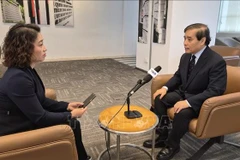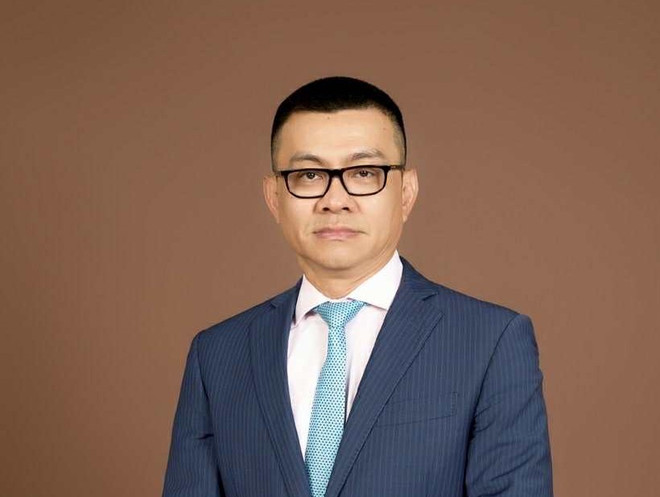
Hanoi (VNA) - With its own capabilities and the close, experienced partnership of the International Atomic Energy Agency (IAEA), Vietnam is well-positioned to pursue its first nuclear power plant that meets the highest international safety standards. Ambassador Vu Le Thai Hoang, Permanent Representative of Vietnam to the United Nations and International Organisations in Vienna, Austria, talked to the Vietnam News Agency about the country’s deepening cooperation with the International Atomic Energy Agency (IAEA) in applying nuclear technology for peaceful purposes.
Reporter: How do you evaluate the cooperation between Vietnam and the IAEA in nuclear technology application for peaceful purposes in recent years?
Ambassador Vu Le Thai Hoang: Vietnam’s cooperation with the International Atomic Energy Agency (IAEA) has made positive, substantive, and comprehensive progress, particularly in the application of nuclear technology for sustainable development. Vietnam has considered the IAEA a strategic partner in improving its capacity in nuclear science and technology, aiming at the goal of using nuclear energy for peaceful, safe, and effective purposes.
With the signing of the Country Programme Framework (CPF) for the 2022-2027 period, the bilateral cooperation has been clearly defined and closely aligned with Vietnam’s development priorities, focusing on seven key areas: radiation safety, health, agriculture, environment, energy, industry, and human resource development. More than 20 projects are being effectively implemented with financial and technical support from the IAEA, thereby enhancing Vietnam’s scientific and technological capacity, and strengthening its legal and technical systems. These are important pillars of cooperation, yielding many practical outcomes in recent years.
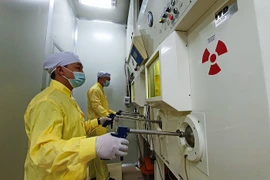
Notably, with the IAEA’s assistance, Vietnam is building a 10 MW research reactor to replace the current Da Lat reactor. This marks an important advancement in preparation for research, training, and production of radioactive isotopes for medical and industrial use. In addition, the IAEA’s first INSServ mission to assess Vietnam’s national nuclear security in March 2023 contributed to strengthening the country’s institutional capacity and affirming its commitment to global nuclear security standards.
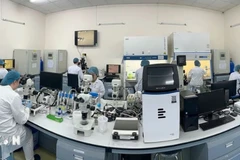
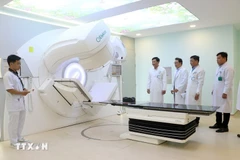
In the health sector, many projects have been implemented to enhance Vietnam’s capacity for cancer diagnosis and treatment using nuclear medicine. With support from the IAEA, the country’s equipment and expertise in this field have been significantly improved, delivering practical benefits to the public. In agriculture, the IAEA has supported Vietnam in applying nuclear and radiation technologies in plant breeding, plant quarantine, post-harvest preservation, and pest control. The results achieved have contributed to increasing productivity, product quality, and efficiency in sustainable agricultural production.
In the field of human resource development, the IAEA has provided practical and long-term support to Vietnam. The agency has not only sponsored hundreds of Vietnamese officials to participate in training and specialised programmes both at home and abroad, but has also closely coordinated with Vietnamese authorities to organise numerous training courses and regional seminars within the country. These activities have made significant contributions to enhancing professional qualifications and gradually building a team of highly skilled nuclear technical experts, capable of meeting the requirements for the safe and sustainable development of the atomic energy sector now and in the future.
A highlight of recent cooperation is the trilateral mechanism between Vietnam, Laos, and Cambodia coordinated by the IAEA. Vietnam plays a key role in training experts, sharing experiences, and supporting research facilities for the two neighbouring countries. Since 2022, more than 15 Cambodian and Lao officials have been trained in Vietnam in such fields as nuclear medicine, non-destructive testing, radiation safety, and agricultural applications. This not only affirms Vietnam’s internal capacity but also demonstrates its active and proactive role in enhancing regional cooperation and promoting the values of nuclear technology for peaceful purposes.
I believe that with the growing need for sustainable development and the national energy transition strategy, including the orientation to restart nuclear power, the cooperation between Vietnam and the IAEA is set to play an increasingly pivotal role, helping the country effectively apply nuclear technology across practical sectors and ensure the highest standards of safety and security.
Reporter: Vietnam and the IAEA have recently held several working exchanges related to the construction of the first nuclear power plant in Vietnam. What are the key outcomes of these bilateral engagements?
Ambassador Vu Le Thai Hoang: To achieve energy transition and realize its net-zero emission commitment by 2050, Vietnam has been gradually conducting research and preparing necessary conditions to build its first nuclear power plant. In this process, the IAEA has been a key partner, accompanying Vietnam through many practical and timely activities.
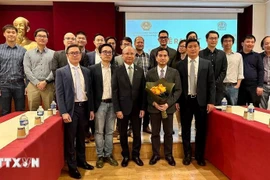
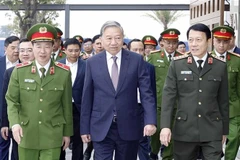
Recent working sessions between Vietnam and the IAEA include the meeting between Chairman of the National Assembly’s Committee on Science, Technology and Environment Le Quang Huy and Deputy Minister of Science and Technology Bui Hoang Phuong with the IAEA’s Department of Nuclear Safety and Security (March 2025); the meeting between Vice Chairwoman of the National Assembly’s Committee on Legal and Judicial Affairs Nguyen Thi Mai Phuong and representatives of the Vietnam Agency for Radiation and Nuclear Safety (VARANS) with IAEA experts (April 2025); as well as the discussion between Deputy Minister of Foreign Affairs Le Thi Thu Hang and IAEA Director General Rafael Grossi on the sidelines of the 34th Session of the Commission on Crime Prevention and Criminal Justice (CCPCJ) (May 2025). All these efforts reflect Vietnam’s strong political will and proactive approach in working closely with the IAEA to prepare for a phase of safe, sustainable nuclear power development aligned with international standards.
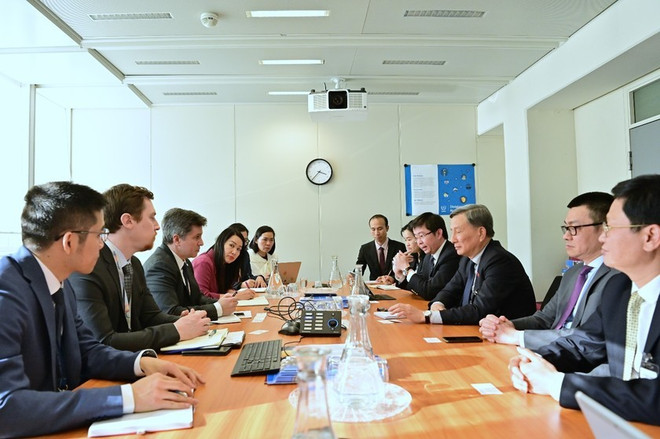
One of the most notable outcomes is the mutual agreement on the need to strengthen cooperation in building a legal framework, providing policy advice, transferring technology, sharing experiences, and training human resources. These are key areas of cooperation aimed at helping Vietnam not only develop its overall capacity to apply nuclear technology, but also lay a solid foundation for the successful implementation of its first nuclear power plant, ensuring the highest standards of nuclear safety and security.
At the same time, the IAEA has expressed its readiness to support the revision, development, and finalisation of the amended Law on Atomic Energy, to ensure a comprehensive, consistent, and internationally compliant legal framework in terms of safety, security, and non-proliferation.
Director General Rafael Grossi highly appreciated Vietnam’s efforts and long-term vision in orienting nuclear power development as a strategic solution to its energy challenges. He affirmed that the IAEA always considers Vietnam a priority partner in Southeast Asia and is committed to continuing close cooperation across the three key pillars: technology, legal framework, and human resource development.
I believe that these working sessions have contributed to laying an important policy and technical foundation for Vietnam to progressively realise its goal of developing nuclear energy for peaceful, safe, and sustainable purposes.
In the coming time, with the support of the IAEA, the close coordination among domestic ministries and sectors, and the strong political determination at the highest level, we are fully capable of building a modern nuclear power programme that meets international standards and contributes to ensuring national energy security in the long run.
Reporter: For Vietnam, when building nuclear power plants, absolute safety and the development of skilled human resources are two critical concerns. How will the IAEA support Vietnam in addressing these issues?
Ambassador Vu Le Thai Hoang: Ensuring absolute safety and cultivating high-quality human resources are indeed the two essential pillars for the success and sustainability of any nuclear power programme. This is especially true for Vietnam, as we are step by step restarting our nuclear power development programme after a period of suspension.
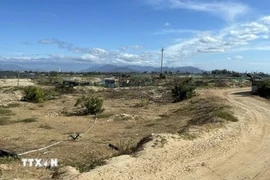
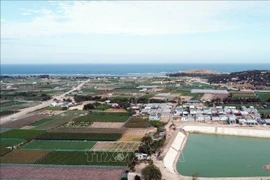
In the period prior to the suspension of the Ninh Thuan project in 2016, the IAEA provided Vietnam with practical support across a range of areas. Vietnam has twice invited Integrated Nuclear Infrastructure Review (INIR) missions to the country (in 2009 and 2012) to conduct comprehensive assessments of its readiness to develop nuclear power infrastructure, in line with the IAEA’s “Milestones” framework. On that basis, the IAEA issued dozens of recommendations related to regulatory regime, nuclear safety, human resource training, financing, and emergency preparedness, playing a key role in helping Vietnam establish a comprehensive legal framework, an inter-agency coordination mechanism, and a long-term human resource development strategy for the sector.
Concurrently, within the framework of its technical cooperation programme, the IAEA has sponsored hundreds of Vietnamese experts to participate in training courses, workshops, and overseas internships, as well as collaborating to organise on-site training in areas such as nuclear plant operation, radiation safety, nuclear regulation, and emergency response.
At present, as Vietnam officially resumes its nuclear power programme, our cooperation with the IAEA is being reactivated with a renewed sense of focus and proactivity. In recent discussions between Vietnamese authorities and IAEA Director General Rafael Grossi, the two sides have outlined specific areas of further support. The IAEA has also expressed its willingness to provide technical assistance in developing a robust legal and regulatory framework via offering feedback on the draft revised Law on Atomic Energy, supporting the establishment of an independent nuclear regulatory body and a licensing process for nuclear power plants, as well as enhancing routine monitoring and inspection capacities.
On workforce development, Vietnam has already built a solid foundation thanks to earlier cooperation programmes. However, putting a nuclear power plant into operation in the future will require a new generation of experts trained to the highest standards. The IAEA has indicated its willingness to collaborate with the Ministry of Science and Technology, domestic research institutes, universities, and any potential third-party donors to design in-depth training programmes like those of earlier collaborations during the 2012-2013 period. They would include “train-the-trainers” schemes, simulated power plant exercises, and site-based programmes in countries operating similar nuclear facilities.
I firmly believe that, with Vietnam’s existing capabilities and the IAEA’s close, experienced support, the country is fully equipped to develop a nuclear power programme that meets the highest international safety standards while gradually building a skilled workforce capable of mastering technology and effectively managing the nuclear energy sector in the years ahead./.