Hanoi (VNA) - A giant “mysterious object” is gradually taking shape on the horizon of Hon Thom, Phu Quoc. From a distance, the structure resembles a multi-tiered flying saucer perched atop a tower. Yet behind this intriguing silhouette lies an architectural concept inspired by a celebrated queen in Vietnamese history, as well as a far from simple engineering challenge at a height of nearly 80 metres.
A “UFO” on the horizon of Phu Quoc?
In recent days, a massive circular structure taking shape atop a tower under construction on Hon Thom has captured attention from vantage points across the island. Viewed from afar, the expansive roof extending beyond the tower’s main structure creates the striking impression of a mysterious object suspended between the sea and sky.
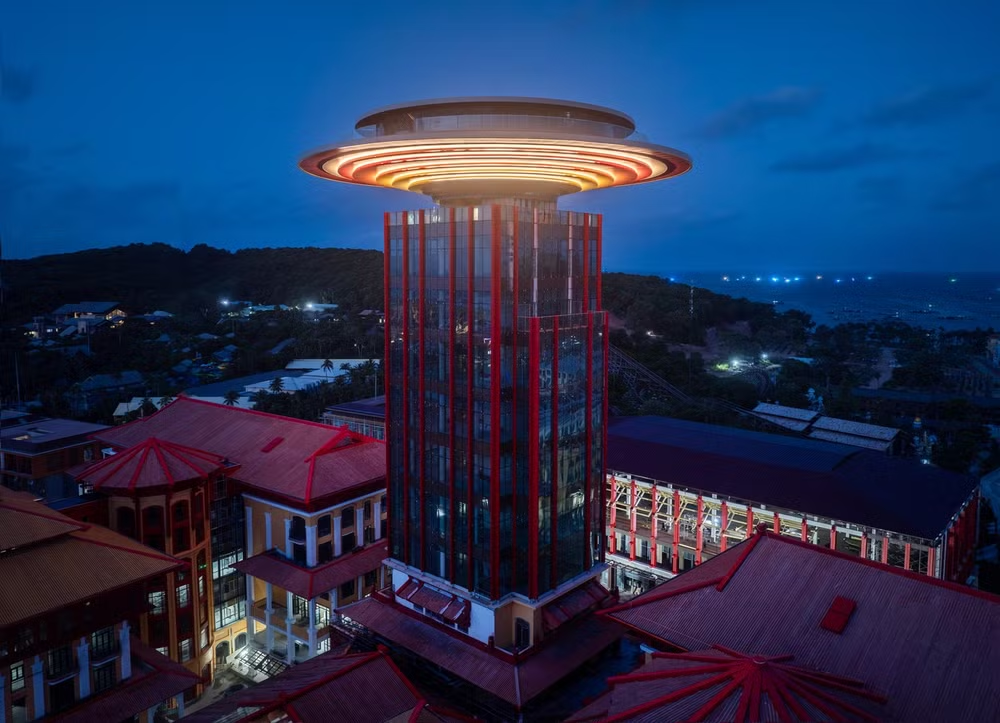
As the lighting system comes to life at night, the structure stands out even more prominently, further reinforcing its resemblance to a “UFO” hovering over Hon Thom.
In fact, the structure is the conical roof of the main tower at Rixos Phu Quoc, the first all-inclusive resort in Southeast Asia by luxury brand Rixos, set to open in Hon Thom, Phu Quoc. It is among the architectural features expected to become a defining visual signature of the resort.
What makes the design particularly intriguing is that the seemingly futuristic form draws inspiration from a distinctly Vietnamese historical icon: the conical hat worn by Nam Phuong - the last queen of Vietnam.

The appearance of this symbol in southern Phu Quoc evokes an intriguing historical connection. This land has long been associated with stories of the Nguyen Dynasty’s royal court, where legend and history intertwine, with some accounts only gaining further historical insight centuries later through the discovery and study of Nguyen Dynasty archival records, known as Chau Ban.
Now, on the horizon of Hon Thom, another contemporary tribute to that era has emerged, expressed through an entirely different language: contemporary resort architecture inspired by the iconic image of Queen Nam Phuong.
Nam Phuong’s hat and the engineering challenge of “Wider as it rises”

According to a representative of Sun Group, the project’s developer, the main tower stands approximately 79m tall, while the conical brim measures around 39–40m in diameter, extending more than 10m beyond the tower’s main structure.
It is this distinctive proportion that creates such a striking impression from a distance. Rather than tapering towards the top like many conventional towers, the structure expands dramatically at its highest point, giving the impression of a giant disc poised atop the tower.

For the engineers, this is also the most technically demanding aspect of the project. Raising a large structure to a height of nearly 80m while extending it beyond the main tower presents a complex set of engineering challenges. The structure’s own weight, wind loads and the overall stability of the system all require rigorous calculation and careful control.
The anchoring bolts, steel framework and structural connections must be precisely engineered and monitored to ensure the conical roof can withstand loads and remain stable under coastal wind conditions.

BIM technology and 3D laser scanning are also being applied throughout the construction process, enabling the technical team to capture spatial data, verify structural elements and maintain a high level of dimensional accuracy for the roof, from structural installation through to completion.

If the steel framework serves as the structure’s “skeleton,” the exterior finishing presents an entirely different challenge: how to achieve a high degree of precision when constructing a massive ring-shaped structure nearly 80 metres above ground.

The conical brim is being constructed using a sequential, zone-by-zone approach. Each section is completed before equipment and construction crews move on to the next. The greatest challenge comes when the entire circular structure is closed, as the starting and finishing points must meet with a high degree of precision to ensure the integrity and accuracy of the overall form.
From the ground, the conical roof may appear simply as an intriguing architectural form. Up close, however, it reveals the result of countless calculations involving structural engineering, wind loads, materials, precision and construction safety.

The “hat” is far more than a mysterious object on the horizon of Hon Thom. It represents a contemporary reinterpretation of the image of Nam Phuong, the last empress of Vietnam, translating the elegance and refinement associated with this historical figure into the contemporary architectural language of a seaside resort.
From a distance, the hat-shaped structure captures attention with the tower’s unusual silhouette. But once its story is revealed, that distinctive form becomes a defining visual signature of Rixos Phu Quoc. In time, the sight of the giant hat rising on the horizon may be enough for visitors to know they have arrived in Hon Thom. The luxury resort, comprising nearly 1,700 rooms, is expected to welcome its first guests in late 2026, with Phase 1 scheduled to commence operations by year-end./.