Agro-forestry-fishery exports rise nearly 6% in Q1

In this period, the sector posted a trade surplus of 4.78 billion USD, representing a 12% increase, said Tran Gia Long, Deputy Director of the Planning and Finance Department.

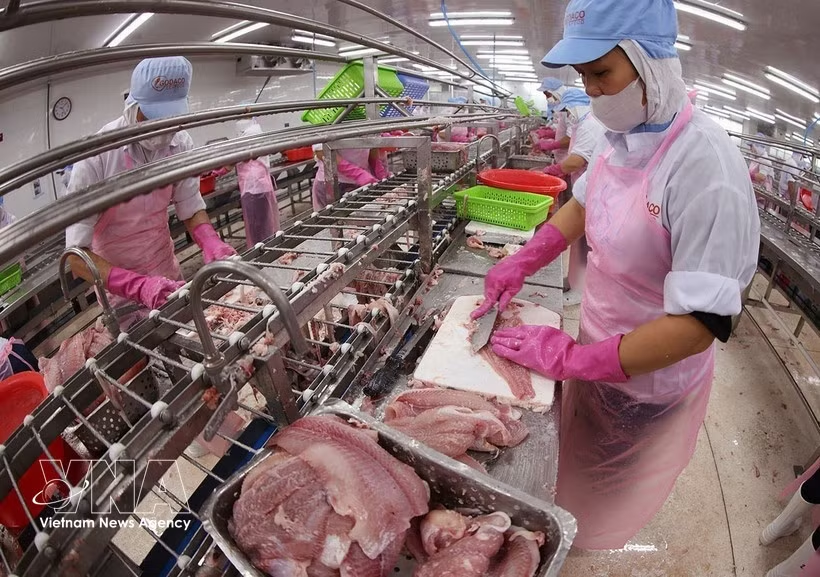
Agro-forestry-fishery exports are estimated at 6.02 billion USD in March, marking a sharp 47.8% increase compared to the previous month. (Photo: VNA)

Hanoi (VNA) – Vietnam’s agro-forestry-fishery exports reached 16.69 billion USD in the first three months of 2026, up 5.9% year-on-year, announced a regular press briefing held by the Ministry of Agriculture and Environment in Hanoi on April 1.

In this period, the sector posted a trade surplus of 4.78 billion USD, representing a 12% increase, said Tran Gia Long, Deputy Director of the Planning and Finance Department.

In March alone, export turnover was estimated at 6.02 billion USD, marking a sharp 47.8% increase compared to the previous month, though slightly down 1.5% year-on-year.

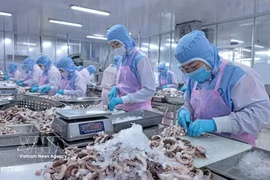
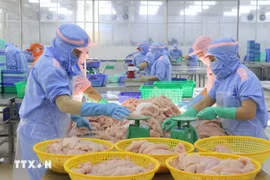
By category, during the January-March period, agricultural products accounted for 8.93 billion USD, up 4.1%; fisheries reached 2.62 billion USD, up 13.3%; livestock products totaled 197.7 million USD, surging 54.3%; while forestry products recorded 4.11 billion USD, down 2.4%.

In terms of markets, Asia remained the largest destination for Vietnam’s agro-forestry-fishery exports, accounting for 45.1% of total export value. It was followed by the Americas (20.7%) and Europe (16.2%), while Africa and Oceania represented smaller shares at 2.1% and 1.4%, respectively. Compared to the same period last year, exports to Asia rose 15.3%, to Europe 4.8%, and to Oceania 20.1%, whereas exports to the Americas declined 3.4% and those to Africa dropped sharply by 29%.

At the country level, China continued to be Vietnam’s largest export market, holding a 22.1% share, followed by the US (18.3%) and Japan (7.1%). In Q1, exports to China surged by 37.6%, exports to Japan edged up 0.7%, while shipments to the US fell 5.2% year-on-year.
xk2.jpg
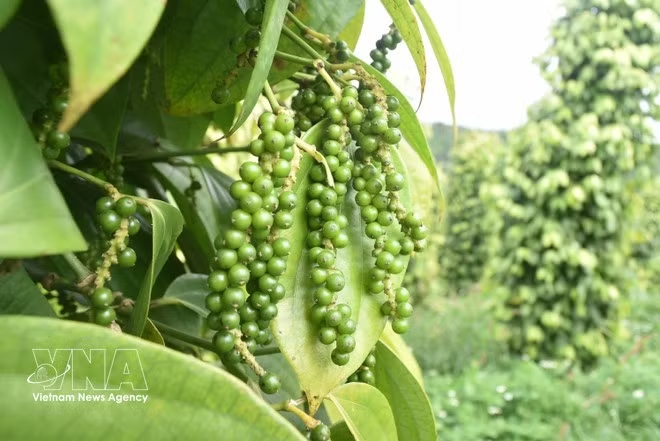
Pepper stands out as a bright spot, with export volume reaching 64,600 tonnes and turnover totalling 417.5 million USD, up 36.8% in volume and 28.8% in value. (Photo: VNA)

Several commodities posted strong growth, helping to support overall export performance. Pepper stood out as a bright spot, with export volume reaching 64,600 tonnes and turnover totaling 417.5 million USD, up 36.8% in volume and 28.8% in value, despite a 5.9% decline in average export prices.

Rubber also maintained growth momentum, with exports of 411,200 tonnes valued at 751.8 million USD, up 8% in volume and 2.4% in value. Notably, shipments to markets such as Indonesia and India rose sharply, by 93.2% and 24.6%, respectively, offsetting declines in the key Chinese market.

Fruit and vegetable exports continued to expand robustly, reaching 1.54 billion USD, up 32.1% year-on-year. China remained the dominant market, accounting for 54% of total exports in this category, with an impressive growth rate of 76.2%.

However, several major export items recorded declines in value, largely due to falling prices. Coffee exports reached 577,300 tonnes, generating 2.71 billion USD, up 12.6% in volume but down 6.4% in value, as average export prices dropped significantly by 16.9%. While exports to markets such as Germany and Spain increased, shipments to Italy and the Philippines declined sharply.

Rice exports totaled 2.3 million tonnes, equivalent to 1.11 billion USD, remaining almost unchanged in volume (up 0.2%) but decreasing 7.8% in value due to an 8% fall in average export prices. The Philippines continued to account for more than half of total rice exports, while exports to China rose significantly, offsetting declines in several African markets.

Meanwhile, total imports of agro-forestry-fishery products in Q1 were estimated at 11.91 billion USD, up 3.6% year-on-year. Agricultural imports accounted for the largest share at 7.62 billion USD, increasing 6.3%. Imports of livestock products reached 1.16 billion USD, up 10%, while forestry imports totaled 786.8 million USD, rising 16.1%. In contrast, aquatic product imports declined slightly by 1.8% to 746.8 million USD./.

VNA

See more

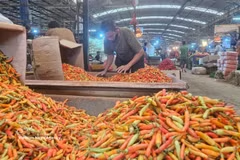
Chili peppers are on the list of essential goods in Indonesia (Photo: VNA)

Indonesia reduces imports of strategic food commodities

In 2026, Indonesia is expected to have approximately 12 million tonnes of rice carried over from the previous year, supported by annual production of around 34.7 million tonnes. With projected consumption of 31.1 million tonnes, national rice reserves could reach approximately 16 million tonnes by the end of the year.

Hanoi’s roadmap to implement low-emission zones from July is providing a strong boost to the electric two-wheeler market (Photo: VNA)

Low-emission zone roadmap drives electric two-wheeler boom in Hanoi

From July 1, Hanoi will introduce time-based or area-based restrictions on petrol-powered motorcycles within Ring Road 1, with plans to expand coverage across the entire zone by 2028 and extend to areas within Ring Road 3 by 2030. The policy is expected to reshape travel habits for millions of urban residents.

Delegates at the opening ceremony of the Made in Da Nang Expo 2026 (Photo: VNA)

Nearly 300 firms join Made in Da Nang Expo 2026

Speaking at the opening ceremony, Vice Chairman of the Da Nang People’s Committee Tran Chi Cuong said the exhibition is a large-scale trade promotion event aimed at showcasing products, connecting markets, and helping businesses enhance competitiveness while expanding domestic and export markets.

 Green production, standardised value chains key to fruit, vegetable sector growth

Green production, standardised value chains key to fruit, vegetable sector growth

Facing mounting pressure from increasingly stringent domestic and international standards, Vietnam’s fruit and vegetable sector is accelerating its shift toward green, safe, and sustainable production models. Beyond changing farming practices, localities and businesses are stepping up efforts to standardise value chains and build brands to achieve growth targets for 2026.

Hiep Phuoc Industrial Park in Ho Chi Minh City. (Photo: VNA)

Southern industrial real estate enters strategic growth phase

Key industrial hubs in the south, including Ho Chi Minh City, Dong Nai and Tay Ninh, are transitioning from a period driven largely by supply expansion and rising land prices to a more refined growth model. This new phase is shaped by infrastructure upgrades, supply chain restructuring, product improvement and greater emphasis on operational performance.

The launch of the Vietnam National Brand Week 2026 on April 16 (Photo: VNA)

Vietnam National Brand Week 2026 opens

Running from April 16 to 23 nationwide, the Vietnam National Brand Week 2026 marks the 18th anniversary of Vietnam Brand Day (April 20, 2008 – 2026).

Ca Mau is currently home to more than 5,200 fishing vessels, including nearly 1,900 boats measuring over 15 metres in length, and all have been equipped with vessel monitoring systems. (Illustrative photo: VNA)

Ca Mau drives changes among fishermen to tackle IUU fishing

Ca Mau is stepping up communication campaigns to disseminate legal regulations on IUU fishing, highlight recent enforcement results, and convey recommendations from the European Commission (EC)’s fifth inspection mission to fishing communities and relevant stakeholders.