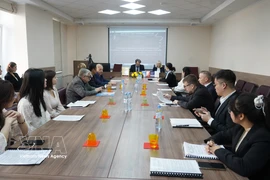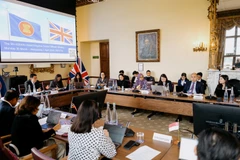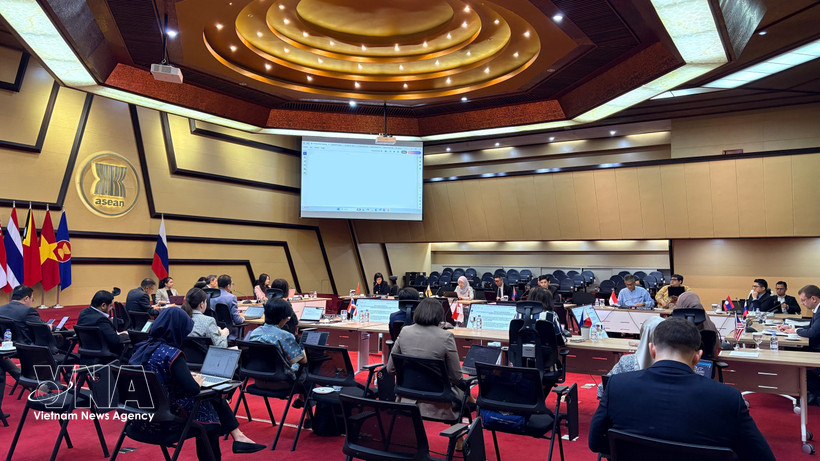
Jakarta (VNA) – The Association of Southeast Asian Nations (ASEAN) and Russia agreed to step up trade and investment exchanges, capitalising on existing potential to expand investment in strategic sectors such as manufacturing, infrastructure and high technology, at the 24th meeting of the ASEAN–Russia Joint Cooperation Committee (ARJCC) Meeting held in Jakarta on April 1.
With bilateral trade reaching approximately 21.6 billion USD, Russia reaffirmed its role as a reliable partner supplying agricultural products and energy to ASEAN countries, while promoting new multimodal transport corridors connecting with the region.
In the context of celebrating 35 years of ASEAN-Russia relations (1991-2026) and 30 years of establishing the Dialogue Partnership (1996-2026), both sides reaffirmed the importance of the ASEAN-Russia Strategic Partnership amidst complex and challenging global developments.
Russia committed to continuing its support for ASEAN's centrality and actively participating in ASEAN-led mechanisms such as the East Asia Summit (EAS), ASEAN Regional Forum (ARF), ASEAN Defense Ministers' Meeting Plus (ADMM+), ASEAN Ministerial Meeting on Transnational Crime Plus (AMMTC+), and the Expanded ASEAN Maritime Forum (EAMF).
Russian Ambassador to ASEAN Evgeny Zagaynov stressed that Russia views ASEAN as an important factor in Asia–Europe connectivity and cooperation, and will continue to promote substantive collaboration with the bloc, contributing to peace, stability and development in the region in line with international law and the principles of the United Nations Charter.
ASEAN member states and Russia welcomed positive progress in implementing the Comprehensive Plan of Action for 2021–2026, with a completion rate of 82%, and agreed to accelerate efforts to finalise the next phase of the plan. The cooperation directions agreed upon by both sides were aligned with ASEAN's priorities in the ASEAN Community Vision 2045 and the practical requirements of the situation.
In response to global energy security challenges, both sides agreed to strengthen cooperation to ensure stable energy supplies, optimise the use of natural gas, and promote the development and application of low-carbon technologies, renewable energy and civilian nuclear power. Russian Energy Agency and the State Atomic Energy Corporation Rosatom will step up cooperation with the ASEAN Centre for Energy (ACE). Russia also highlighted its agreement with Vietnam on nuclear power plant development as a notable step in bilateral energy cooperation, supporting the region’s energy transition and sustainable development goals.
ASEAN and Russia reaffirmed their commitment to intensifying cooperation in combating transnational crime, particularly high-tech crime, and ensuring cybersecurity. Russia pledged to continue organising in-depth training courses for ASEAN law enforcement officers in digital forensics, cyber incident response and counter-terrorism, while proposing to expand maritime cooperation, an area of Russia’s strength and of importance to ASEAN countries.
On the occasion, Russia’s Ambassador-at-Large for Eurasian Security Alexander Trofimov presented an initiative to promote regional security cooperation across Eurasia, calling on ASEAN countries to actively participate and lend their support.
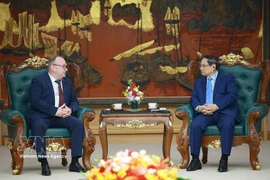
Ambassador Ton Thi Ngoc Huong, Head of the Permanent Delegation of Vietnam to ASEAN, affirmed that Russia is an important partner of ASEAN, welcoming Russia's commitment to working with ASEAN to enhance cooperation in maintaining peace, security, stability, and development in the region. Sharing outcomes of Prime Minister Pham Minh Chinh's recent visit to Russia, she affirmed that Vietnam always values and will strive to contribute to promoting the ASEAN-Russia partnership in a substantive and effective manner.
Huong suggested several priorities for future cooperation, including encouraging Russia to engage more actively in ASEAN-led mechanisms such as the EAS and ARF; strengthening capacity-building for ASEAN law enforcement forces in combating transnational crime; enhancing cooperation in energy security and renewable energy, including nuclear power; facilitating trade, investment and cross-border payments between ASEAN and the EAEU; encouraging Russian enterprises to invest in transport infrastructure such as metro systems and railways; and promoting cooperation in science, technology and innovation.
She also called on Russia to support and actively participate in the ASEAN Future Forum 2026 to be held in Hanoi./.