Hanoi (VNA) - Vietnam’s agriculture and environment sector is setting ambitious targets for 2026, aiming to raise agro-forestry-aquatic product export turnover to 73–74 billion USD and build momentum towards achieving 100 billion USD in exports in the 2026–2030 period.
The goal reflects growing confidence within the sector following a year of record performance and continued structural transformation aimed at enhancing competitiveness and sustainability.
Deputy Minister of Agriculture and Environment Phung Duc Tien said the outlook for 2026 remains challenging amid global economic uncertainties, increasingly complex trade barriers and the impacts of climate change and natural disasters. However, he emphasised that decades of accumulated production experience and an improved ability to respond swiftly to market signals have helped create a solid foundation for the sector’s continued growth. In recent years, Vietnamese agricultural exports have shown stronger alignment with international demand, gradually diversifying into new markets in Europe and Africa alongside traditional destinations in Asia and the Americas.

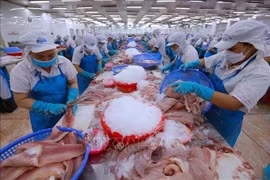
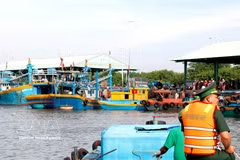
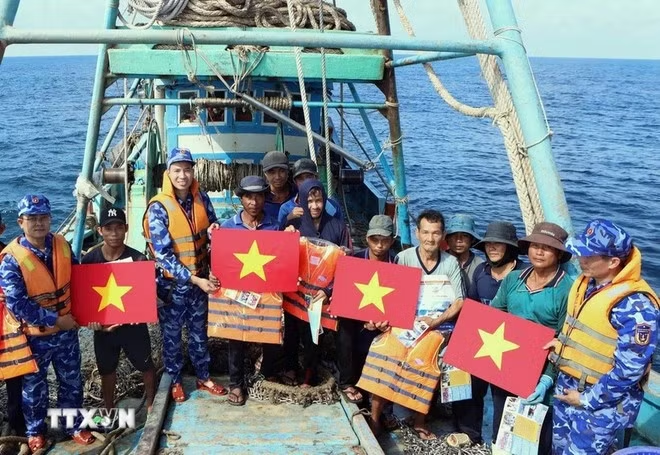
The sector’s resilience was clearly demonstrated in 2025, when agro-forestry-aquatic product export turnover reached a record 70.09 billion USD, significantly exceeding the Government-assigned target of 65 billion USD. The achievement underscored the role of agriculture as a stabilising pillar of the national economy during periods of global volatility. Among the major export groups, fisheries delivered particularly impressive results despite facing what officials described as a “double storm” of adverse weather conditions and mounting pressure to address illegal, unreported, and unregulated (IUU) fishing concerns. Total aquatic output approached 9.95 million tonnes, while export value climbed to a historic high of 11.3 billion USD.
Market diversification also contributed to the sector’s strong performance. China remained the largest export destination, accounting for 22.3% of total agro-forestry-aquatic product exports, followed by the US with 20.6% and Japan with 7.1%. Export value to these key markets rose notably compared with the previous year, highlighting improving product quality, deeper integration into global supply chains, and enhanced trade promotion efforts.
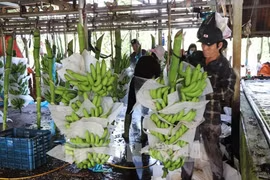
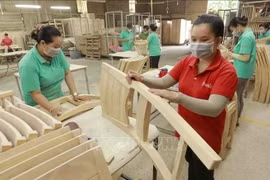
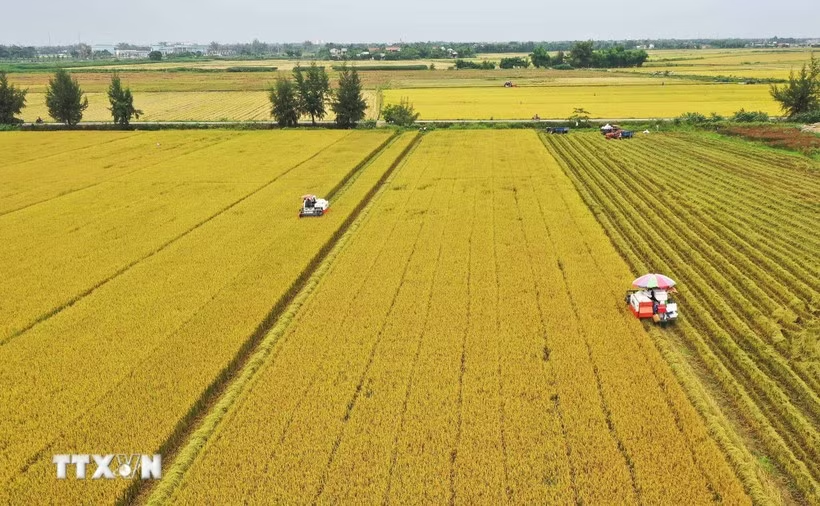
Building on this momentum, authorities have outlined detailed targets for 2026. Agricultural products are expected to generate around 40 billion USD in export revenue, up 7.2% year-on-year. Aquatic product exports are projected to reach approximately 12 billion USD, an increase of 7.6%, while forestry products and wooden furniture are forecast to bring in about 18.8 billion USD, up 3.6%. These targets are intended not only to sustain short-term growth but also to create favourable conditions for a more significant breakthrough in the medium term.
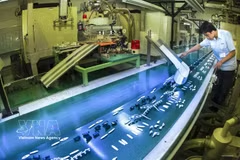
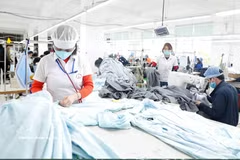
Looking ahead, policymakers have stressed that economic expansion will not come at the expense of environmental sustainability. The sector is set to accelerate its transition from a production-focused mindset to an integrated agricultural-economy approach, emphasising efficient resource management and more comprehensive solutions to environmental pollution. Deep processing of agro-forestry-aquatic products has been identified as a key driver for increasing value addition and achieving the long-term export goal of 100 billion USD.
At the same time, the Ministry of Agriculture and Environment plans to continue reviewing and adjusting legal frameworks and policy mechanisms to better align with evolving development needs. Administrative reforms, enhanced food safety management, stricter control of agricultural inputs, and expanded traceability systems are expected to strengthen the reputation of Vietnamese products in global markets. Science and technology are also seen as crucial catalysts, supporting improvements in production, harvesting, preservation, and processing.
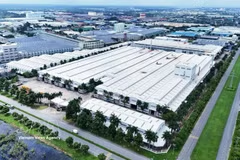
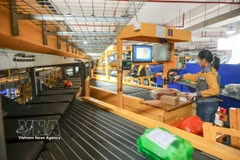
In parallel, the sector aims to promote green agriculture, circular economy models, and value-chain-based restructuring. Investment in logistics infrastructure, including specialised cold-storage systems, as well as digital transformation in supply-chain management, will be prioritised to reduce post-harvest losses and improve market responsiveness.
Authorities believed that with synchronised solutions on infrastructure development, technological innovation, and climate adaptation, Vietnam’s agriculture and environment sector can maintain robust growth, enhance national branding, and further consolidate its position in global agricultural trade in the years ahead./.