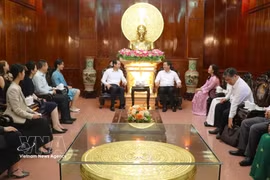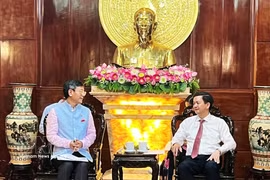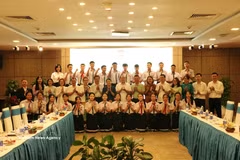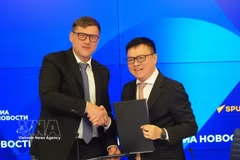
Can Tho (VNA) – Can Tho and partners from the Republic of Korea (RoK) are seeking to expand cooperation in smart urban development, artificial intelligence (AI) and green industry, following talks between the municipal People's Committee and a RoK delegation led by Prof. Kim Hak-min, head of the Ethics Investigation Advisory Committee of the RoK National Assembly.
During the meeting on July 2, Kim said the delegation aims to deepen cooperation with the Mekong Delta city of Can Tho in cultural exchanges, high-quality human resources development, and the implementation of existing joint projects.
He proposed establishing a regional cooperation platform linking government agencies, universities and businesses. Strengthening connectivity among Can Tho, Soc Trang and Hau Giang, he said, would help create a new growth pole and provide fresh momentum for the Mekong Delta's long-term development.
Kim also suggested that Can Tho focus on three innovation pillars - advanced manufacturing and digital technologies, biotechnology, and water management and sustainable agriculture. Leveraging the region's existing infrastructure and human resources, he said, could accelerate development and unlock new growth opportunities. He pledged to bring together Korean experts to help formulate a comprehensive master plan for the region.
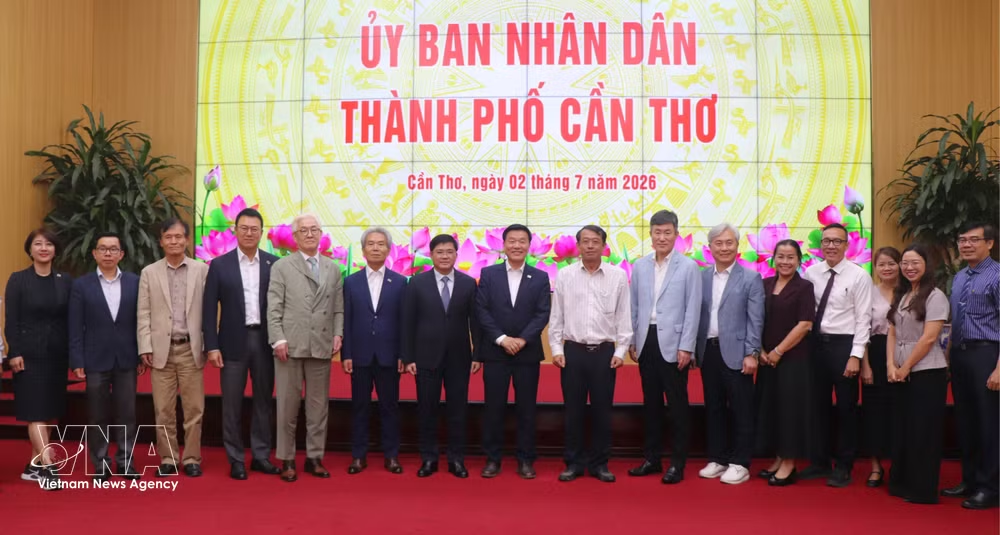
At the meeting, Can Tho introduced its investment priorities and shared information on five groups of projects and programmes planned for implementation from 2026. These include science and technology development, digital transformation, AI applications, smart city initiatives, priority projects seeking international partners, and the city's technology needs through 2030, many of which align with the interests of Korean businesses in areas such as environmental protection, climate change, AI and agricultural production.
Vice Chairman of the municipal People's Committee Nguyen Van Khoi said the city's strategic role in regional connectivity has become even more prominent following recent administrative restructuring. He noted that transport and logistics infrastructure continues to improve, while the investment and business environment has become increasingly attractive.
Can Tho is building an innovation ecosystem centred on AI, digital technologies, semiconductors, data centres and smart city development, he said, describing these as sectors where the RoK possesses considerable expertise and offers strong potential for future cooperation.
The city hopes to work more closely with Korean partners in developing modern infrastructure and logistics, high-tech and supporting industries, science and technology, innovation, digital transformation, high-tech agriculture, the green economy, people-to-people exchanges and the training of a highly skilled workforce.
The RoK currently has 14 foreign direct investment projects in Can Tho with combined registered capital of around 316 million USD. The projects span manufacturing, trade, services, logistics and real estate.
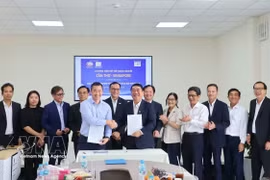
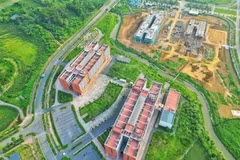
Among the flagship cooperation initiatives is the Korea-Vietnam Incubator Park (KVIP), which has served as a platform for technology transfer, business innovation, human resources development and broader innovation cooperation between the two countries.
Kim has nearly four decades of experience in innovation policy and development in the RoK. In Vietnam, he has played a key role in establishing both KVIP in Can Tho and the Vietnam-Korea Institute of Science and Technology (VKIST) in Hanoi./.