Central, Central Highlands localities respond to Typhoon Kalmaegi

As Typhoon Kalmaegi, the 13th storm to hit the East Sea this year, intensifies and heads toward Vietnam’s central coast, localities across the central and Central Highlands regions, including Dak Lak, Lam Dong, Da Nang and Quang Ngai, have activated their highest-level disaster response measures to ensure the safety of people and property.

High waves in Ly Son island, Quang Ngai province due to Typhoon Kalmaegi. (Photo: VNA)

Hanoi (VNA) – As Typhoon Kalmaegi, the 13th storm to hit the East Sea this year, intensifies and heads toward Vietnam’s central coast, localities across the central and Central Highlands regions, including Dak Lak, Lam Dong, Da Nang and Quang Ngai, have activated their highest-level disaster response measures to ensure the safety of people and property.

On November 6, Dak Lak province issued an urgent dispatch requiring all departments, agencies and communes to urgently carry out storm preparedness and evacuation plans. Local authorities were instructed to ban all marine activities, ensure that no residents remain on fishing boats or aquaculture cages, and prohibit road travel in storm-affected areas from 16:30 the same day, except for rescue and security forces.

By late afternoon, all 7,976 residents in high-risk zones vulnerable to flooding or landslides had been safely relocated. The provincial Military Command has mobilised nearly 3,900 soldiers, 34 vehicles, and 60 specialised rescue units, while the Border Guard has helped evacuate over 200 households from landslide-prone areas. The provincial police have deployed 379 officers to guide traffic and maintain public order.

Provincial authorities have also ordered the lowering of water levels at hydropower and irrigation reservoirs to prevent dam overflow and flash flooding. Residents were instructed to reinforce homes, secure crops, and trim trees ahead of expected strong winds and heavy rains, forecast to reach 200–400mm in eastern parts.

In Lam Dong province, the Department of Education and Training has directed all schools to assess the safety of classrooms, dormitories, power lines, and trees; and suspend classes in flood- or landslide-prone areas. Schools have been told to prepare emergency food, water, medicine, and backup power for boarding students.

Local authorities have also stepped up public awareness campaigns, reminding parents and students not to cross flooded areas or engage in outdoor activities during the storm. With over 800,000 students enrolled in 1,605 schools across the province, early preparedness is seen as crucial to minimising damage and ensuring safety as Typhoon Kalmaegi brings a high risk of flash floods and landslides.

canh-sat-bien.jpg
Coast Guard ships anchored at port. (Photo: VNA)

In Da Nang, the Vietnam Coast Guard Region 2 Command has been placed on full alert. Major General Le Dinh Cuong, Commander of the Vietnam Coast Guard, inspected storm preparedness measures, emphasising the principle of “on-site readiness” and the “four-on-the-spot” approach - manpower, materials, command, and logistics.

The Coast Guard has strengthened infrastructure, warehouses and facilities, and mobilised 13 vessels and eight vehicles for rescue missions. Additional mobile units have been stationed along rivers and coastal areas to assist fishermen and guide ships to safe anchorage. Around 90 temporary shelters have been prepared to host evacuees if needed.

quang-ngai.jpg
Residents in Quang Ngai province are evacuated to safer place before the typhoon. (Photo: VNA)

In Quang Ngai province, where the storm is expected to make landfall with winds of up to levels 14-15 (150-183 km/h), authorities have evacuated more than 2,000 residents from low-lying areas in Long Phung commune to reinforced community shelters and schools.

Chairman of the provincial People’s Committee Nguyen Hoang Giang affirmed that protecting human life is the top priority. He added that local authorities have built detailed post-storm recovery plans to help residents quickly return home once conditions improve.

The province has mobilised youth and militia forces to help residents secure homes, move livestock, and stockpile essential supplies. With seven coastal communes - Sa Huynh, Tra Cau, Duc Pho, Khanh Cuong, Nguyen Nghiem, Dang Thuy Tram and Lan Phong - identified as at the storm’s centre, inspection teams have been dispatched to each site to direct anti-storm efforts./.

VNA

See more

Construction workers reinforce steel and pour concrete to cover the underground drainage channel, helping collect rainwater and tackle flooding in Da Nang. (Photo: VNA)

A new “shield” against climate change

Smart urban areas are no longer simply about technology; they are becoming a tool that enables authorities to forecast risks, adapt quickly and protect their residents.

Vietnam is exerting efforts to cope with climate change. (Illustrative photo: VNA)

Vietnam approves carbon credit pact with Singapore under Paris Agreement

Signed on September 16, 2025, the Implementation Agreement on carbon credits collaboration under Article 6 of the Paris Agreement on climate change affirms Vietnam and Singapore’s pioneering role and commitment to close cooperation in the international carbon market, making a substantive contribution to global climate response.

A view of Vo Cuong ward, Bac Ninh province (Photo: VNA)

Bac Ninh earmarks over 1.7 billion USD for environmental protection

By 2030, Bac Ninh aims to ensure that all operating industrial clusters and industrial parks have centralised wastewater treatment systems meeting standards, while at least 95% of wastewater in Grade-I urban areas and 70% in Grade-II urban areas is collected and treated to required standards.

Many inland canals in Can Tho city dries up following a prolonged period of extreme heat. (Photo: VNA)

Government adopts action programme on environmental protection, climate resilience

The programme aims to translate the Party's orientations into concrete actions while strengthening environmental governance, enhancing climate resilience, and promoting a green, circular and low-carbon economy. It will serve as the basis for ministries, sectors and localities to formulate implementation plans for the 2026–2030 period, with a vision to 2045.

Dray Sap Waterfall lies within the UNESCO Dak Nong Global Geopark in Nam Da commune, Lam Dong province. (Photo: VNA)

Lam Dong steps up efforts to retain UNESCO global geopark status

Covering nearly 4,760 square kilometres across 22 communes and wards in western Lam Dong (equivalent to 73.1% of the former Dak Nong province's natural area), the geopark was shaped by millions of years of geological activity and successive volcanic eruptions.

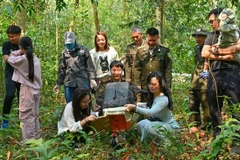
A stump-tailed macaque (Macaca arctoides) is handed over to the Cam Lo–Dong Ha forest ranger station in Quang Tri province on January 27, 2026 (Photo: VNA)

Rare primate handed over to Phong Nha - Ke Bang National Park

A stump-tailed macaque (Macaca arctoides) was handed over to the Centre for Rescue, Conservation, and Development of Creatures under the Management Board of Phong Nha - Ke Bang National Park in Quang Tri province on July 21, for rehabilitation and eventual release into the wild.

Two Red Lories (Eos rubra) found among the 104 wild animals being kept without documentation proving their lawful origin in Phuoc Thanh commune, Tay Ninh province. (Photo published by VNA)

Criminal proceedings launched against case of illegal keeping, trading of 104 wild animals

They recorded a total of 104 wild animals, comprising 92 African spurred tortoises (Geochelone sulcata) of various sizes, six Red Lories (Eos rubra) and six Green-cheeked Parakeets (Pyrrhura molinae). Authorities said the animals are subject to management under Vietnam's forestry legal regulations and are listed in Appendix II of the Convention on International Trade in Endangered Species of Wild Fauna and Flora (CITES).

BUYO Bioplastics' biodegradable plastic products are made from brewer's grains and sugarcane bagasse. (Photo: nhandan.vn)

Vietnam urged to shift from plastic waste treatment to full life-cycle management

For years, efforts to tackle plastic pollution in Vietnam have focused mainly on waste collection, recycling and disposal. However, as sustainable development and green trade standards become increasingly important, specialists argued that a broader approach is needed, covering everything from product design and material selection to production, consumption and recycling.