FTSE upgrade: Foreign capital inflows and domestic market absorptive capacity

While the upgrade is expected to attract billions of dollars in foreign capital, experts said the greater challenge lies in ensuring the domestic market can absorb the inflows and sustain long-term growth.

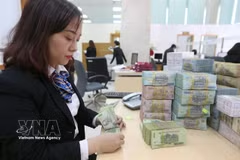
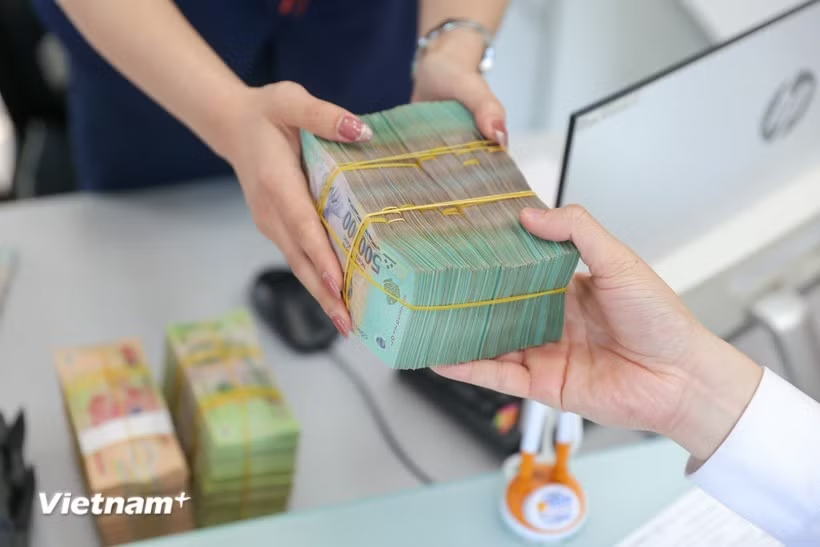
Banks strive to lower interest rates to support growth. (Photo: VietnamPlus)

Hanoi (VNA) – Vietnam’s stock market is entering a new phase after FTSE Russell confirmed in its March 2026 interim review that the country will be upgraded to Secondary Emerging Market status. The new status would be gained through a phased process beginning in September 2026.

The long-awaited decision marks international recognition of Vietnam’s efforts to improve market regulations and trading infrastructure. While the upgrade is expected to attract billions of dollars in foreign capital, experts said the greater challenge lies in ensuring the domestic market can absorb the inflows and sustain long-term growth.

Capital inflows expected to come gradually

Rather than implementing the upgrade at once, FTSE Russell will complete the process in four stages between September 2026 and March 2027.

Pham Luu Hung, Chief Economist and Director of Research and Investment Advisory at SSI Securities Corporation (SSI Research), estimated that Vietnam could receive about 1.67 billion USD in index-related capital, with actual inflows in the initial phase reaching around 1.52–1.53 billion USD.

The first round of index rebalancing on September 21 is expected to bring roughly 150 million USD into the market.

Although modest compared with current market liquidity, Hung said the first inflow would carry strong symbolic value by signalling Vietnam’s entry into the global emerging markets.

Tran Thi Thanh Nhan, an analyst at Maybank Securities, described the market upgrade as a potential "liquidity inflection point." She estimated that, over time, passive investment funds together with allocations from active funds could bring between 6 - 8 billion USD into Vietnam.

She added that FTSE Russell's decision to extend the upgrade over four phases would allow the market to absorb new capital more smoothly, reducing the risk of excessive price swings or liquidity shocks.

Not all analysts, however, expect an immediate turnaround.
market-1a.jpg
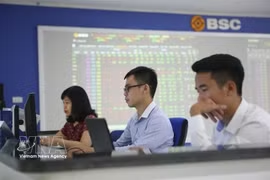
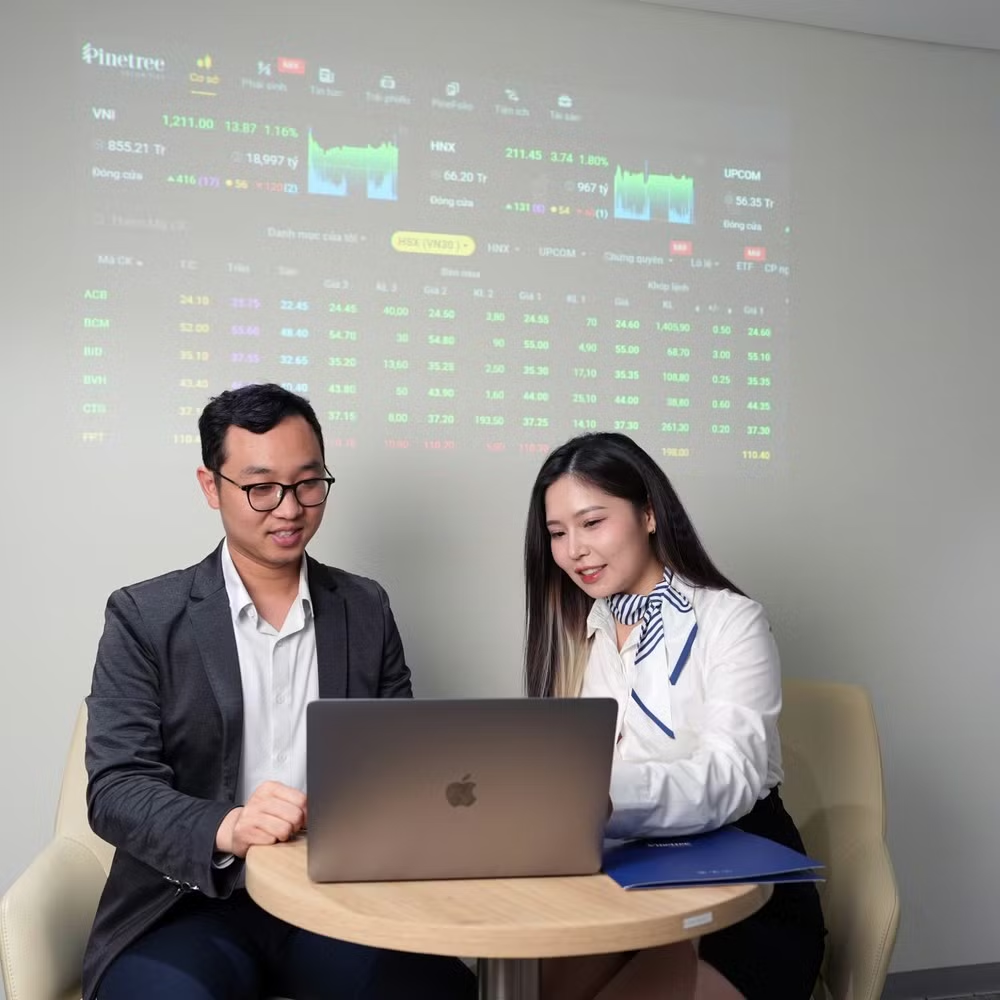
While passive funds are forced to buy according to index rules, much larger active funds are still in an observing mode. (Photo: VietnamPlus)

​Nguyen Duc Khang, Head of Research at Pinetree Securities, cautioned investors against viewing the market upgrade as a "magic wand."

He noted that passive funds tracking FTSE indices are expected to inject only around 600–800 million USD, equivalent to 15–20 trillion VND, a relatively small amount compared with the more than 125 trillion VND in net foreign selling recorded in 2025 and another 30 trillion VND withdrawn during the first months of 2026.

According to Khang, while passive funds must buy Vietnamese stocks after the upgrade, much larger actively managed funds remain cautious amid global interest rate differences, exchange rate volatility and economic uncertainty.

Their return, he said, will depend more on macroeconomic fundamentals, including listed companies' earnings prospects, exchange rate stability and the availability of more high-quality listed firms.

Reform remains the key

Experts stressed that the market upgrade is not just about capital inflows; more importantly, it is about a fundamental transformation in infrastructure quality and regulatory mindset.

Ho Huu Tuan Hieu, an investment strategist at SSI Securities, said the FTSE upgrade should be viewed as an important milestone rather than the final destination. Vietnam's longer-term objective remains inclusion in the MSCI Emerging Markets Index, which tracks significantly larger investment assets.

A key reform is the planned introduction of the Central Counterparty Clearing (CCP) mechanism, designed to remove the long-standing pre-funding requirement that has discouraged many institutional foreign investors.

Hung said that if the CCP system is introduced as scheduled by late 2026 or early 2027, Vietnam could satisfy at least three additional MSCI criteria. The market currently meets about 10 of MSCI's 18 assessment criteria.

Progress has also been made in easing foreign ownership limits in selected sectors, including aviation and banking, while listed companies have improved English-language information disclosure.

Hung expressed his confidence that Vietnam could be placed on MSCI's watchlist in 2026 or 2027 as international institutional investors increase their exposure to the market.

Analysts also noted that meeting FTSE Russell's requirements demonstrate the reliability of Vietnam's upgraded trading infrastructure and addresses many operational concerns previously raised by global investors.

Nevertheless, the stock market remains closely linked to broader economic conditions. External factors, including fluctuations in global financial markets, geopolitical tensions and commodity prices, continue to pose risks.

Domestically, policies aimed at boosting consumption, accelerating public investment disbursement and reforming personal income tax are expected to strengthen corporate earnings and support market growth.

market-1.jpg
If the CCP system is introduced as scheduled by late 2026 or early 2027, Vietnam could satisfy at least three additional MSCI criteria. The market currently meets about 10 of MSCI’s 18 assessment criteria. (Photo: VietnamPlus)

Looking ahead, experts believed the market upgrade will encourage a more professional investment culture, with greater emphasis on company fundamentals, data analysis and transparency rather than short-term speculation.

They said maintaining reform momentum, improving market transparency and expanding the supply of quality listed companies will be essential for retaining foreign capital and transforming Vietnam's upgraded market status into sustainable economic growth.

The FTSE Russell upgrade also reflects Vietnam's commitment to deeper integration into global financial markets and is expected to strengthen the country's position as an increasingly attractive destination for international investors./.

VNA

See more

Members of the Vietnam-ASEAN value chain cooperation initiative make debut (Photo: VNA)

Ho Chi Minh City launches VSM 70 pilot programme to upgrade factory competitiveness

Selected companies will have their operations assessed and benchmarked against international best practices. They will get tailored improvement roadmaps and direct support from experts at their factories. They will also join a business community to share real-world experience, and must name one point of contact, share accurate operational data, and keep leaders involved throughout the process.

Ship 743 brings fisherman Truong Van Chung back to the Naval Squadron 129 port at noon on August 18, 2026. (Photo: VNA)

Ho Chi Minh City advances strategy for strong maritime nation

The resolution marks a shift from focusing primarily on the maritime economy to viewing the sea as an economic, strategic and living space, requiring close coordination between development, defence, security, foreign affairs and modern maritime governance.

Vietnamese products increasingly win popularity (Photo: VNA)

Vietnam’s home market gives local brands room to grow

Notably, the domestic market has changed a lot. Consumers no longer pick products solely on whether they are domestic or foreign. Quality, price, origin, design, safety, after-sales service and shopping experience increasingly drive purchases.

Quang Tri steps up development of large-timber forests. (Photo: VNA)

Vietnam’s wood industry seeks higher value

According to the Vietnam Timber and Forest Product Association (VIFORE) , about 74% of timber from planted forests is currently used to make wood chips and pellets, while 18% goes into plywood and laminated veneer lumber (LVL). Although these products consume around 80% of the raw material supply, they generate only about 3-4 billion USD of the sector’s total export turnover of 18 billion USD.

Banks dominated July's new supply, accounting for 79% or about 21 trillion VND. (Photo: VNA)

Corporate bond issuance hits five-month low in July

Despite the sharp monthly decline in issuance, Vietnam’s outstanding corporate bond market remained sizeable at nearly 1.5 quadrillion VND as of July. Private-placement bonds accounted for over 1.3 quadrillion VND, while publicly offered bonds represented 180 trillion VND.

A vessel owner completes declaration procedures at the Vam Lang Border Guard Station before heading out to sea. (Photo: VNA)

Enhancing role of local authorities in combating IUU fishing

Vice Chairman of the My Tho People's Committee Dinh Tu Khoa said lists of ineligible vessels are publicly posted at the ward People's Committee office and residential areas. Heads of residential groups are assigned to supervise vessel owners and ensure that fishing gear and equipment are not kept on ineligible vessels.

A Musinsa store in the Republic of Korea. (Photo: VNA)

Korean online fashion brand enters Vietnam

Musinsa has already signed a partnership agreement with Au Chau Fashion and Cosmetics (ACFC), a unit of Imex Pan Pacific Group (IPPG), one of Vietnam’s largest distributors.

Illustrative image (Photo: Viettel)

Viettel enters 11th international market, eyes telecom investment in Caribbean

Viettel announced on August 21 that its subsidiary, Viettel Global Investment JSC (Viettel Global), had won the right to use 240 MHz of spectrum in the 700 MHz, 2300 MHz and C-Band frequencies for 4G/5G mobile networks for 20 years, under Resolution No. 073-2026 issued by the Dominican Institute of Telecommunications (INDOTEL).

India's opening of its market to Vietnamese durian is a notable development that creats new opportunities for producers and exporters in both countries. (Photo: VNA)

Vietnam, India seek to expand agricultural trade

Economic and trade cooperation is an important pillar of Vietnam–India relations, with agricultural trade offering considerable room for expansion and diversification, said Trade Counsellor Bui Trung Thuong.

Vietnam sets a goal to raise GDP per capita to around 8,500 USD by 2030. (Photo: VNA)

Resolution 19 marks strategic shift in Vietnam’s development thinking

After 40 years of Doi Moi (Renewal), the economy has begun to show signs of shifting from a growth model heavily reliant on expanding capital and labour towards one driven by innovation, science and technology and digital transformation, with greater emphasis on improving labour productivity.

Border guards inspect fishing vessels entering and leaving La Gi fishing port. (Photo: VNA)

Lam Dong launches peak crackdown on illegal fishing

The campaign brings together the provincial Border Guard Command and relevant agencies to step up inspections, patrols and law enforcement while addressing shortcomings pointed out by the European Commission (EC).

Minister of Finance Ngo Van Tuan (R) and Guinean Minister of Planning, International Cooperation and Development Ismaël NaBé signed a Memorandum of Understanding (MOU) on cooperation between the two ministries in Hanoi on August 20. (Photo published by VNA)

Vietnam, Guinea seek to boost investment cooperation

The MOU signed between the Vietnamese Ministry of Finance and the Guinean Minister of Planning, International Cooperation and Development aims to formalise cooperation, strengthen institutional capacity and share experience in planning, development and other areas agreed upon by the two sides in writing, in line with their respective functions and responsibilities.