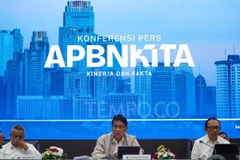
Jakarta (VNA) – Indonesia has the potential to become one of the world's five largest economies by 2050 if it maintains its current growth momentum and structural reforms, its Coordinating Minister for Economic Affairs Airlangga Hartarto has said.
Airlangga expressed optimism about short-term prospects, suggesting that Indonesia's economic growth in 2026 could reach approximately 5.4%. According to him, the fundamentals of the domestic economy remain stable, evidenced by a trade surplus for 69 consecutive months, safe levels of foreign exchange reserves, and inflation controlled within the target range.
The Indonesian government is accelerating a strategy to strengthen coordination between the public and private sectors, promoting industrialisation, digital transformation, and green economic development. The main policy focus includes strategic infrastructure, downstream mineral resources, electric vehicle development, renewable energy, and domestic supply chain strengthening.
Airlangga emphasised that Indonesia is ready to expand cooperation with regional partners, particularly within the framework of the Association of Southeast Asian Nations (ASEAN) and free trade agreements, to enhance the resilience of the global economy amid geopolitical volatility.
He said Asia has the potential to become the world’s main economic power if it remains committed to open and inclusive regional cooperation. The region is projected to contribute about 52% of global GDP by 2050.
Citing long-term forecasts, he stated that by 2050, China could reach a GDP of 58 trillion USD, India 44 trillion USD, while Indonesia is expected to reach 10–11 trillion USD, ranking third in Asia and among the five largest economies globally.
To realise this goal, Indonesia is suggested to maintain sustainable growth of above 5% per year, accelerate institutional reforms, improve the quality of its human resources, and enhance labour productivity. Its advantages of a young population, a large domestic market, and abundant resources are considered important drivers for the long-term ambitions of Southeast Asia's largest economy./.