Ragasa approaches super typhoon status

The National Centre for Hydrometeorological Forecasting is closely monitoring Typhoon Ragasa’s developments. Authorities and residents are advised to keep updated on typhoon forecasts, especially short-term warnings, to respond in a timely manner and ensure the safety of lives and property.

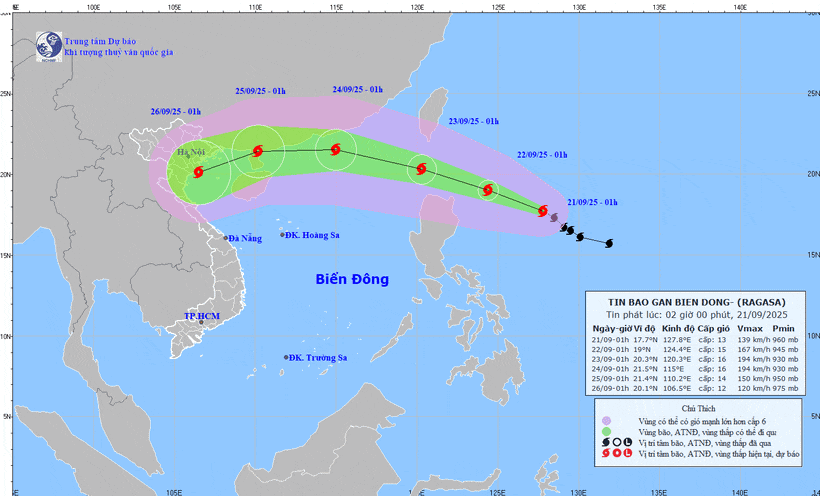
One possible path of Typhoon Ragasa. (Photo courtesy of the National Centre for Hydrometeorological Forecasting)

Hanoi (VNA) - Typhoon Ragasa is expected to strengthen into a super typhoon with wind speeds of more than 200km per hour when it enters the East Sea on September 23.

Its movement is complicated, and the National Centre for Hydrometeorological Forecasting (NCHMF) predicts two scenarios: either the storm will hit China and weaken before affecting Vietnam, or it will veer westward and make direct landfall here.

Nguyen Van Huong, head of the Weather Forecasting Division under the NCHMF, said that Ragasa is set to be the first super typhoon in the Northwest Pacific region this year.

The path of the typhoon is still relatively complex to predict, and international forecasts vary considerably.

Some experts expect that as Ragasa approaches the 120th meridian, it will turn northward toward Taiwan (China). Under this scenario, the system would have minimal impact on Vietnam.

However, the highest probability is that Typhoon Ragasa will enter the East Sea on September 23, becoming the ninth storm, with two possible pathways.

The first potential scenario is that the typhoon hits land in China's Guangdong province, passes the Leizhou Peninsula (also in China), and then affects mainland Vietnam with a significantly weakened intensity.

The second, and worst-case scenario, is that once in the East Sea, the typhoon primarily moves westward, making landfall in northern and central Vietnam. Although its intensity may weaken after passing Hainan Island in China, it would still have a strong impact.

Huong said that regardless of which scenario the typhoon follows, from September 25 to 27, the northern and central regions from Thanh Hoa province to Hue city are highly likely to experience heavy rains and strong winds.

The NCHMF said that by 1am on September 23, the typhoon’s centre will likely be over the northern waters of Luzon Island in the Philippines. The natural disaster risk level is level four.

On September 24, the typhoon is expected to maintain its direction while accelerating to 20-25km per hour. By 1am on this day, its centre will be about 140km southeast of Hong Kong (China).

Winds are likely to remain at super typhoon strength of more than 200km per hour.

Afterwards, experts believe the typhoon is likely to move westward before turning west-southwest, travelling at about 20km per hour, with gradually weakening intensity.

The NCHMF is closely monitoring Typhoon Ragasa’s developments. Authorities and residents are advised to keep updated on typhoon forecasts, especially short-term warnings, to respond in a timely manner and ensure the safety of lives and property./.

VNA
See more

Official heritage plaque i sinstalled on the 12 recognised Shan Tuyet tea trees in Dong Phuc commune. (Photo: VNA)

Thai Nguyen: 12 ancient Shan Tuyet tea trees win national heritage status

The recognition honours the biological, cultural and historical values of these centuries-old Shan Tuyet tea trees – natural treasures deeply woven into the livelihoods, traditions and identity of local ethnic communities. The title affirms the community’s commitment to preserving and promoting the value of this iconic local tea variety.

Sarus cranes at Tram Chim National Park (Photo: VNA)

Return of sarus cranes: Hope takes wing in Dong Thap wetland

Beneath the wide Mekong Delta sky, Tram Chim National Park is racing against time, pouring heart and science into a decade-long (2022–2032) plan to rescue the Eastern sarus crane – an elegant, scarlet-headed bird listed as endangered on the International Union for the Conservation of Nature (IUCN) Red List and a living emblem of both the park and all of Dong Thap province

French Ambassador Olivier Brochet speaks at the press conference in Hanoi on December 11 to mark the 10th anniversary of the Paris Agreement on climate change and highlighting the COP30 outcomes. (Photo: VNA)

International community ready to support Vietnam in energy transition, climate response

In a video message to the press conference, UN Resident Coordinator in Vietnam Pauline Tamesis said the UN is ready to support Vietnam in building a pipeline of projects capable of absorbing financing mobilised under the Political Declaration on establishing the Just Energy Transition Partnership (JETP), as well as from global climate finance sources, including the Green Climate Fund and the Loss and Damage Fund.

Forest rangers in Son La province apply technological devices and software to forest management, monitoring, and protection. (Photo: nhandan.vn)

Digital technology application enhances forest management, protection

With a total forest area of over 14 million hectares, including more than 10 million hectares of natural forests, forests exist in all 34 provinces and cities across the country. Given the large area and limited workforce, applying digital solutions in forest management and protection has become a top priority for the forestry sector.

Sunda pangolins (Manis javanica), also known as the Javan pangolin, are listed in Group IB – critically endangered and strictly protected from all commercial exploitation (Photo: VNA)

Quang Ngai releases rare pangolin back into nature

Initial verification showed that the animal weighed 3.7kg and measured over 60cm. It was identified as a Sunda pangolin (Manis javanica), also known as the Javan pangolin, listed in Group IB – critically endangered and strictly protected from all commercial exploitation.

Residents of Tuyen Quang province take part in the One Billion Trees Programme. (Photo: VNA)

Tree-planting programme exceeds one-billion-tree goal

The total comprises 573.9 million scattered trees and 865.2 million trees grown in concentrated plantations, equivalent to 429,125 hectares of forest. Provinces posting the strongest results include Phu Tho with 177.9 million trees, Lao Cai with 108.8 million, and An Giang with 98.5 million.

Construction activity is one of the causes of air pollution in Hanoi. (Photo: VNA)

Hanoi takes urgent measures to curb air pollution

The city requires the enhanced application of advanced technologies and remote monitoring systems, including satellite remote sensing, drones, and AI-integrated traffic cameras, to monitor, detect, and strictly address the illegal burning of garbage, straw, and agricultural by-products.