Hanoi (VNA) – State-owned enterprises (SOEs) have been urged to continue leading the deployment of strategic technologies and products, becoming a decisive force in achieving the country’s double-digit growth targets.
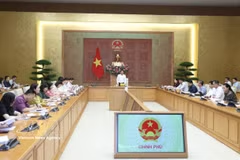
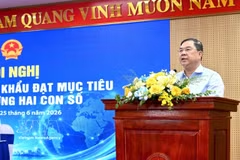
At a conference reviewing first-quarter performance in 2026 and outlining tasks for the coming period for enterprises under the Ministry of Finance on March 19, Minister of Finance Nguyen Van Thang stressed the need to maximise internal strength through institutional reform, particularly the implementation of new regulations such as Law No. 68/2025/QH15 and Resolution No. 79-NQ/TW.
Driving force for innovation
Thang underlined that SOEs must take the lead and play the most important role in deploying strategic technologies and products.
Accordingly, the State economic sector must serve as a “launchpad” that paves the way for and supports the private sector in expanding, integrating more deeply into global value chains, increasing localisation rates, and forming internationally competitive industrial clusters.
The minister emphasised that if Vietnam wants to sustain double-digit growth in the long term, the economy can no longer rely heavily on capital or land resources. Instead, the focus must shift strongly towards science-technology development and innovation.
Therefore, SOEs must pioneer efforts to fully tap unprecedented preferential mechanisms and State support resources to implement strategic technologies and products. This is regarded as the “key” for enterprises to make breakthroughs and contribute more substantially to national development.
Presenting a report on first-quarter performance in 2026 and outlining tasks for the coming period for enterprises under the Ministry of Finance, Vu Hong Phuong, Director General of the Department for State-owned Enterprise Development, said that despite facing numerous challenges from the global geopolitical situation, such as conflicts in the Middle East or fluctuations in US tariff policies, businesses have basically maintained stable production.
In 2025, total consolidated revenue reached 1.6 quadrillion VND (64 billion USD), exceeding the annual plan by 7.4%. Pre-tax profit totalled 117 trillion VND, or 219% of the target, while contributions to the State budget hit 133 trillion VND, equivalent to 117% of the annual target.
This momentum continued into early 2026, with revenue, profit, and tax payments recording year-on-year growth, creating an important foundation for the whole year.
Nine groups of solutions
To achieve double-digit growth in 2026 and sustain it in the following years, the finance minister outlined nine key solutions for agencies and enterprises under the ministry.
Focus should be placed on implementing Party resolutions on the development of the State economy and culture, he said.
It is also necessary to proactively implement Law No. 68/2025/QH15 and related guiding documents.
Functional units under the ministry must urgently review and reform administrative procedures while promoting stronger decentralisation to create the most favourable conditions for businesses.
Thang stressed the need to implement the double-digit growth target for 2026 while intensifying anti-corruption and anti-wastefulness efforts. Enterprises were urged to devise five-year development strategies.
The minister said the Vietnam National Industry-Energy Group (PVN) should devise a strategy to enter the world’s 500 largest enterprises by 2030, while other corporations should strive to rank among Southeast Asia’s top 500 firms.
Attention should also be paid to reviewing major investment projects, thoroughly addressing delayed and inefficient projects, and preventing scattered investments that could lead to capital losses.
Enterprises must accelerate the application of science, technology, innovation, and digital transformation in line with Resolution No. 57-NQ/TW, while improving governance capacity and streamlining organisational structures to meet development requirements in the new period.
Forecasting capacity should be enhanced, together with the development of timely response scenarios for unpredictable fluctuations in international markets, especially for strategic commodities such as electricity and petroleum.
It is essential to strengthen coordination between units under the ministry and enterprises to ensure smooth information flows and timely policy advisory work, he stated.
For enterprises still facing difficulties and bottlenecks, Thang assigned the Department for State-owned Enterprise Development to compile and classify recommendations so that relevant units under the ministry can address them within their authority or report them to competent authorities for consideration if they exceed their jurisdiction./.