Hanoi (VNA) - As Vietnam pursues ambitious growth and innovation goals, developing and retaining talent has become a strategic priority. Yet experts say persistent bottlenecks in education, recruitment, and talent management continue to prevent the country from fully harnessing its human capital.
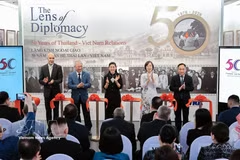
The challenges were highlighted at a seminar on talent development and utilisation held in Hanoi on April 8 by the Ministry of Education and Training, Tien Phong newspaper and partner organisations.
While acknowledging progress in recent years, participants agreed that Vietnam needs more comprehensive reforms to identify, nurture and effectively employ talented individuals.
Nguyen Ngoc Tien, Deputy Editor-in-Chief of Tien Phong newspaper, said Vietnam does not lack talented people. The key issue, he noted, lies in creating effective mechanisms to identify talent early, provide appropriate training pathways and ensure merit-based opportunities for advancement.
Bottlenecks in talent development
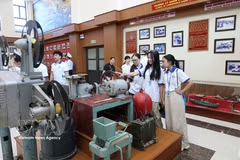
Vietnam has long invested in talent development through its network of specialised high schools nationwide and high-quality university programmes. However, experts said the current system remains constrained by outdated perceptions, rigid curricula and limited educational approaches.
Tran Thuy Duong, Principal of Hanoi-Amsterdam High School for the Gifted, said the concept of talent must be broadened beyond traditional academic excellence in subjects such as mathematics and literature.
According to her, talented students today may excel in robotics, engineering, science, technology, arts or interdisciplinary fields, and many possess strengths across multiple areas.

Nguyen Thi Nhiep, Principal of Chu Van An High School, identified a lack of diversity and excessive emphasis on academic achievements as the biggest challenges at the secondary level.
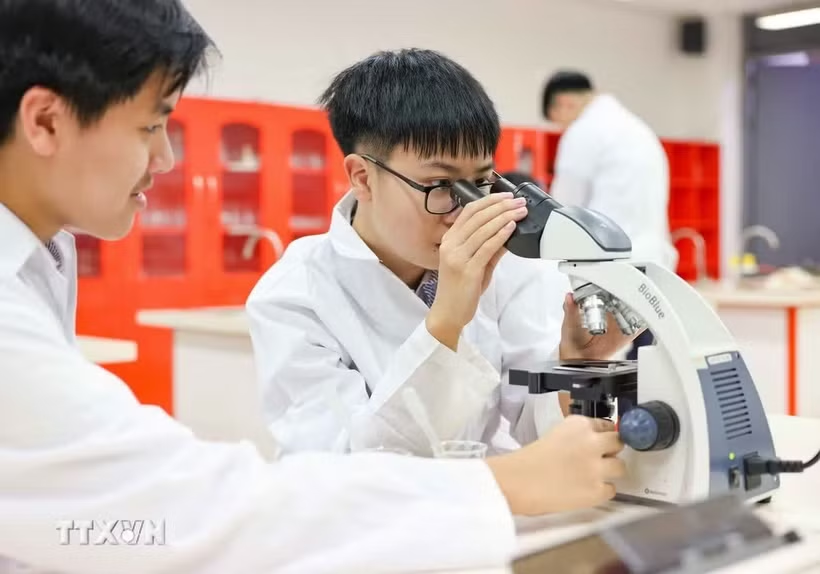
She said schools and competitions continue to focus largely on identifying students with strong academic performance while overlooking talents in innovation, scientific research, arts and other fields. In addition, facilities supporting STEAM education remain limited.
As a result, many gifted students become trapped in a cycle of examinations, awards and medal competitions. Although highly skilled at solving test questions, they often have fewer opportunities to develop creativity, independent problem-solving abilities and real-world experience, she said.
Nhiep also noted that talent is inherently individual, while educational programmes remain largely standardised. The lack of personalised learning pathways makes it difficult for students to fully realise their potential, particularly as they progress to higher levels of education.
Another concern is that schools do not sufficiently foster environments where students can experiment, make mistakes and learn from failure. Fear of failure and social judgment often discourages young people from taking risks and exploring new ideas.

Asso. Prof. Nguyen Phong Dien, Vice President of the Hanoi University of Science and Technology, said talent training requires fundamentally different teaching methods. Rather than relying primarily on lectures, universities should adopt small-group and project-based learning models that encourage students to take initiative and engage in discussions under the guidance of experienced mentors.
Such an approach, he added, requires highly qualified faculty members with both deep expertise and practical experience.
Assoc. Prof. Dr. Nguyen Thu Huong, Vice Rector of the University of Social Sciences and Humanities under Vietnam National University, Hanoi, said institutions also need to move beyond purely academic assessments and adopt more comprehensive evaluations that emphasise creativity, innovation, and social responsibility.
Personalised mentoring and long-term guidance are essential to helping talented students identify suitable development paths and maximise their potential, she added.
From an employer’s perspective, Do Duc Dung, Director of Software Solutions at Samsung R&D Centre Vietnam, said the capabilities of top Vietnamese students have improved significantly, but often still fall short of business expectations.
He observed that university programmes remain highly selective at admission but less demanding in terms of outcomes. To address this gap, Samsung has collaborated with universities since 2012 to help students better understand the requirements of businesses and workplace expectations.
Creating conditions for talent to thrive
Beyond education, experts stressed that retaining and utilising talent effectively is equally important. They said that while financial resources may be limited, Vietnam can attract and keep talented individuals by creating more open, flexible and supportive working environments.
Prof. David Tran of the University of Massachusetts Boston, who also leads the Blockchain programme at the Vietnam Institute for Advanced Study in Mathematics (VIASM), said he returned to Vietnam out of a desire to contribute his expertise, new ideas and scientific knowledge to young people and work with colleagues to build a stronger future for the country.
Although Vietnam has introduced attractive policies to recruit talent, he said compensation remains less competitive than in many developed countries. Therefore, a supportive professional environment becomes even more important.
Complex procedures, funding constraints and pressure for immediate results can discourage scientific innovation, he said.
“No scientist can produce breakthrough discoveries under constant pressure,” he said, calling for greater trust, flexibility and academic freedom.
Assoc. Prof. Le Minh Ha from the VIASM echoed those concerns, saying current evaluation systems place too much emphasis on publication numbers rather than leadership potential or the ability to open new research directions.
According to Nguyen Tien Thao, head of the Higher Education Department under the Ministry of Education and Training, as Vietnam aims for double-digit economic growth and seeks leadership in emerging technologies, high-quality human resources and world-class scientists will be essential drivers of development.
The implementation of Resolution No. 57-NQ/TW on science and technology development and Resolution No. 71-NQ/TW on breakthroughs in education and training development is expected to gradually remove institutional and legal bottlenecks, he said./.